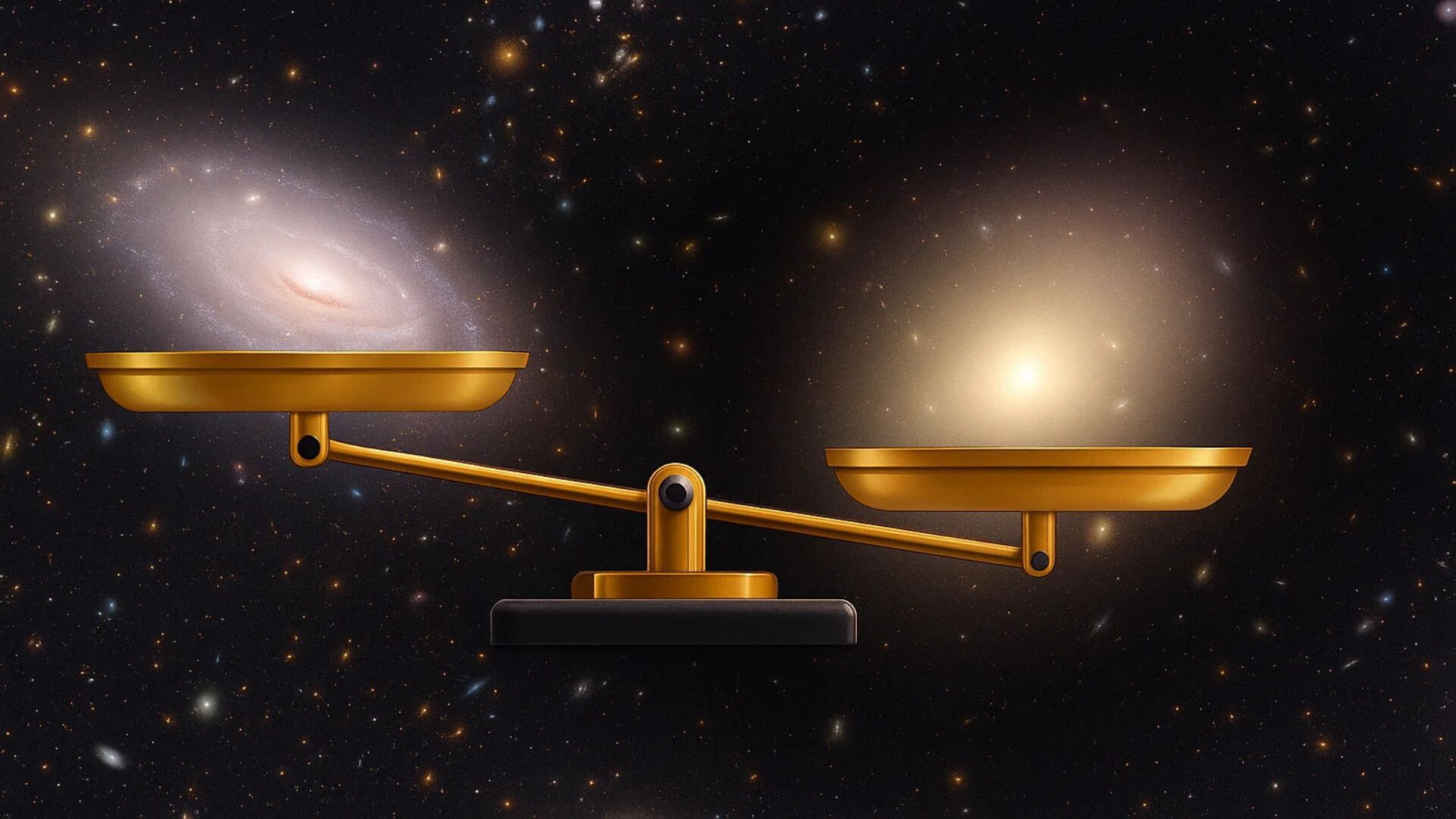
Dark Matter And Dark Energy Might Be A Cosmic Illusion, Says A Bold New Study.
For decades, two invisible entities have ruled our cosmology: dark matter, thought to hold galaxies together, and dark energy, believed to push the cosmos apart. Together, they supposedly make up 95% of the universe — unseen, undetected, yet deeply embedded in the standard model of cosmology.

Content of the Universe according to standard cosmology
But what if neither of them is real?
A bold new study from the University of Ottawa suggests that these so-called “dark” components might simply be illusions — the result of something far more subtle: the weakening of nature’s fundamental forces over time.
Rethinking the Dark Universe
Physicist Rajendra Gupta believes we’ve been misinterpreting the cosmic clues. In his latest paper, “Testing CCC+TL Cosmology with Galaxy Rotation Curves” (published in Galaxies), Gupta proposes a revolutionary idea: if the strength of natural forces like gravity slowly evolves across space and time, then what we observe — from the strange motions of galaxies to the acceleration of cosmic expansion — might not need dark matter or dark energy to explain it at all.
“The universe’s forces actually get weaker as it expands,” says Gupta. “That makes it appear as though some invisible energy is pushing the cosmos apart — which we currently label as dark energy. But it may just be a mirage caused by changing physical laws.”
One Equation to Explain It All
Traditionally, astronomers use two different sets of equations to explain two different cosmic scales:
- At cosmological scales (hundreds of millions of light-years), dark energy is invoked to explain why the universe is expanding faster than expected.
- At galactic and cluster scales, dark matter is used to account for excess gravitational effects — like why stars at the edges of galaxies rotate faster than they should.
Gupta’s new model claims to unify both phenomena with a single equation. No exotic particles, no extra energy. Just the known forces of nature, changing ever so slightly as the universe evolves.
The Role of α: A Cosmic Chameleon
In Gupta’s model, a key parameter — denoted by the Greek letter α — emerges when you allow the coupling constants (which define the strength of forces) to evolve over time. At the largest scales, α behaves like a constant. But zoom in, and it starts to change from place to place.
This variable α mimics the effects of dark matter. In areas filled with visible matter — like stars and gas — the gravitational boost from α is mild. But in the outskirts of galaxies, where standard matter thins out, α amplifies gravity. That naturally explains why stars on the edges of galaxies move faster than expected — a mystery previously solved by adding hypothetical dark matter halos.
In essence, there’s no need to “add” anything to galaxies. The extra pull comes from the evolving nature of gravity itself.
A Universe with More Time
Perhaps the most profound implication is what this means for the timeline of the universe.
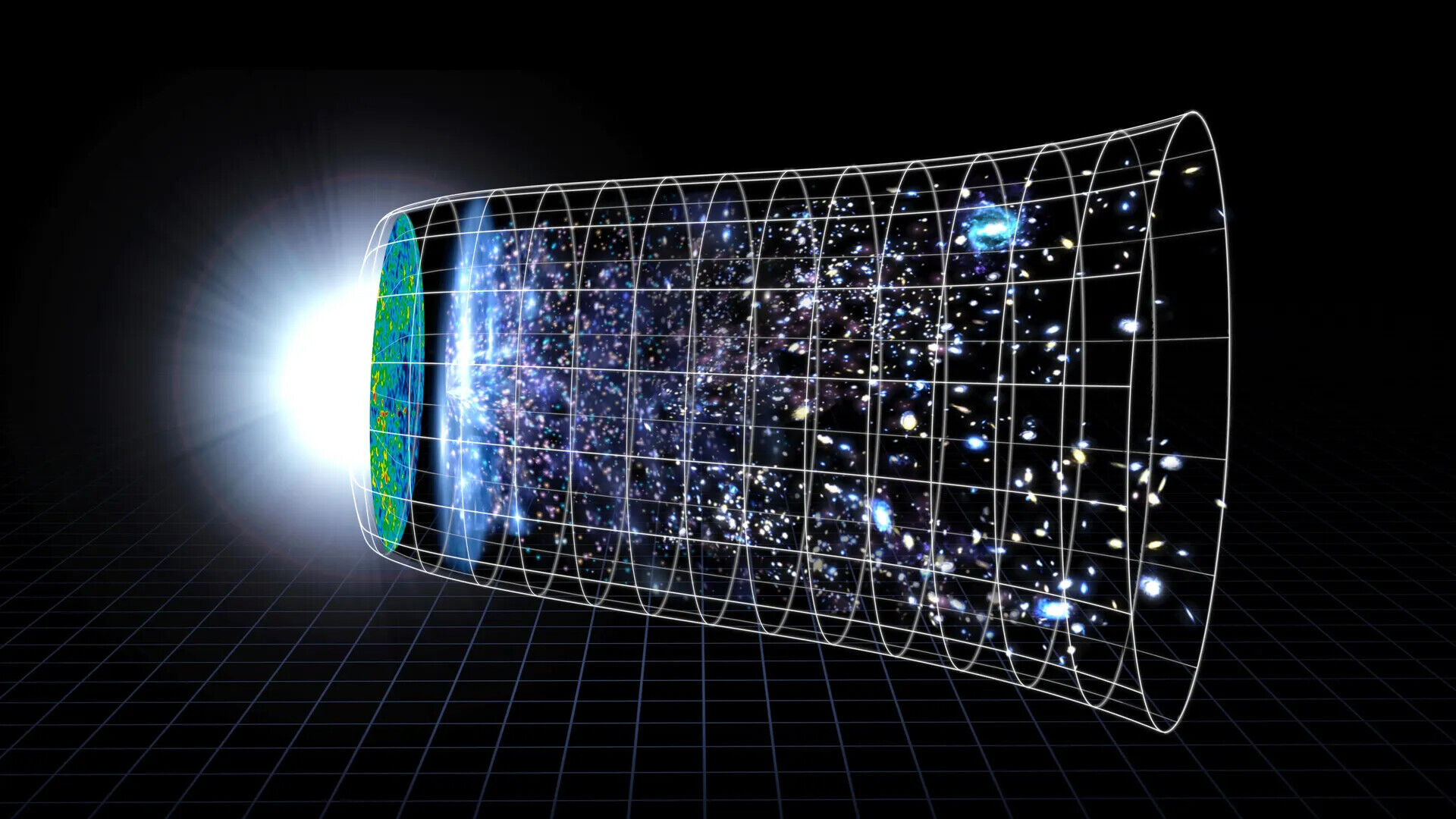
By stretching out how cosmic expansion unfolds, the model effectively doubles the age of the universe — making it much easier to explain how massive galaxies and black holes could have formed so early. This could resolve long-standing puzzles, like how the James Webb Space Telescope keeps finding mature galaxies in an infant universe.
In Gupta’s words: “With our model, you don’t need to break physics or assume exotic particles. You just give the universe more time to grow.”
Billions Spent. What If It Was a Ghost Hunt?
If true, this theory could radically shift the direction of fundamental physics. Over the years, scientists have poured billions into experiments like the Large Hadron Collider and dark matter detectors buried deep underground — all hoping to catch a glimpse of the elusive particles thought to make up dark matter.
But Gupta argues we might not need to find them. Even if exotic particles exist, they may not be necessary to explain the universe as we see it.
“Sometimes, the simplest explanation is the best one,” he says. “Maybe dark matter and dark energy aren’t real things at all. Maybe they’re just tricks played by the slowly changing rules of nature.”
Research paper
Rajendra Gupta, Testing CCC+TL Cosmology with Galaxy Rotation Curves, Galaxies (2025) DOI: 10.3390/galaxies13050108