The Universe’s Expansion May Have Already Started Slowing Down, Physicists Say.
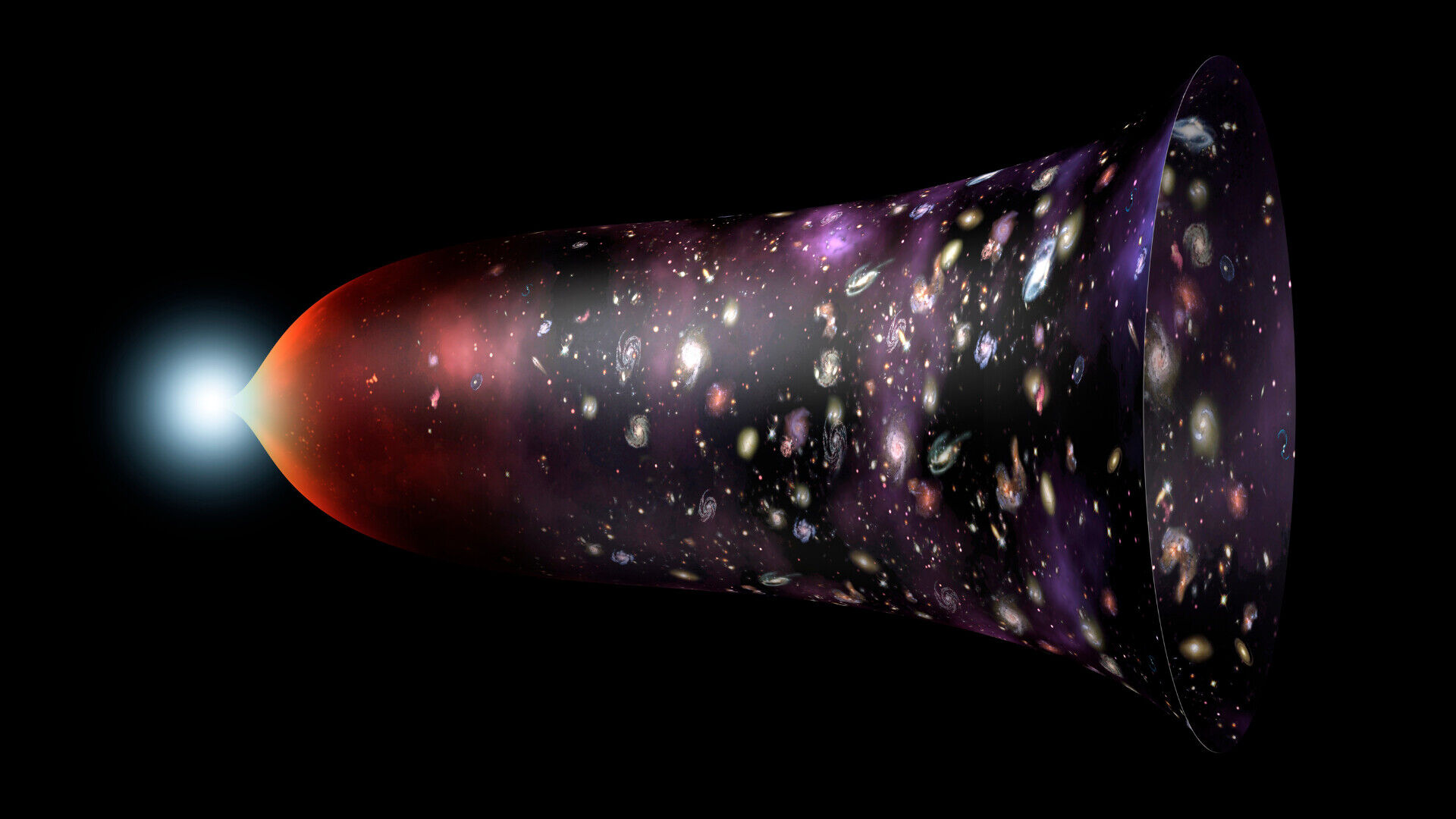
For decades, astronomers have known that the universe is expanding. But how fast that expansion is happening and what drives it remains one of the biggest puzzles in cosmology. A new study is now challenging a cornerstone of modern astronomy: the idea that the universe’s expansion is accelerating due to a mysterious force known as dark energy.
The concept of accelerated expansion dates back to 1998, when studies of Type Ia supernovae revealed that the host galaxies of these stellar explosions were farther away than expected. The finding implied that galaxies were receding at an ever-increasing pace, driven by an unknown repulsive energy permeating space.
Dubbed as dark energy, this repulsive force quickly became a key pillar of the standard cosmological model, thought to make up roughly 68 percent of the entire universe.

Content of the Universe according to standard cosmology
Shaking things up
The new research from Yonsei University in South Korea suggests the picture may be far more complex. According to the study, the universe may no longer be accelerating. In fact, its expansion may have already begun to slow down.
“Our study shows that the universe has already entered a phase of decelerated expansion at the present epoch and that dark energy evolves with time much more rapidly than previously thought,” lead author Young-Wook Lee, a professor at Yonsei University, said in a statement. “If these results are confirmed, it would mark a major paradigm shift in cosmology since the discovery of dark energy 27 years ago.”
At the heart of the study, published in Monthly Notices of the Royal Astronomical Society, is a reassessment of Type Ia supernovae, the very objects that led to dark energy. For years, these explosions have been treated as “standard candles,” assumed to have the same intrinsic brightness. But the new results indicate that their brightness depends on the age of the stars that produced them. Supernovae originating from younger stellar populations appear systematically fainter, even after standard calibration, while those from older populations appear brighter.
Based on a sample of 300 supernova host galaxies, the team found this “age effect” with extremely high statistical confidence (99.999%). This means that part of the observed dimming in distant supernovae may be due not only to cosmic expansion but also to the evolutionary history of their progenitor stars. In other words, a previously unrecognized bias may have influenced past interpretations of accelerated expansion.
When the researchers corrected the data for this age-related bias, the supernova measurements no longer fit the standard ΛCDM model. Instead, the corrected results aligned more closely with findings from the Dark Energy Spectroscopic Instrument (DESI) project, which uses independent measurements such as baryonic acoustic oscillations (BAO)—sound-wave patterns from the early universe—and the cosmic microwave background (CMB).
These combined datasets suggest that the strength of dark energy may be decreasing with time and that the universe could already be in a state of decelerated expansion, rather than accelerating as long believed.
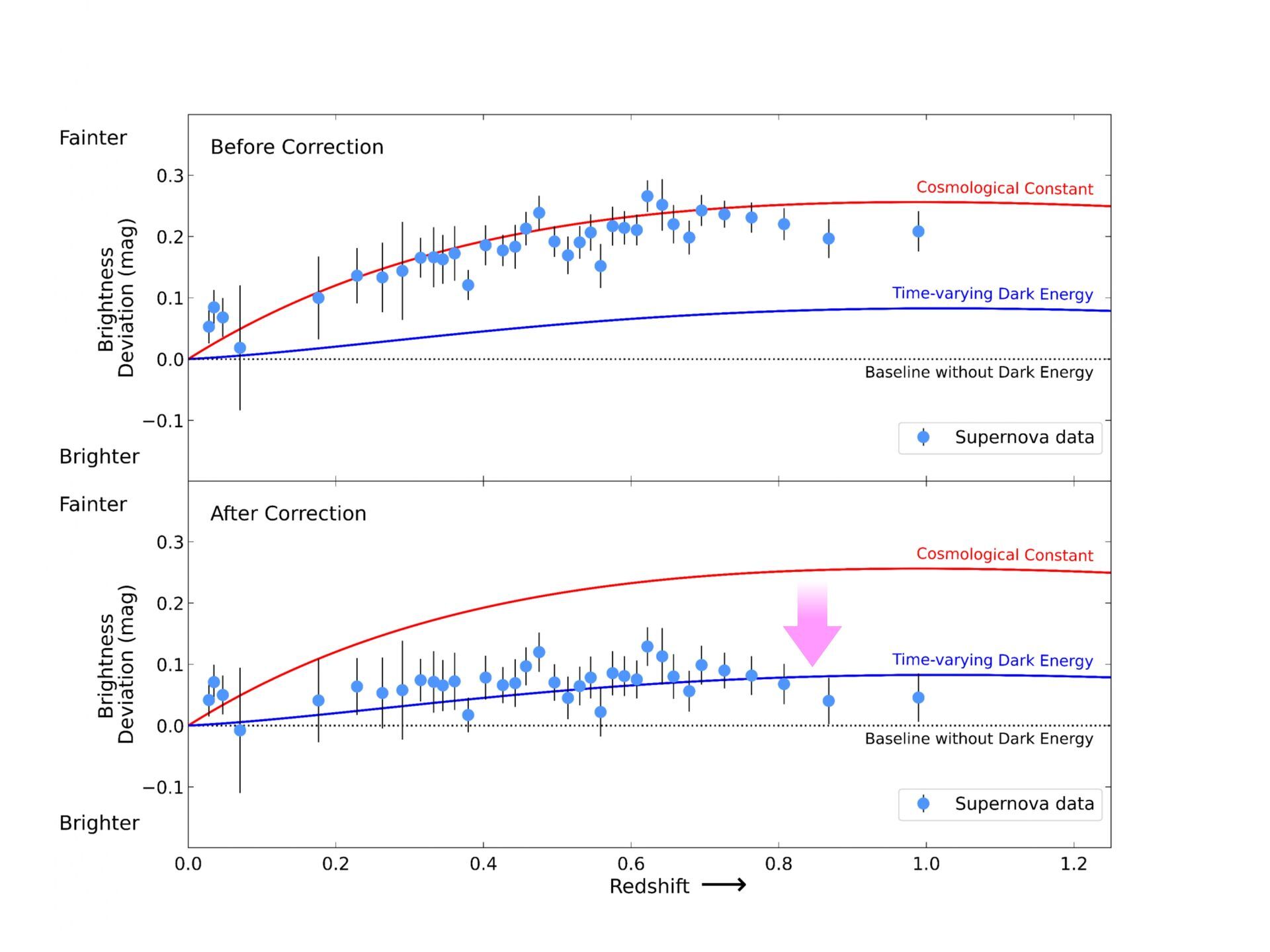
ΛCDM model with a cosmological constant describing dark energy is represented by a red line. Blue line represents time-varying dark energy model. The uncorrected data points in blue align with the ΛCDM model. After the age-bias correction (2nd panel), the data points favor the time-varying dark energy model.
“In the DESI project, the key results were obtained by combining uncorrected supernova data with baryonic acoustic oscillation measurements, leading to the conclusion that while the universe will decelerate in the future, it is still accelerating at present,” Lee explained. “By contrast, our analysis — which applies the age-bias correction — shows that the universe has already entered a decelerating phase today. Remarkably, this agrees with what is independently predicted from BAO-only or BAO+CMB analyses, though this fact has received little attention so far.”
To strengthen their conclusions, the Yonsei team is now performing an “evolution-free test,” using only supernovae from young, uniform host galaxies across a wide redshift range. Early results already support their main findings.
If confirmed, this shift in interpretation could fundamentally reshape our understanding of dark energy and the fate of the universe. With refined tools and new approaches, astronomers may finally be able to probe the true nature of the force that governs the universe’s expansion—or discover that it behaves very differently than we once believed.
Research paper
J. Son et al, Monthly Notices of the Royal Astronomical Society(2025), DOI: https://doi.org/10.1093/mnras/staf1685