LIGO May Have Detected The First Primordial Black Hole.
This black hole wasn’t supposed to exist.
And yet, on November 12, 2025, LIGO detected it.
A new study suggests that a recently detected gravitational wave event may be the first observational fingerprint of primordial black holes — ancient objects formed in the earliest moments of the Universe that could account for dark matter itself.
On November 12, 2025, the LIGO-Virgo-KAGRA (LVK) collaboration detected a gravitational wave signal designated S251112cm, generated by two compact objects spiraling into each other and merging. What makes this event extraordinary is its mass: the system's chirp mass falls in the range of 0.1 to 0.87 solar masses, and there is a greater than 99% probability that at least one of the merging objects is lighter than the Sun. That places it firmly in a mass range where black holes simply should not exist. According to conventional stellar physics, a dying star should be significantly more massive than the Sun to collapse into a black hole.
In a new paper published in The Astrophysical Journal on March 27, Alberto Magaraggia and Nico Cappelluti of the University of Miami propose that the answer may lie in the very early Universe: primordial black holes (PBHs).
Ancient relics
Primordial black holes are theoretical objects that form from the extreme density fluctuations present in the first fractions of a second after the Big Bang, and not from collapsing stars. One particularly productive period for their formation would have been the Quantum Chromodynamics (QCD) epoch — a phase transition when quarks bound together to form protons and neutrons that occurred within a fraction of second after the Big Bang. This transition would have briefly softened the pressure of the early Universe, making gravitational collapse easier and producing a broad population of black holes spanning an enormous range of masses.
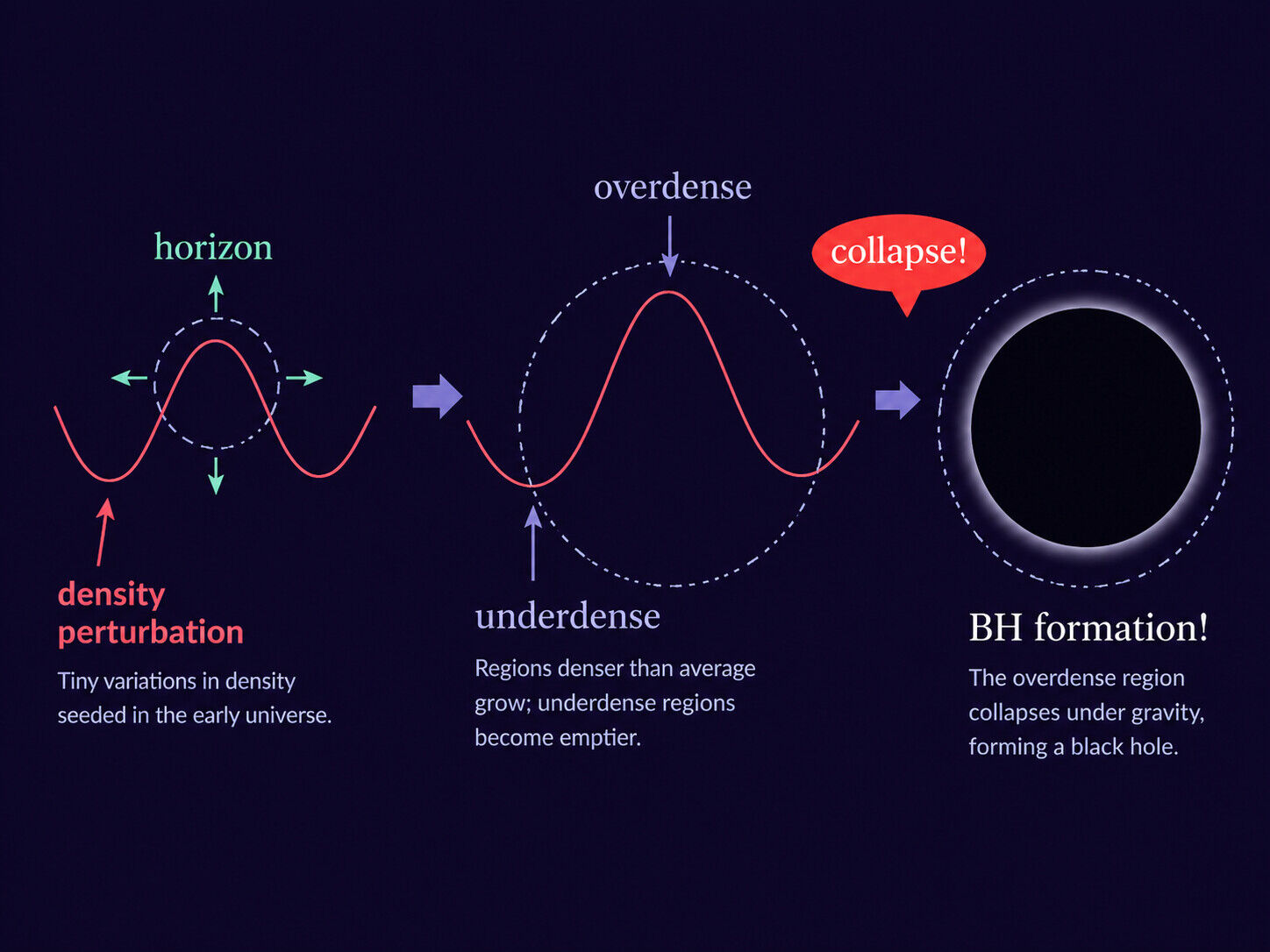
Primordial black holes were possibly formed by the collapse of overdense regions in the inflationary or early radiation-dominated universe.
Many researchers have hypothesized that PBHs could explain dark matter — the invisible substance that makes up about 27% of the Universe's total mass-energy content, yet has never been directly detected. If PBHs formed in sufficient numbers, they could collectively account for the gravitational influence attributed to dark matter across galaxies and galaxy clusters.
Running the numbers
In this new study, researchers tested whether a population of QCD-epoch primordial black holes could produce a merger event like S251112cm.
"We attempted to estimate how many primordial black holes may exist in the universe and how many of them LIGO should be able to detect," Magaraggia said in a statement. "And our results are encouraging. We predict that subsolar black holes like the one LIGO may have observed should indeed be rare, consistent with how infrequently such events have been seen so far."
Their work also showed that these primordial black holes could account for a significant portion (around 4%), if not all, of dark matter.
The absence of any electromagnetic counterpart to S251112cm such as no kilo-nova, no gamma-ray burst, no optical transient further supports a black hole interpretation, since neutron star mergers typically produce such signals. However, "the absence of an electromagnetic counterpart does not uniquely favor a PBH origin as other compact-object mergers are intrinsically electromagnetically dark," the researchers write in their paper.
Since researchers are basing their study on an early alert that LIGO sent out shortly after detecting the signal, they say that the event could turn out to be a false alarm, since there is roughly a 1-in-4 chance this signal is just noise masquerading as a real event over any given year.
"But we'll need to detect another such signal or even several others to get the smoking-gun confirmation that they are real," Cappelluti said.
If confirmed, this study would transform primordial black holes from a speculative dark matter candidate to an observationally supported one.
Research paper
Alberto Magaraggia and Nico Cappelluti, Implications for Primordial Black Hole Dark Matter from a Single Subsolar Mass Gravitational-wave Detection in LVK O1–O4, The Astrophysical Journal (2026). DOI: https://doi.org/10.3847/1538-4357/ae48f9