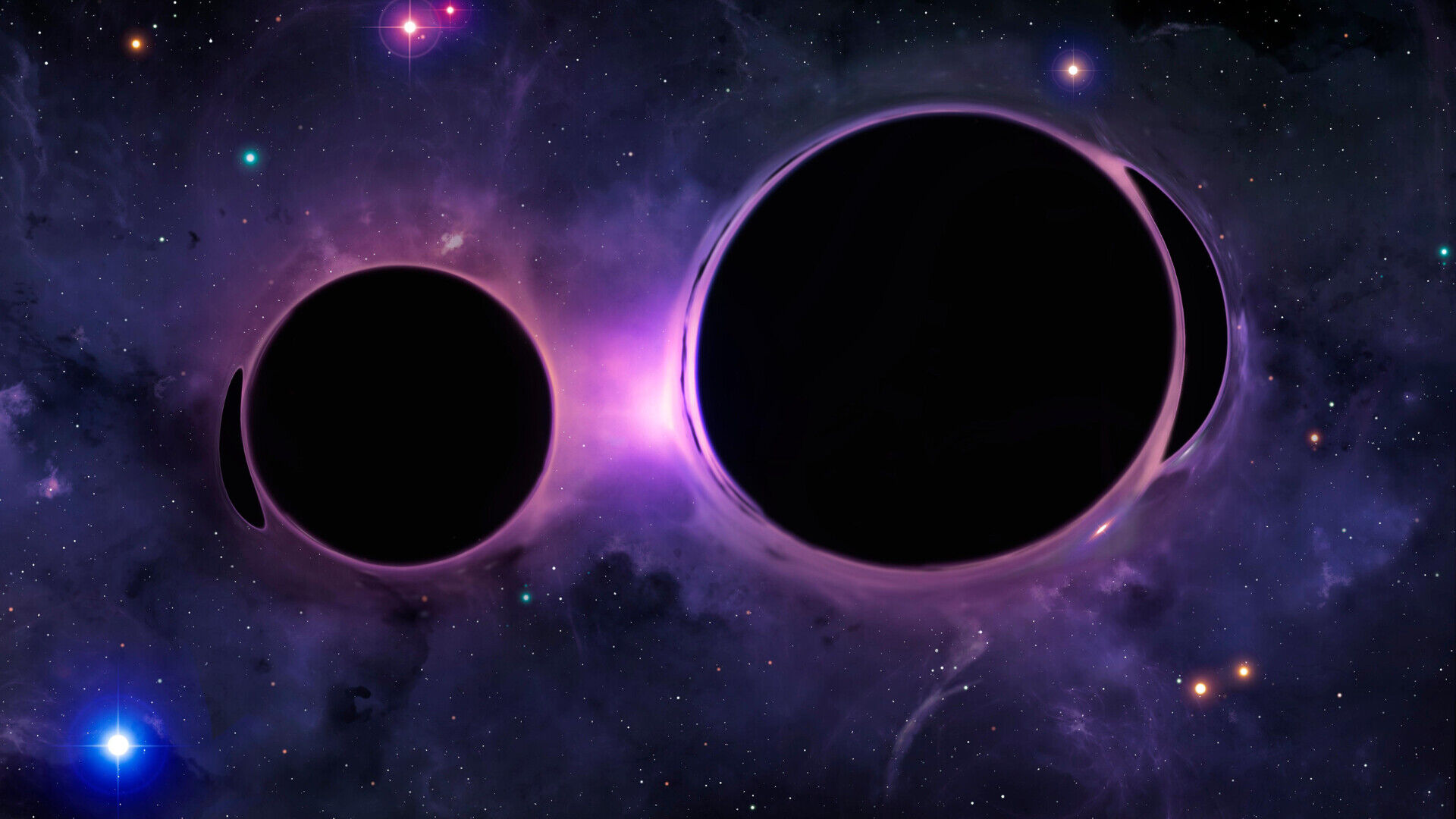
Scientists Capture the First-Ever Image of Two Black Holes Orbiting Each Other
For decades, scientists have imagined what it might look like when two supermassive black holes dance around one another — two invisible giants locked in a cosmic embrace. Now, after years of searching, that image finally exists.
Astronomers have captured the first direct radio image of two black holes orbiting each other, providing the strongest visual evidence yet that binary black holes are real. The pair resides in a blazing quasar called OJ287, located about 5 billion light-years away in the constellation Cancer.
A Century-Old Mystery, Finally Solved
OJ287 has fascinated astronomers for more than a century. Early photographic plates from the late 1800s unknowingly captured this bright point of light, long before anyone even knew black holes existed.
It wasn’t until the 1980s that Finnish astronomer Aimo Sillanpää noticed something strange — OJ287’s brightness rose and faded in a regular, 12-year cycle. The simplest explanation? Two black holes orbiting each other, their gravitational tug causing the quasar to flicker in rhythm.
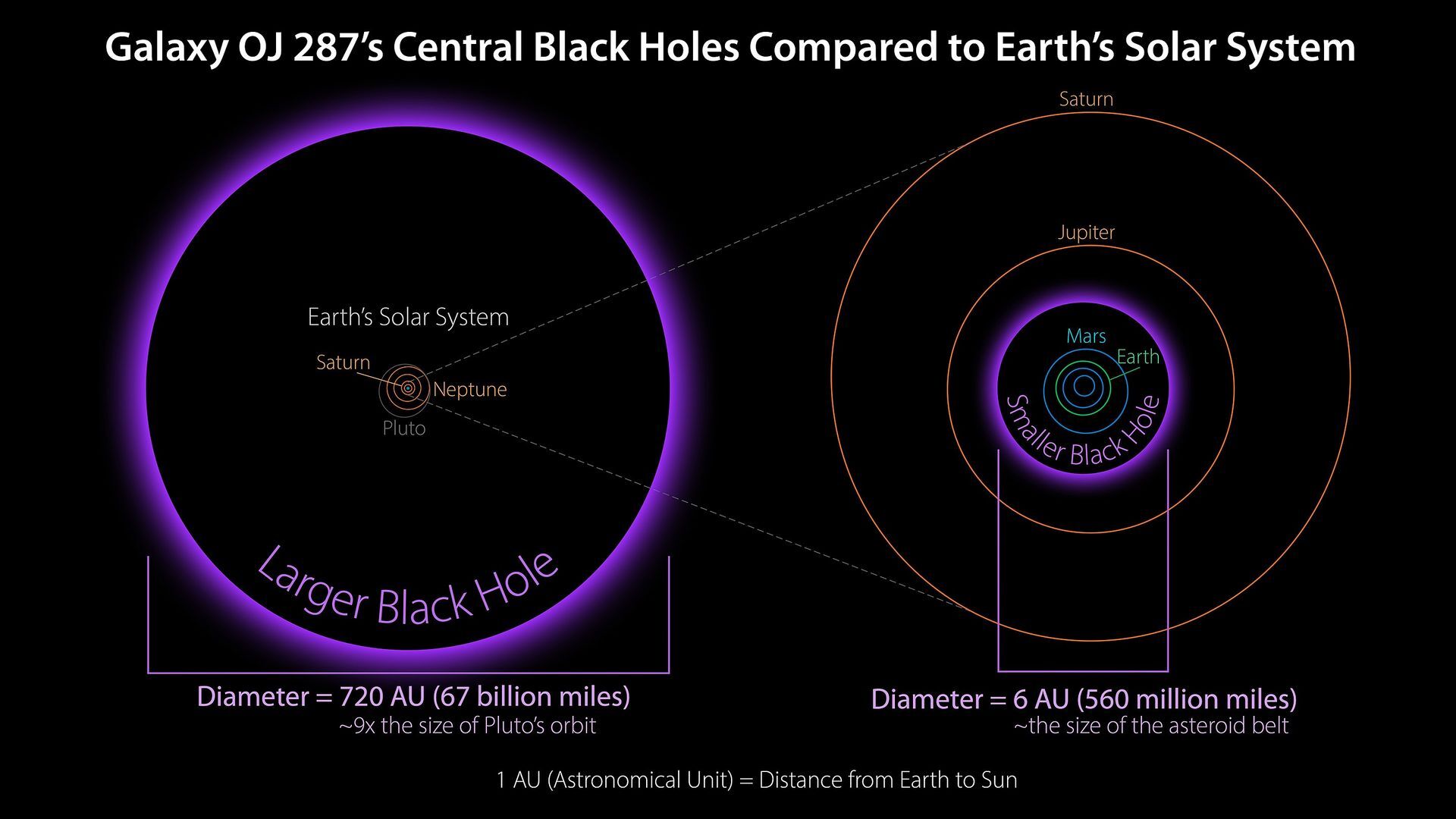
Sizes of Black Holes in Galaxy OJ 287 Relative to the Solar System. The larger one, with about 18 billion times the mass of our sun (left), would encompass all the planets in the solar system with room to spare. The smaller one is about 150 million times the mass of our sun (right), which would be large enough to swallow up everything out to the asteroid belt, just inside the orbit of Jupiter.
For forty years, astronomers tracked this cosmic heartbeat, hoping to one day see the black holes themselves. That proof has now arrived.
The Sharpest View in the Universe
Using an extraordinary array of radio telescopes — including the RadioAstron satellite, whose orbit once reached halfway to the Moon — researchers achieved a resolution 100,000 times sharper than typical optical images.
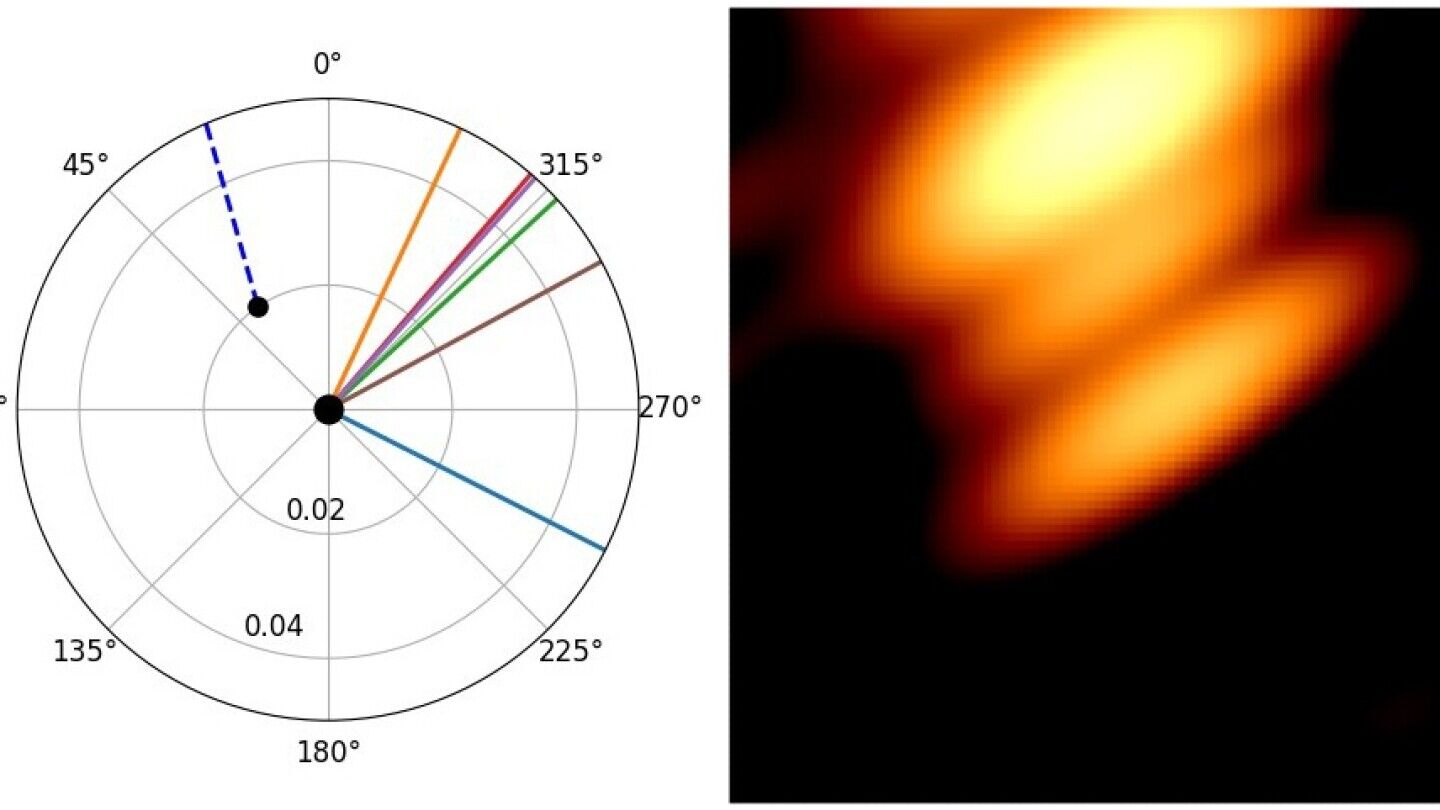
Two black holes in orbit around each other in quasar OJ287. On the left is a theoretical diagram, calculated by Lankeswar Dey, showing where the black holes and the jets emanating from them were at the time when the picture was taken. On the right is part of an image taken by the system including the RadioAstron satellite (J.L. Gomez and et al., 2022), where the two lower bright spots are the radio emission coming from the two black holes, and the topmost spot is the jet of the smaller black hole. This is shown as a dashed line on the left-hand side diagram, while the black holes are shown as dots.
The result is historic: a radio image clearly showing two glowing spots, each corresponding to a black hole within OJ287. The lower pair marks the black holes themselves, while a third, upper spot traces a jet from the smaller one — a jet that appears twisted like a spinning garden hose as it spirals through space.
“When we compared the image with our predictions,” says Mauri Valtonen of the University of Turku, “the black holes were right where theory said they would be. For the first time, we have seen two black holes in orbit around each other.”
A Cosmic Dance of Titans
Black holes are, by nature, invisible. They reveal themselves only through the glowing matter and relativistic jets that erupt from their surroundings. In OJ287, both black holes are feeding on gas and dust, converting that matter into light so intense it outshines entire galaxies.
The smaller black hole completes an orbit every 12 years, weaving around its massive companion and tugging on its jet like a cosmic tail. In the years ahead, astronomers expect to watch this “wagging” jet shift directions — offering a rare, real-time glimpse into a black hole’s motion.
Why It Matters
This discovery confirms a long-held prediction of Einstein’s general relativity and provides a direct view of a system that could one day merge and unleash a storm of gravitational waves.
Binary black holes like these are the engines of galactic evolution — their eventual collisions ripple across spacetime and reshape galaxies. Now that we can see them, we can finally begin to study how they form, interact, and influence the universe on the largest scales.
Research paper
Mauri J. Valtonen et al, Identifying the Secondary Jet in the RadioAstron Image of OJ 287, ApJ 992 110 (2025) DOI: 10.3847/1538-4357/ae057e