Scientists Find Strongest Evidence Yet That Saturn’s Moon Enceladus is Habitable
For a world barely 500 kilometers wide, Enceladus has become one of the most intriguing places in the solar system. Beneath its frozen crust, this small moon of Saturn hides a global ocean — and new findings from NASA’s Cassini mission reveal that this ocean is far more chemically active than we ever imagined.

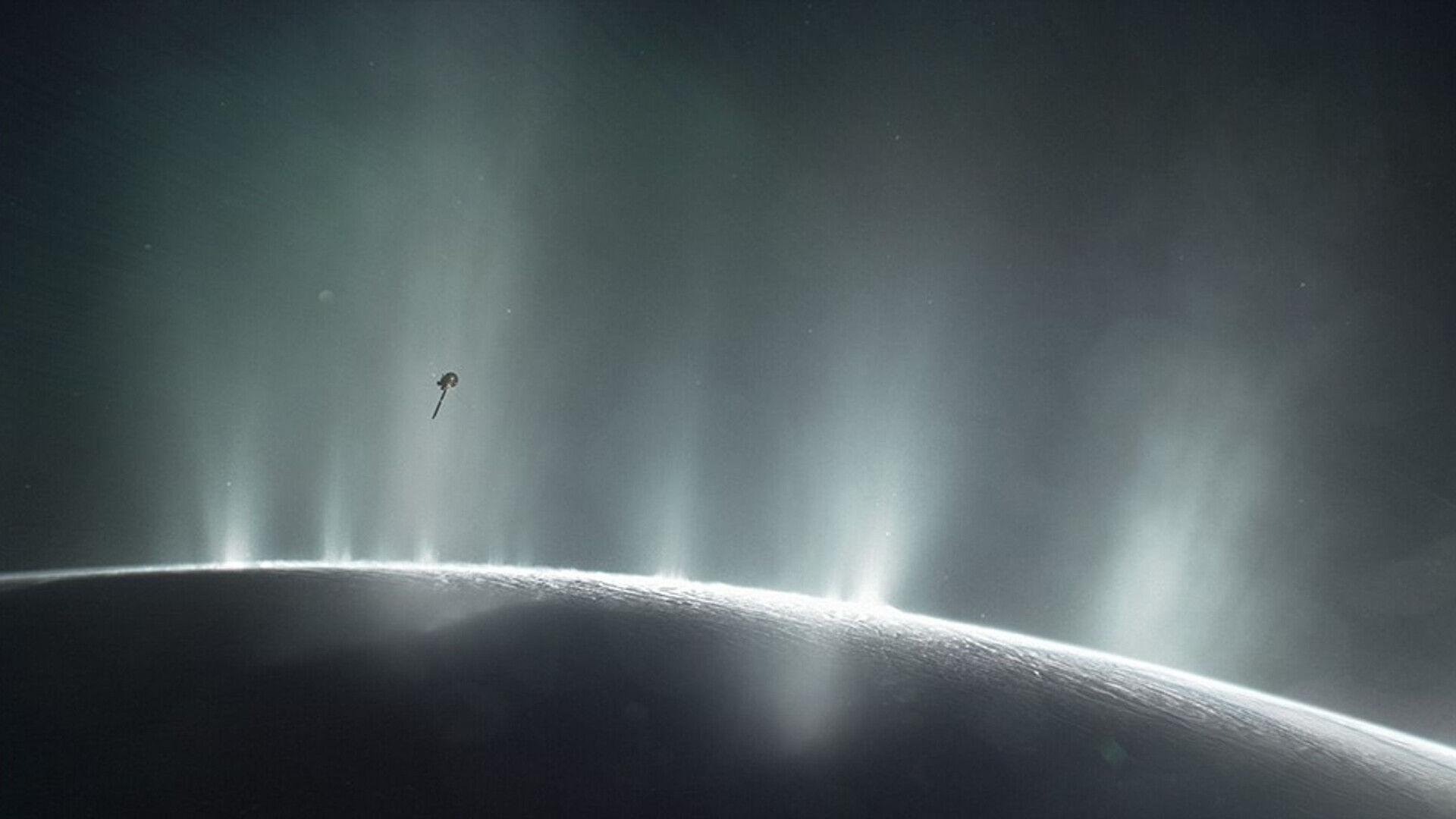
Cassini’s last look at Enceladus
Almost two decades after Cassini first flew through the icy plumes erupting from Enceladus’ south pole, scientists have uncovered complex organic molecules within the moon’s frozen spray — compounds that form part of the chemical chain leading toward life’s building blocks.
Cassini’s Legacy Lives On
Although Cassini plunged into Saturn’s atmosphere in 2017, its vast archive of data continues to deliver discoveries. A new analysis of readings from the spacecraft’s Cosmic Dust Analyzer (CDA), led by Nozair Khawaja at the Free University of Berlin, has revealed previously hidden organic signatures inside ice grains shot from Enceladus’ subsurface ocean.
When Cassini crossed Saturn’s E-ring — a faint ring created by material escaping from Enceladus — it routinely collected these microscopic ice grains. But radiation trapped in Saturn’s magnetic field can alter molecules in the ring, leaving scientists uncertain whether the organics truly came from the moon’s interior or were forged by space weathering.
To settle the issue, Khawaja’s team revisited archival CDA data from 2008, when Cassini flew directly through the plumes themselves. At those speeds — roughly 18 km per second — ice grains smashed into the detector with enough energy to expose pristine material before radiation could modify it. What they found was striking.
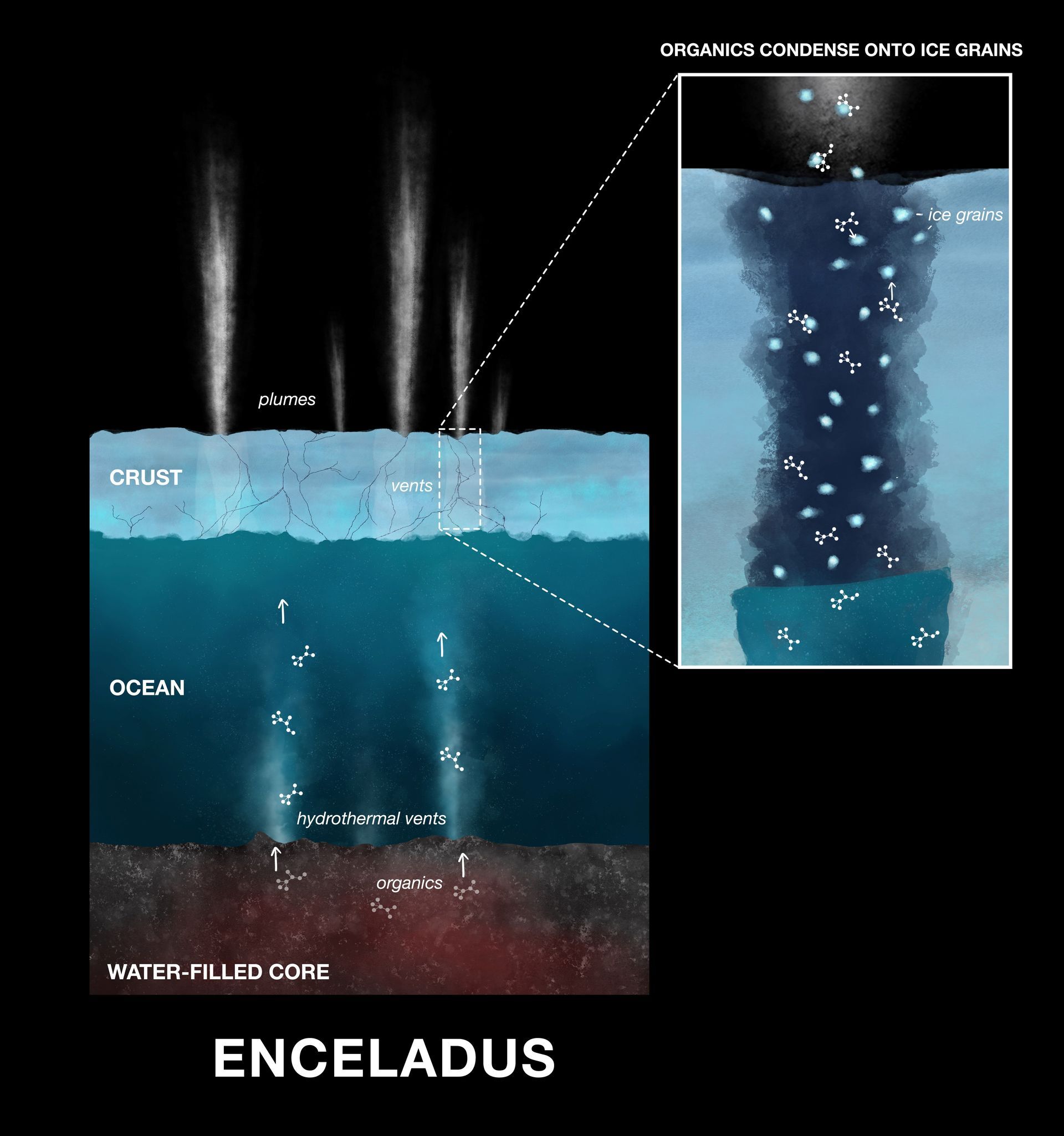
A graphical depiction of how organic molecules condense into ice grains as they form a plume emanating from the tiger stripe cracks.
Life’s Chemistry in the Plumes
The re-examined data revealed a family of organic molecules including aliphatic chains, cyclic esters, ethers, and possible nitrogen- and oxygen-bearing compounds. On Earth, similar molecules participate in the reactions that lead to amino acids and other pre-biotic chemistry.
“The ice grains contain not just frozen water, but also other molecules — including organics,” Khawaja explained. “These are the same signatures seen in the E-ring, meaning they must originate from Enceladus’ ocean itself.”
In other words, the chemistry of life is not confined to Earth’s oceans — it may be bubbling quietly beneath the crust of a moon half a billion miles away.
A Note of Caution
Not everyone is convinced. Research led by Grace Richards of Italy’s National Institute for Astrophysics suggests that radiation striking Enceladus’ surface could also create organic molecules on and around its “tiger-stripe” fissures. If true, some of Cassini’s detections might represent surface chemistry rather than deep-ocean reactions.
To truly know, scientists will need to return to Enceladus. The European Space Agency is already evaluating a mission concept — a combined orbiter and lander that could arrive around 2054, sampling fresh ice directly from the source. Only then will we know whether Enceladus’ dark ocean really holds the chemical recipe for life.
Research paper
Nozair Khwaja et al "Detection of organic compounds in freshly ejected ice grains from Enceladus’s ocean.” Nature Astronomy (2025)