Some Black Holes Are Forbidden, and Gravitational Waves Just Proved It.
A new study has found indirect evidence for a prediction of stellar theory that says that one of the most violent events in the cosmos known as pair-instability supernova leaves absolutely nothing behind — no black hole, no neutron star. And the proof came from gravitational waves.
A Forbidden Zone
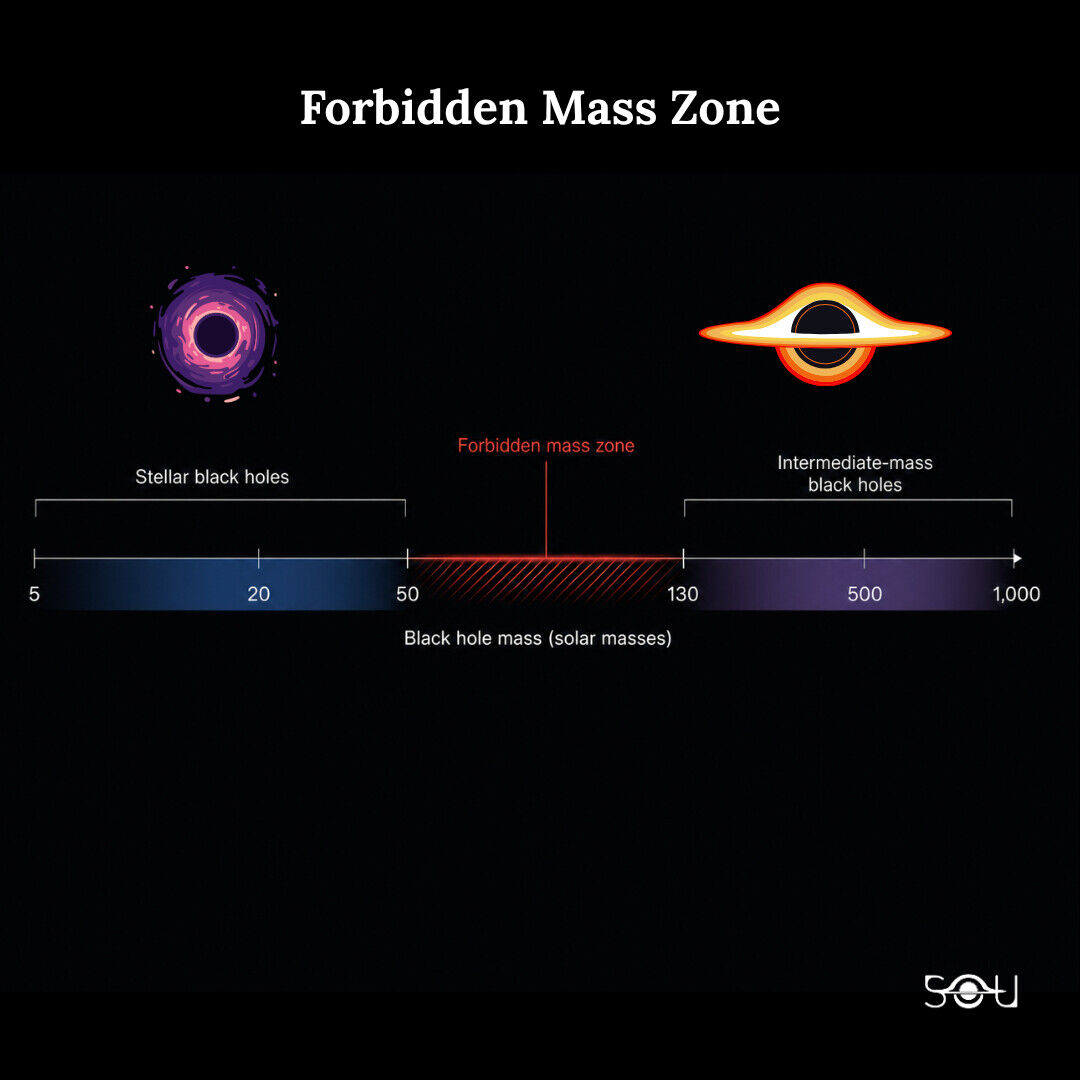
Forbidden Mass Zone of Black Holes
Stellar theory predicts that black holes shouldn't exist in the mass range of roughly 50 to 130 solar masses. Stars massive enough to fall in this window — those with initial masses between about 100 and 260 solar masses — are expected to undergo a runaway collapse followed by a catastrophic explosion in a pair-instability supernova that tears the star apart entirely. This phenomenon was first theorized in the 1960s, but directly confirming it has always been difficult because the explosion leaves almost nothing behind.
Researchers led by Hui Tong, a Ph.D. candidate at Monash University used gravitational wave detections from the LIGO-Virgo-KAGRA network to map out the masses of hundreds of black holes and found a "forbidden range" of black-hole masses.
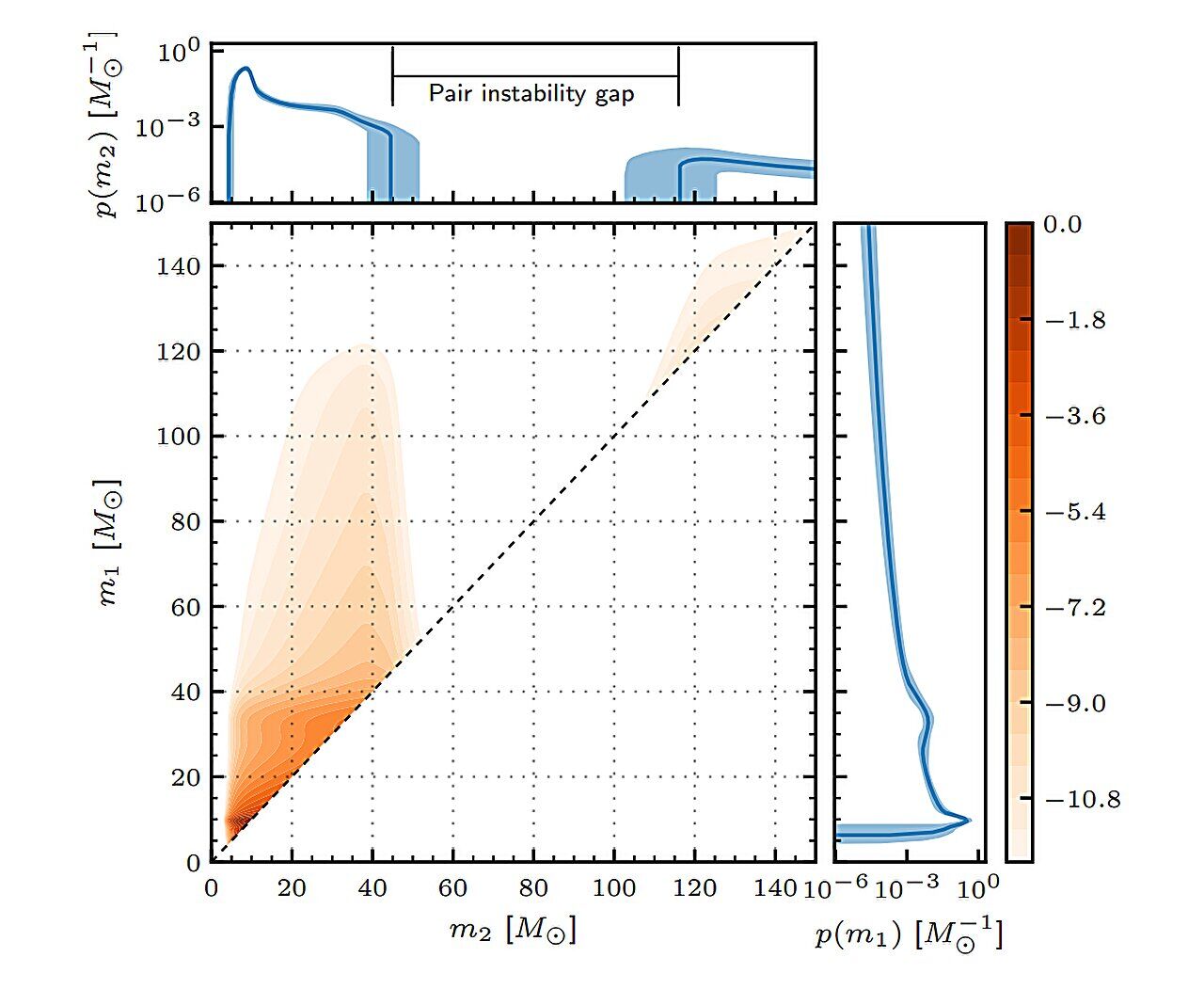
Reconstructed distribution of binary black-hole masses shows a mass gap starting from from 50 solar masses.
They found that black holes above roughly 45 solar masses are rare. They think this is because the stars that are massive enough to produce them detonate in pair-instability supernovae instead, wiping themselves out completely. The gap in the black hole mass distribution is essentially a signature left behind by these extreme explosions.
“The observation is well explained by pair instability; there are no stellar-origin black holes in the forbidden zone because stars are undergoing pair-instability supernovae,” Tong said in a statement. “The only black holes in this mass range are made from merging smaller black holes, rather than directly from stars.”
“Titanic blasts”
The study, published in Nature on April 1, also reveals about stellar physics indirectly. The location of the mass gap is sensitive to the nuclear reactions occurring in the cores of the massive stars. By measuring where the gap sits, researchers can effectively peer into the interiors of stars that no longer exist.
“It's a cool result because we are using black holes to learn about the nuclear reactions inside stars,” said Professor Eric Thrane, Chief Investigator at OzGrav.
Professor Maya Fishbach of the University of Toronto explained that gravitational waves are now giving astronomers a way to study not only the deaths of stars, but also their entire life cycle.
“We are seeing indirect evidence of one of the most titanic blasts in the cosmos: pair-instability supernovae,” Fishbach said. “At the same time, we are finding that once they are born, black holes can grow via repeated mergers.”
Future Work
The researchers acknowledge that black holes grown through repeated mergers could be “contaminating” the mass gap region and also that the results are sensitive to the assumptions made about black hole spins.
The team points to one clear direction for future work: building a more sophisticated model that separately tracks different "generations" of black holes. As LIGO-Virgo-KAGRA continues to detect more mergers, the growing sample will increase the accuracy of the results.
“As the number of detections increases, it will be possible to gain new insights into the pair-instability gap and the prevalence of hierarchical mergers in merging binaries,” the team writes in the paper.
Research paper
Hui Tong et al, Evidence of the pair-instability gap from black-hole masses, Nature (2026). DOI: https://doi.org/10.1038/s41586-026-10359-0