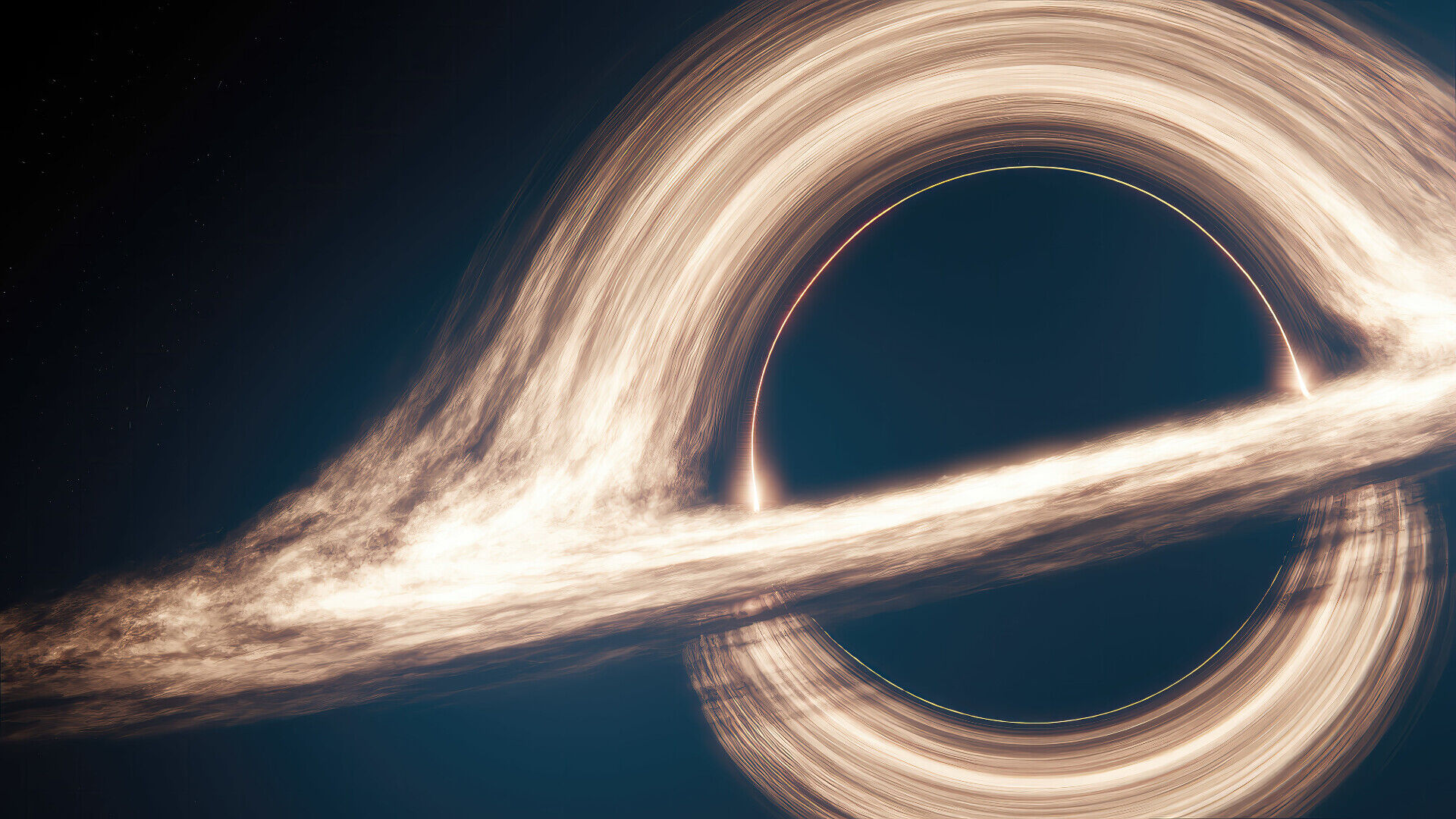
Astronomers Have Found a Black Hole 10 Times More Massive Than Its Entire Host Galaxy
For years, astronomers believed that the smallest galaxies in the universe were held together mainly by dark matter. Now, a detailed study of the ultra-faint galaxy Segue 1 has turned that idea on its head, revealing a black hole so large it may be responsible for much of the galaxy’s gravity itself.
A galaxy too small for its secret
Segue 1 is an ultra-faint dwarf galaxy located near the Milky Way. With only about a thousand stars, it is barely large enough to be called a galaxy at all. In contrast, our own galaxy contains hundreds of billions of stars. Because such small systems lack enough visible matter to hold themselves together through gravity alone, astronomers have long believed they must be filled with dark matter, the invisible substance that makes up most of the universe’s mass.
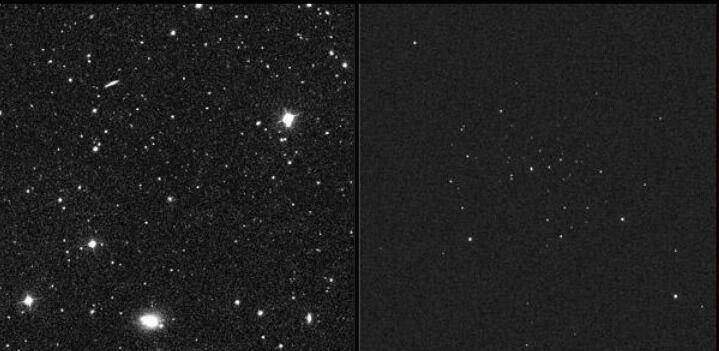
Two views of the ultra-faint dwarf galaxy Segue 1, a close satellite of the Milky Way. In the left image from the Sloan Digital Sky Survey, Segue 1 is nearly indistinguishable among numerous foreground stars and background galaxies. The right image, produced by M. Geha, shows only the stars whose colors and magnitudes match those expected for Segue 1, revealing the faint overdensity of its member stars near the center.
But new modeling work led by Nathaniel Lujan at the University of Texas at San Antonio has revealed a surprising alternative. When his team simulated how Segue 1’s stars should move under different gravitational conditions, models dominated by dark matter failed to match real observations.
“I was running hundreds of thousands of models, and I wasn’t finding anything that fit,” says Lujan. “Then I decided to adjust the black hole mass — and suddenly everything lined up.”
A heavyweight in a featherweight galaxy
The best-fitting model contained a supermassive black hole about 450,000 times the mass of the Sun. For a galaxy as tiny as Segue 1, that is enormous — roughly ten times more massive than all of the galaxy’s stars combined.
This result was startling for two reasons. First, galaxies that small were not expected to host black holes of such magnitude. Second, the few ancient stars in Segue 1 suggest it formed only about 400 million years after the first stars in the universe. That doesn’t leave much time for a black hole to grow to such a colossal size, especially since the nearby Milky Way would have pulled away much of the gas that could have fueled its growth early on.
Rethinking dark matter and galaxy evolution
If the finding holds up, it could have significant implications. For years, astronomers have assumed that dwarf galaxies like Segue 1 were dominated by dark matter, which supplied the gravitational glue holding their sparse stars together. But if massive black holes turn out to be common in these galaxies, they could account for some of that missing gravity themselves.
“This probably means there are more supermassive black holes than we thought,” says Lujan. If that’s true, these hidden black holes might contribute to the universe’s overall gravitational balance in ways we’ve never considered.
However, scientists caution that Segue 1 may not represent all dwarf galaxies. Some could still be mostly dark matter, while others might conceal similar black holes. The challenge now is to search for more examples — a task that will require powerful telescopes capable of measuring subtle motions in the faintest galaxies around the Milky Way.
The hunt continues
If astronomers can discover additional dwarf galaxies with massive black holes, it could significantly transform our understanding of both galaxy formation and cosmic structure. Giant black holes may have played a far greater role in shaping the early universe than previously thought, influencing how the first galaxies formed and how matter was distributed across space.
Segue 1, once considered one of the universe’s simplest galaxies, may instead be one of its most intriguing. Its tiny collection of stars hides a gravitational giant — one that challenges the balance between dark matter, black holes, and the formation of galaxies themselves.
Research paper
Nathaniel Lujan et al., "Modeling the “Dark-matter Dominated” Dwarf Galaxy Segue 1 with a Supermassive Black Hole", The Astrophysical Journal Letters (2025) DOI: 10.3847/2041-8213/ae0b4f