This Mysterious Glow at our Galaxy's Core Could Be the First Evidence of Dark Matter
Researchers may have discovered a significant clue in the search for dark matter at the center of the Milky Way galaxy.
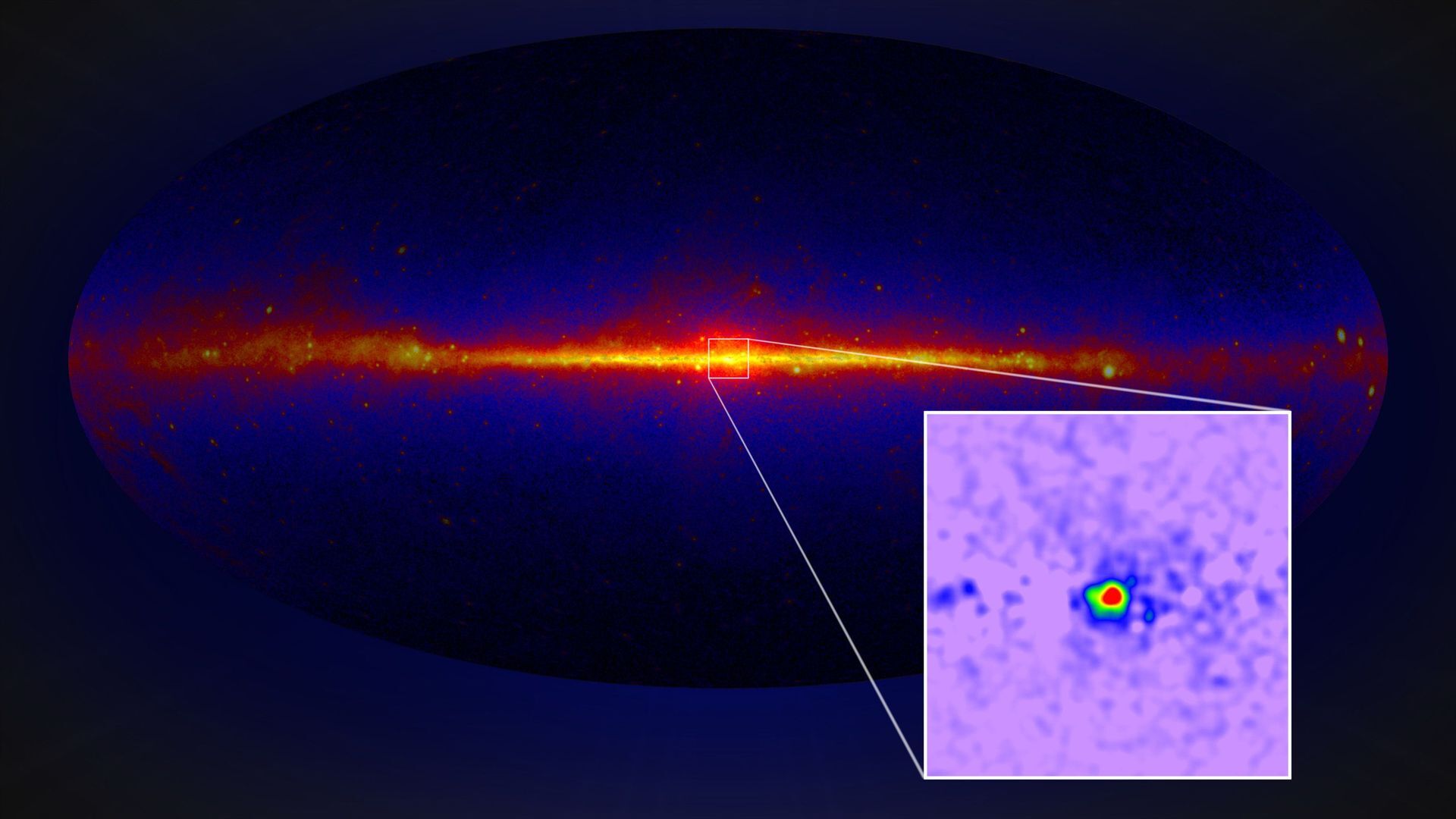
In 2008, NASA's Fermi Gamma-ray Space Telescope detected a mysterious, faint glow of gamma rays near the center of our galaxy. This hazy glow of high-energy light spanned across 7,000 light-years and was much brighter than existing models could account for.
Some scientists suggest that these gamma rays could be the result of invisible dark matter particles known as WIMPs (weakly interacting massive particles) colliding and annihilating each other. Others believe that the rays originate from fast-spinning stellar remnants called millisecond pulsars, which are rapidly spinning neutron stars that emit beams of radiation like cosmic lighthouses.
Dark matter’s “fingerprint”?
In the new research published in the journal Physical Review Letters, researchers tested these two ideas. They used powerful supercomputers to pinpoint the location of dark matter in our galaxy, given the Milky Way’s formation history and evolution process. They recreated the conditions under which the Milky Way was formed by simulating billions of years of violent collisions and mergers with smaller galaxies, and the simulated maps aligned with the actual gamma-ray maps created based on observations by the Fermi Gamma-ray Space Telescope.
This suggests that the excess glow of gamma-rays from the Milky Way center could originate from dark matter particle annihilation.
"Dark matter dominates the universe and holds galaxies together. It's extremely consequential, and we're desperately thinking all the time of ideas as to how we could detect it," co-author Joseph Silk, a professor of physics and astronomy at Johns Hopkins and a researcher at the Institute of Astrophysics, Sorbonne University, and CNRS, said in a statement. "Gamma rays, and specifically the excess light we're observing at the center of our galaxy, could be our first clue."

A snippet from a NASA video that shows gamma-ray map of the Milky Way center recorded by the Fermi Gamma-ray Space Telescope
On the other hand, the light from the rapidly spinning millisecond pulsars also matches the observed gamma-ray map, and hence the study does not completely rule out pulsars. But this idea is not flawless. To make the maps match, researchers would need to assume that far more millisecond pulsars exist than have actually been detected. The team concludes that both theories are equally likely. But if the Milky Way’s gamma light is not from pulsars, then this could be the first evidence of the existence of dark matter.
The definitive proof may come with the advent of a massive new gamma-ray project called the Cherenkov Telescope Array, which will enable astronomers to measure high-energy signals more clearly. Using its higher-resolution data, they can distinguish whether the signal is from pulsars or from dark matter. Silk noted that a clean signal would be smoking gun evidence.
"It's possible we will see the new data and confirm one theory over the other," Silk said. "Or maybe we'll find nothing, in which case it'll be an even greater mystery to resolve."
Meanwhile, the researchers plan to work on testing the predictions about where to find dark matter in several selected dwarf galaxies orbiting the Milky Way. Once they have mapped their predictions, they can compare them to the upcoming high-resolution data.
Research paper
Moorits Mihkel Muru et al, Fermi-LAT Galactic Center Excess Morphology of Dark Matter in Simulations of the Milky Way Galaxy, Physical Review Letters (2025). DOI: https://doi.org/10.1103/g9qz-h8wd