Is There Another Planet Out There? Evidence Builds for ‘Planet Y’
For decades, astronomers have searched for hidden worlds in the dark outskirts of our solar system — worlds whose gravity might quietly shape the orbits of distant icy bodies. The legends of Planet X and later Planet Nine have long captured our imagination. Now, a new candidate has entered the frame: Planet Y.
Recent research led by Amir Siraj and colleagues at Princeton University suggests that the mysterious warping of orbital planes in the Kuiper Belt — the icy region beyond Neptune — could be the gravitational fingerprint of an unseen planet. If true, this discovery could transform our understanding of the solar system’s structure and history.
A Warp in the Outer Solar System
The Kuiper Belt acts as a frozen archive of the early solar system. Its objects — known as trans-Neptunian objects (TNOs) — typically orbit near a flat, shared plane called the invariable plane, defined by the total angular momentum of the solar system.
But when Siraj’s team re-examined the orbits of 154 distant TNOs (with semimajor axes between 50 and 400 AU), they found something unusual: a 15° tilt in the average orbital plane of those lying between 80–200 AU and 80–400 AU from the Sun.
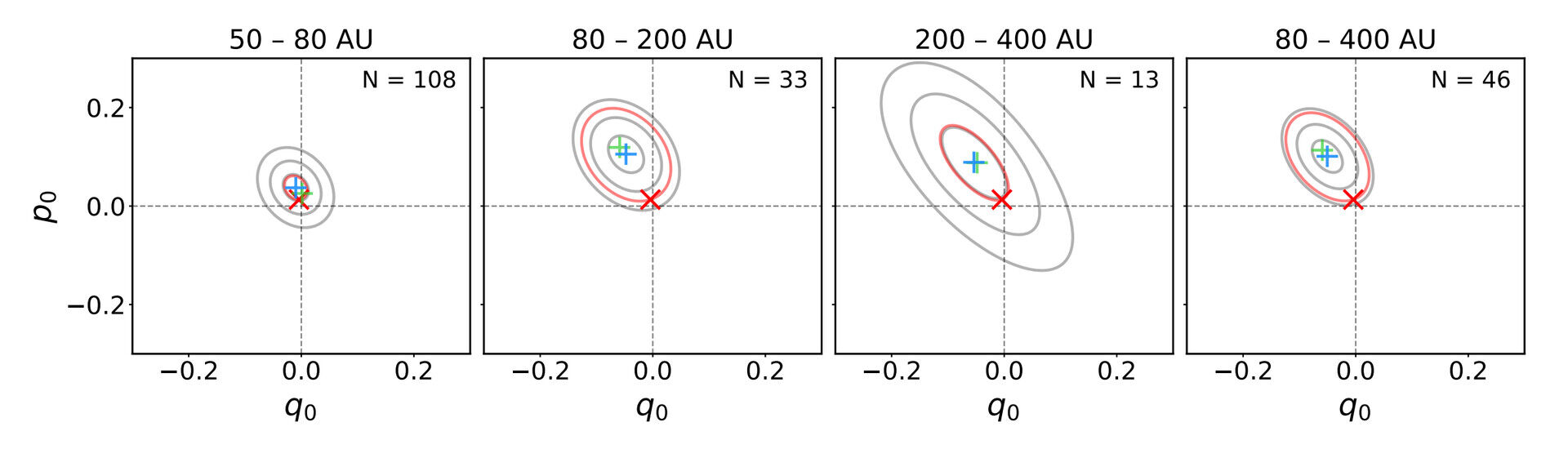
This figure from the research paper shows the warp in the mean plane of TNOs at different orbit ranges (50–80 AU, 80–200 AU, 200–400 AU, and 80–400 AU bins). The red 'X' marks the invariable plane, while blue pluses and probability ellipses reveal how the observed warp stands out specifically at 80–200 AU and 80–400 AU. The fact that the invariable plane lies outside the area enclosed by the 2-sigma ellipse in the 80 − 200 AU and 80 − 400 AU bins illustrates the tentative detection of a local warp reported in this paper.
This “warp” could not be explained by the gravitational pull of any known planets. It hinted instead at a hidden gravitational force — possibly a small, unseen planet influencing these icy worlds over billions of years.
Not a Fluke, But a Fingerprint
Could the warp simply be a statistical illusion? The researchers tested that possibility exhaustively. Their analysis revealed a 98% probability that the 80–400 AU warp is real, and 96% for the 80–200 AU range — meaning the odds of such alignment arising by chance are less than 1 in 25.
Monte Carlo simulations further ruled out the effects of survey bias or random clustering. The conclusion was striking: something massive and unseen may be sculpting the Kuiper Belt.
Simulating a Hidden Planet
To determine what could cause such a distortion, the researchers ran detailed N-body simulations — digital models that track the motion of thousands of celestial bodies over time.
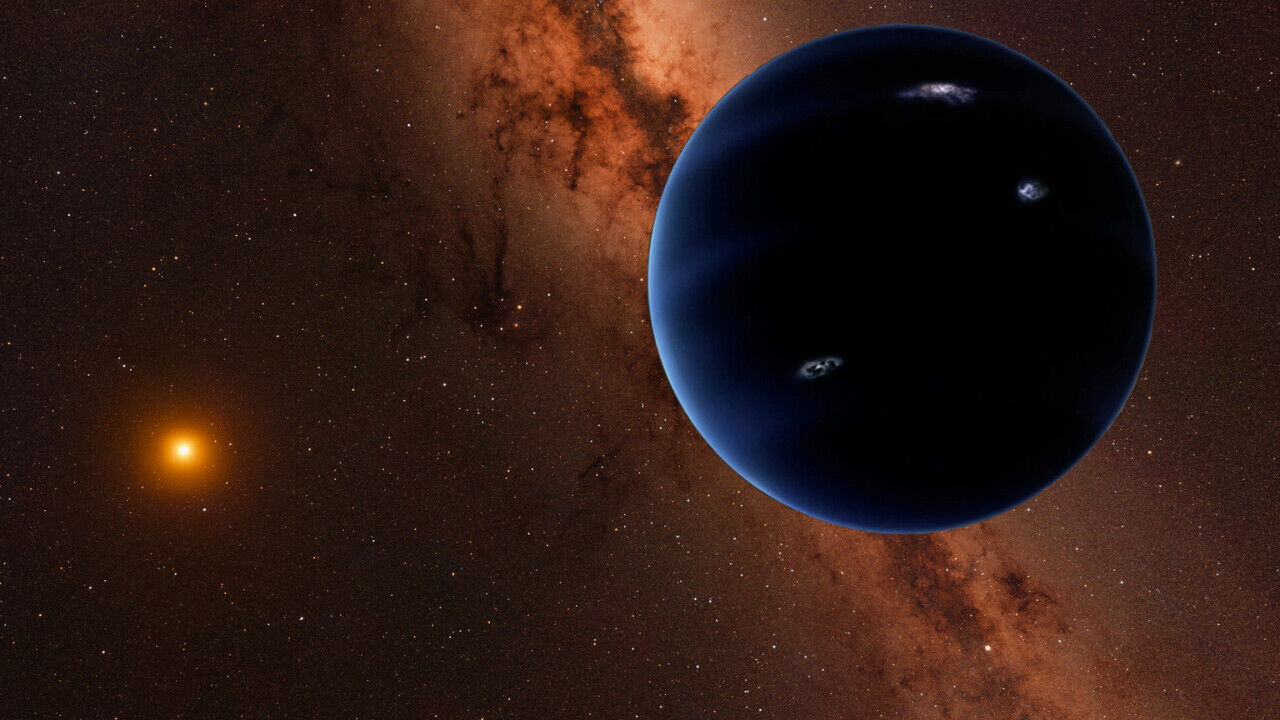
The results pointed to a single plausible explanation: a planet with a mass between Mercury and Earth (0.06–1 Earth masses), orbiting 100–200 AU from the Sun, and inclined by at least 10° relative to the solar system’s main plane.
Anything larger or farther away didn’t fit the data. The pattern matched only if this planet — dubbed Planet Y — has quietly tugged on the orbits of these distant objects for billions of years.
Importantly, this proposed world is not Planet Nine. Whereas Planet Nine is hypothesized to be a super-Earth orbiting beyond 300 AU, Planet Y would be closer, lighter, and responsible for a completely different gravitational signature. If both exist, the outer solar system could be even more intricate — and crowded — than anyone imagined.
A Frontier Still Full of Surprises
Caution remains essential. The number of known TNOs beyond 80 AU is still small, and statistical anomalies have disappeared before as more data came in. But the good news is that the hypothesis is eminently testable.
When the Vera C. Rubin Observatory begins its ten-year survey of the southern sky, it will detect thousands of new distant objects — perhaps even the planet itself. Each new discovery will either sharpen or dissolve the case for Planet Y.
For now, one thing is clear: the solar system we thought we knew may still hold hidden worlds waiting to be found.
Research paper
A. Siraj et al, "Measuring the mean plane of the distant Kuiper belt.”, MNRAS (2025)