Scientists Revisit 45-Year-Old Venus Data — And Make a Shocking Discovery
Nearly half a century after NASA’s Pioneer Venus mission plunged a probe into the planet’s thick atmosphere, scientists have uncovered a surprising detail in the data: Venus’ clouds may contain far more water and iron than the current estimations.
In a study published this week in Journal of Geophysical Research: Planets, researchers led by Rakesh Mogul, a professor at California State Polytechnic University, Pomona, revisited data collected by the Pioneer Venus Large Probe in 1978. Their reanalysis suggests that Venus’ cloud aerosols are not just concentrated sulfuric acid, as long believed, but instead a complex mixture of water, iron sulfates, and sulfuric acid, with water making up as much as 60 percent by mass.

Photo of Venus, taken by the Pioneer-Venus Orbiter, showing its turbulent, cloudy atmosphere.
“Together, these direct measurements in Venus’ clouds highlight reservoirs of water and iron in the aerosols,” said Mogul in a statement. “This type of aerosol composition, which was not previously known, presents new considerations for cloud chemistry models, cloud habitability discussions, and the continued and vigorous exploration of Venus.”
A Forgotten Treasure
The Pioneer Venus Large Probe was designed to study the planet’s scorching atmosphere as it descended toward the surface. One of its onboard instruments, the Large Probe Neutral Mass Spectrometer, sampled the atmospheric gases and particles during the descent. This dataset was stored on microfilm and eventually archived by NASA — largely forgotten by the Venus science community for decades.
That changed in 2021. During a discussion about the composition of Venus’ clouds, Mogul and Sanjay S. Limaye, a senior Venus scientist at the University of Wisconsin–Madison and a co-author of the study, began wondering whether the old Pioneer Venus data could still hold untapped clues. With help from Michael J. Way, a NASA scientist, the team tracked down the archived dataset at NASA’s Space Science Data Coordinated Archive. Mikhail Yu. Zolotov, a scientist at Arizona State University who specializes in Venus’ geology, also joined the team to study Venus' complex composition.
Chemistry of the Clouds
By applying evolved gas analysis to the vintage data, the team uncovered spectral signatures that had gone unrecognized in the 1970s. Their analysis revealed that the aerosols contained iron sulfates and sulfuric acid in nearly equal proportions, along with three times more water than previously thought. The water appears to be locked within hydrated minerals such as ferric and magnesium sulfates — compounds that could play a key role in the chemistry and reflectivity of Venus’ clouds.
When the Pioneer Venus probe passed through the planet’s dense atmosphere, its instruments likely captured tiny droplets of the clouds themselves. As these particles were heated, they released gases like water (H₂O), sulfur dioxide (SO₂), oxygen (O₂), and possibly iron oxides (Fe₂O₃), which appeared in the data as ionized molecules — a subtle but crucial clue that the instruments had sampled aerosols, not just gases.
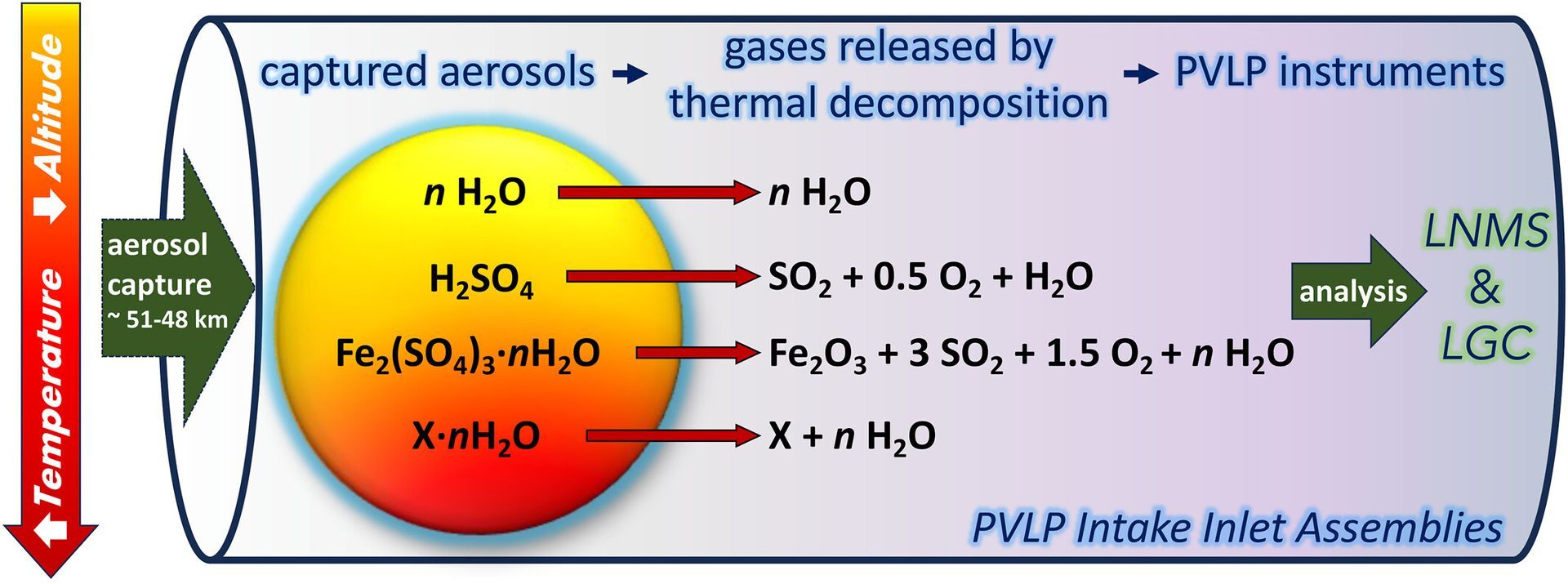
The diagram shows how the Pioneer Venus Large Probe instruments capture and analyze aerosols (yellow spheres. The thermal decomposition of these aerosols varies within the atmosphere, with products directed into the Large Probe Neutral Mass Spectrometer and Large Probe Gas Chromatograph. The decomposition sequence includes the loss of water, sulfuric acid, hydrated ferric sulfate, and uncharacterized hydrates.
Similar measurements from the Soviet Venera and Vega probes in the 1980s also detected unexpected amounts of water, suggesting that multiple missions had unknowingly collected these cloud droplets.
These findings could reshape our understanding of Venus’ atmosphere and reignite debates about its potential for habitability. If the planet’s clouds contain more water and complex chemistry than once assumed, they might be more dynamic, and possibly more Earth-like, than scientists thought.
This discovery invites researchers to revisit the long-standing view that Venus is bone-dry. The study suggests that even the oldest datasets can yield groundbreaking insights when seen through a modern lens.
Research paper
R. Mogul et al, Re‐Analysis of Pioneer Venus Data: Water, Iron Sulfate, and Sulfuric Acid are Major Components in Venus' Aerosols, Journal of Geophysical Research: Planets (2025). DOI: 10.1029/2024je008582