A Planet Just 40 Light-Years Away May Have the Right Air for Life
A New Hope in the Search for Life
Imagine a planet just 40 light-years away — close by cosmic standards — quietly orbiting a small red star. It’s called TRAPPIST-1e, and it's fast becoming one of the most promising candidates in our search for life beyond Earth. For years, astronomers have wondered: does this rocky world have an atmosphere? And could it be one that shelters life?
Now, the James Webb Space Telescope may have just delivered the first real clue.
The TRAPPIST-1 System: A Compact Family of Planets
Back in 2016, astronomers discovered a tiny, dim star known as TRAPPIST-1, located about 40 light-years from Earth in the constellation Aquarius. What made it extraordinary wasn’t just the star — it was what circled it.
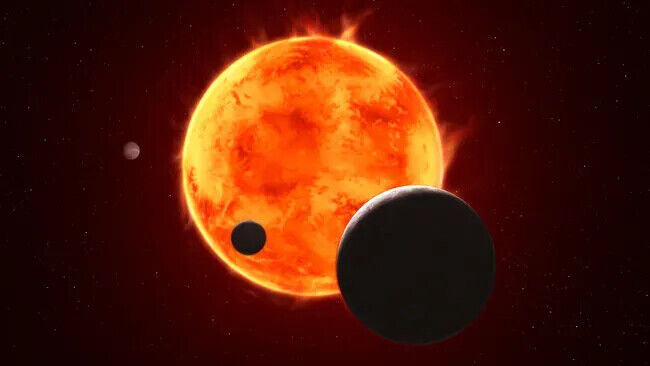
An illustration of the TRAPPIST-1 system. (Image credit: NASA, ESA, CSA, STScI, Joseph Olmsted (STScI))
Seven Earth-sized planets were found orbiting this cool red dwarf. Three of them, including TRAPPIST-1e, lie in the star’s so-called Goldilocks zone — the region where temperatures are just right for liquid water to exist. Not too hot, not too cold.
Naturally, this system skyrocketed to the top of every astrobiologist’s wish list.
The First Round of Disappointments
Despite the early hype, the excitement around TRAPPIST-1 began to fade as observations rolled in. Initial studies using the Hubble and later the Webb telescope showed no clear signs of atmospheres around the planets. Many of them appeared to be bare, rocky worlds — not the life-harboring havens scientists had hoped for.
But one planet kept drawing attention: TRAPPIST-1e. Right in the middle of the habitable zone. Just the right size. Just the right distance. And now — finally — just the right signal.
Webb Turns Its Eyes to TRAPPIST-1e
In 2023, a team of astronomers led by Ryan MacDonald from the University of St Andrews began a dedicated observation campaign of TRAPPIST-1e using the James Webb Space Telescope (JWST). Their goal was ambitious: to detect an atmosphere, if it existed.
The process is subtle. When the planet passes in front of its star — a transit — some of the starlight filters through any potential atmosphere. By analyzing how that light changes, scientists can look for fingerprints of various gases.
The challenge? TRAPPIST-1 is a red dwarf, far cooler than our Sun. And cooler stars are messy. Molecules like water or methane might show up in the star’s light itself, making it difficult to tell whether those signals are coming from the planet — or just the star’s own atmosphere.
The Breakthrough
After carefully modeling the data from four separate transits, MacDonald and his team noticed something intriguing.
“We’re starting to see bumps and wiggles in the spectra,” says MacDonald, “and they’re best explained by a nitrogen-rich atmosphere—potentially with traces of methane.”
This is significant.
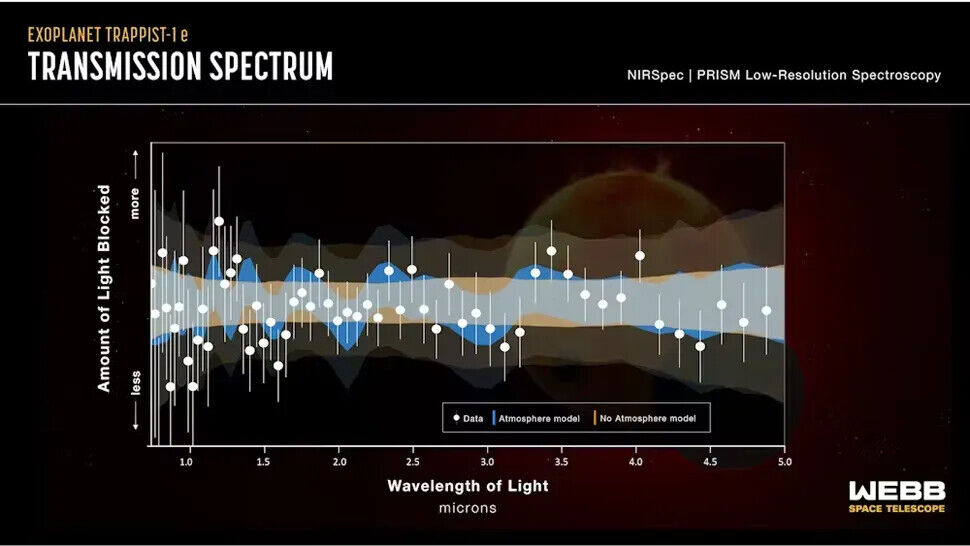
A graph showing the transmission spectrum of TRAPPIST-1, using data from the Webb's NIRSpec instrument. The data obtained has been compared with computer models of TRAPPIST-1 e, with the blue line representing a model assuming the presence of an atmosphere, and the orange line without one. (Image credit: NASA, ESA, CSA, STScI, Joseph Olmsted (STScI))
Nitrogen is the dominant gas in Earth’s atmosphere. And while it’s not a biosignature by itself, it creates the right pressure conditions for liquid water to exist. It also stabilizes the climate and helps keep temperatures within a life-friendly range.
Methane, on the other hand, is more tantalizing. On Earth, most methane is biological in origin. But to be clear: methane can also be produced geologically. It’s not proof of life — but it’s the kind of molecule scientists get very excited about.
Why Atmosphere Matters
A planet can be in the habitable zone and still be completely inhospitable. Just look at Venus — it orbits within our Sun’s Goldilocks zone, but its thick atmosphere creates a runaway greenhouse effect, roasting the surface to 460°C.
Mars, on the flip side, is also near the habitable edge — but its thin atmosphere can’t hold onto heat or protect it from solar radiation.
That’s why discovering a stable, nitrogen-rich atmosphere on TRAPPIST-1e would be a game-changer. It’s the missing piece that could make this rocky exoplanet not just potentially habitable — but possibly alive.
What Comes Next?
So far, the team has analyzed just four transits. They need at least 15 more to confidently confirm the presence — and makeup — of this atmosphere.
“We need to shrink the error bars,” says MacDonald. That means more data, better models, and clearer detections of gases like carbon dioxide, water vapor, and methane. Once those are in, scientists can simulate the climate on TRAPPIST-1e and estimate surface temperatures — and whether liquid water could exist.
If water is confirmed, that would mark one of the most promising worlds for life we've ever found.
The Bigger Picture: What If?
Dr. Matthew Genge of Imperial College London puts it simply: “You can be the right distance from a star, but without the right atmosphere, you end up with Venus or Mars.”
But if TRAPPIST-1e truly has a stable, Earth-like atmosphere, then it's fair to ask: what’s been happening there for the last 7.6 billion years? That’s how old the planet is — older than Earth. Plenty of time, potentially, for life to emerge… and evolve.
And if that’s the case — what kind of life might be out there?
Even more tantalizing, if oxygen is ever detected — a molecule hard to build up without photosynthesis — it could be the first real clue that biology is shaping the atmosphere of another world.
Still a Long Road Ahead
Despite the promising results, scientists are staying cautious.
“We’re a skeptical bunch,” says MacDonald. "This is the most promising spectrum we’ve seen from TRAPPIST-1 so far, but we’re not claiming discovery yet. It’s going to take time.”
By 2060, he believes we may have found multiple planets with atmospheric compositions that defy explanation without some form of biology.
Until then, we continue watching. Listening. Waiting.
Because somewhere out there, perhaps TRAPPIST-1e is whispering back.
Research paper
Ana Glidden et al., "JWST-TST DREAMS: Secondary Atmosphere Constraints for the Habitable Zone Planet TRAPPIST-1 e",