The Most Precise Measurement in Cosmology Just Made Its Biggest Mystery Worse
For decades, cosmologists hoped the most unsettling number in physics was just a measurement error. In April 2026, a global team of astronomers produced the most precise measurement yet. The number held. The mystery deepened.
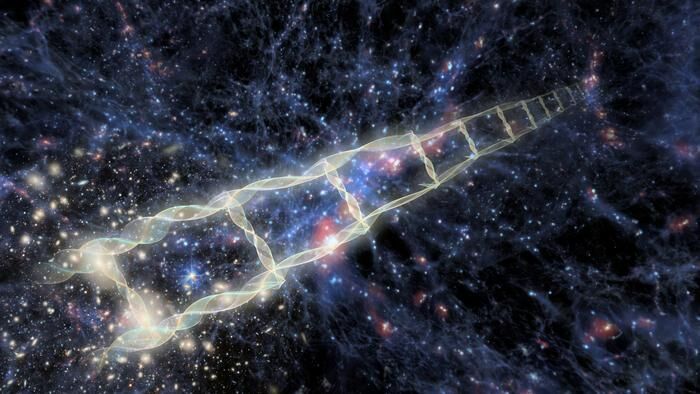
Artist’s interpretation of the cosmic distance ladder — a succession of overlapping methods used to measure distances across the Universe, where each rung of the ladder provides information that can be used to determine the distances at the next higher rung. Methods include observations of pulsating Cepheid variable stars, red giant stars that shine with a known brightness, Type Ia supernovae, and certain types of galaxies.
A Number That Refuses to Cooperate
There is a number at the heart of modern cosmology that has been causing headaches for nearly a decade. It is called the Hubble constant, the rate at which the universe is expanding, and the problem is not that scientists cannot measure it. The problem is that they measure it too well, and the two best ways of doing so refuse to agree.
On one side: astronomers who look at the nearby universe, measuring distances to stars and galaxies to directly calculate how fast everything is flying apart. Their answer consistently comes in at around 73 kilometres per second per megaparsec. Think of it as: for every 3.26 million light-years of distance between two objects, those objects are moving apart at 73 kilometres every second.
On the other side: physicists who read the cosmic microwave background — the faint glow of radiation left over from the Big Bang — and use the standard model of cosmology to calculate what the expansion rate should be today. Their answer: about 67 or 68.
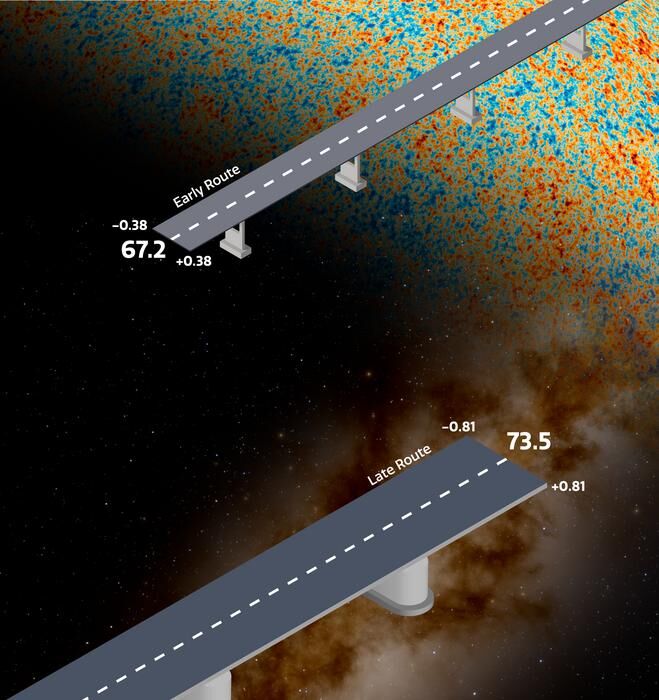
This graphic represents the tension that exists between measurements of the expansion rate of the late, nearby Universe, versus what would be expected based on measurements of the early Universe, specifically the cosmic microwave background (CMB). Under the standard model of cosmology, these two approaches are expected to yield the same result, but they don’t. This discrepancy is known as the Hubble tension, and is represented in this graphic by the misalignment between the Early Route and Late Route "bridges."
In theory, both methods should produce the same answer. In reality, they do not. The gap between these values is small in absolute terms, but far too large to dismiss as a statistical fluke. This mismatch is known as the Hubble tension, and it has appeared repeatedly across independent studies.
For years, the optimistic explanation was simple: one of the measurements must be wrong. A systematic error buried in the instruments. A miscalibration. A blind spot in the data. Now, that explanation is running out of room.
The Most Precise Measurement Ever — And It Still Doesn't Fit
An international collaboration of astronomers has achieved the most precise direct measurement to date of the current expansion rate of the universe, reporting a value of the Hubble constant of 73.50 ± 0.81 km/s/Mpc, corresponding to a precision of just over 1%.
That number, produced by the H0 Distance Network (H0DN) Collaboration and published on April 10, 2026 in Astronomy & Astrophysics, is not just a new data point. It is the result of something unprecedented: a deliberate, global effort to bring competing scientific teams together, pool decades of independent observations, and build a single unified measurement framework from the ground up.
The study grew out of a broad community effort launched at the ISSI Breakthrough Workshop "What's under the H0od?", held at the International Space Science Institute in Bern, Switzerland, in March 2025.
The name of the workshop, a wink at what lies "under the hood" of the Hubble constant, hints at the spirit of the exercise: not just to measure, but to interrogate the measurement itself.
Building a Distance Network, Not a Ladder
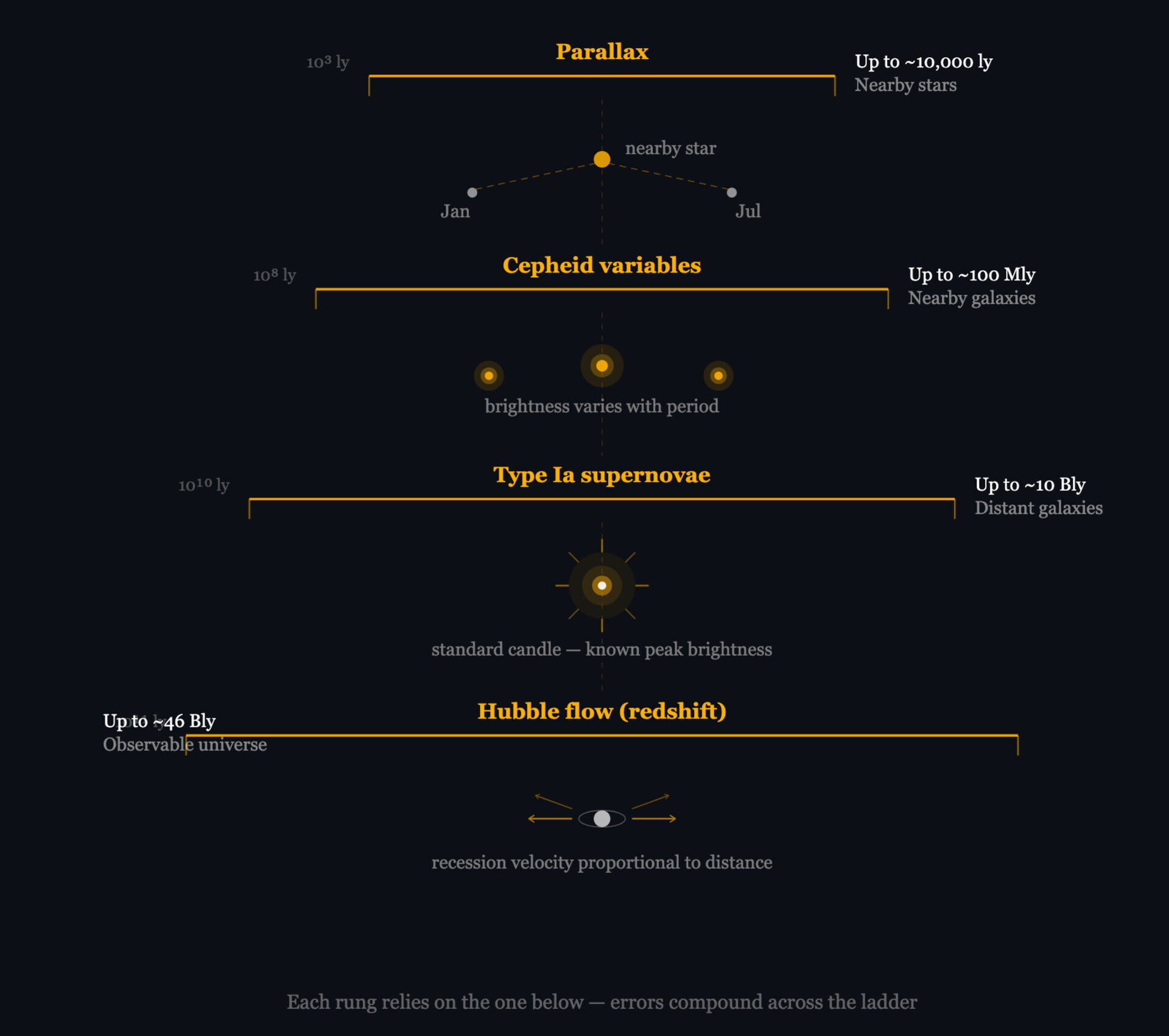
The Cosmic Distance Ladder
For nearly a century, astronomers have measured cosmic distances using what is called the "distance ladder" — a series of overlapping techniques, each calibrated against the last, extending from our own solar neighbourhood out to the furthest reaches of the observable universe. Each rung of the ladder carries its own uncertainties. And critics of the Hubble tension have long argued that an error on one rung could cascade through the whole structure, quietly inflating the final answer.
The H0DN collaboration took this concern seriously. Rather than depending on a single technique, the team built what they call a "distance network." This system connects several overlapping methods used to measure cosmic distances — Cepheid variable stars, which brighten and dim in predictable ways, red giant stars with known brightness, Type Ia supernovae, and certain galaxy types.
The key innovation was redundancy. If any single technique harboured a hidden error, removing it from the analysis should shift the result. Even when individual techniques were excluded, the overall result remained largely unchanged. The consistency across methods strengthens confidence in the measured expansion rate.
The verdict was clear. "This work effectively rules out explanations of the Hubble tension that rely on a single overlooked error in local distance measurements. If the tension is real, as the growing body of evidence suggests, it may point to new physics beyond the standard cosmological model," the authors concluded.
What Could Explain It?
The standard model of cosmology — the mathematical framework that describes how the universe evolved from the Big Bang to the present day — has been spectacularly successful. It predicted the large-scale structure of the universe, the relative abundances of the elements, and the patterns in the cosmic microwave background with extraordinary accuracy. But it was built on assumptions. And one of those assumptions may now be cracking.
The slower expansion rate derived from the early universe depends on the standard model of cosmology, which describes how the universe has evolved since the Big Bang. If that model is missing something — such as details about dark energy, unknown particles, or changes in gravity — its predictions for today's expansion could be off.
Dark energy is the leading suspect. It is the mysterious force accelerating the expansion of the universe, accounting for roughly 68 percent of all the energy in the cosmos — and it is almost entirely unknown. Current models assume it is a simple, constant property of space itself. But if dark energy has changed over time, or behaves differently than expected, it could explain why the universe today seems to be expanding faster than its early history would predict.
Other possibilities include unknown light particles in the early universe that altered how it evolved, or subtle modifications to Einstein's theory of gravity that only manifest at cosmological scales.
None of these are confirmed. All of them, if true, would represent a fundamental revision of our understanding of how the universe works.
The Mystery Just Got Harder to Ignore
The H0DN result sits 5.0 sigma away from the prediction derived from baryon acoustic oscillation data within the standard flat cosmological model. In physics, five sigma is the threshold for a formal discovery. The gap between what the universe is doing and what the standard model predicts it should be doing has now crossed that line.
The newly developed distance network also provides a framework for future studies. By making their methods and data publicly available, the team has created a system that can be refined as new observations become available. Upcoming observatories are expected to deliver even more precise measurements, which may help determine whether the discrepancy will eventually be resolved or continue to point toward new physics.
The universe has been sending the same message for years. Sharper instruments, more precise methods, broader collaborations — all have been tried. And every time, the answer comes back the same: the cosmos is expanding faster than it has any right to.
Something, out there in the fabric of space and time, is not behaving the way it should. The question is no longer whether the problem is real. The question is what the universe is trying to tell us.