
The 5 Space Apps That Will Change How You See the Night Sky
Have you ever looked up at the night sky and wished you had a cosmic guide beside you?
Someone—or something—that could point out the planets, name the stars, tell you when the next meteor shower peaks, and even alert you to an eclipse before the world starts buzzing about it? In the age of smartphones and stardust, that guide now fits in your pocket.
Whether you’re a beginner just starting to recognize the Moon’s phases, or a seasoned stargazer who can tell Saturn from Jupiter with a glance, the right space apps can elevate your journey through the cosmos. Here are the top 5 astronomy apps that blend science, technology, and wonder—handpicked to turn your night sky experiences into unforgettable celestial adventures.
1. Sky Guide
Available on: iOS only (iPhone & iPad)
Free with optional in-app purchases / One-time premium version

Imagine pointing your phone at the night sky, and watching constellations softly light up over the stars above you. That’s the magic of Sky Guide. It’s one of the most beautifully designed and intuitive astronomy apps available. No internet? No problem—Sky Guide works offline, using your phone’s built-in sensors to map out the sky wherever you are.
You can identify stars, planets, constellations, satellites, and even track space events in real-time. It’s especially handy when you're out camping or away from city lights. The ambient soundtrack and elegant design make stargazing feel less like using an app—and more like attending a planetarium show in your palm.
Why it shines:
- Real-time sky tracking with accurate overlays
- Notifications for ISS flyovers, planetary alignments, and meteor showers
- Time-travel feature to simulate past or future skies
- Detailed info on thousands of celestial objects
Best for: Casual observers and Apple users looking for a beautifully immersive experience.
2. Stellarium
Available on: iOS and Android
Free basic version / Paid Plus version with more features

Stellarium started as open-source software used by planetariums—and now it’s in your pocket. It turns your device into a high-powered digital telescope, giving you access to over 1.6 million stars, 2 million deep-sky objects, and dozens of satellites, comets, and space stations.
Unlike apps that simplify the sky too much, Stellarium stays scientifically rigorous without overwhelming beginners. Its interface is clean, responsive, and deeply customizable. You can even set your location anywhere on Earth—or simulate a view from the Moon or Mars.
Why it shines:
- Ultra-precise sky simulation with real-time celestial mechanics
- Deep sky catalog: galaxies, nebulae, globular clusters, etc.
- Telescope control (for compatible models)
- Adjustable light pollution settings and realistic horizons
Best for: Intermediate to advanced users, astronomy educators, and those who want precision and detail.
3. Sky Safari
Available on: iOS and Android
Free basic version / Paid Plus version with more features

SkySafari isn’t just an app—it’s a portable observatory.
Built with the serious astronomy enthusiast in mind, SkySafari has been evolving for years—and its latest versions (Plus and Pro) are more powerful than ever. While most apps are designed for casual skywatchers, SkySafari aims for the heart of the amateur astronomer community.
The Plus version already offers a formidable database: 2.5 million stars and 32,000 deep-sky objects. But for those who crave even more detail, the Pro version goes much deeper—with an astonishing 100 million stars, 3 million galaxies, and 750,000 Solar System objects cataloged, reaching down to 18th magnitude.
One of SkySafari’s standout features is its compatibility with Wi-Fi-enabled telescopes. Whether you're using ASCOM Alpaca, INDI, or another supported system, the app can control your telescope directly from your device—allowing you to jump to any object in the sky with precision. For many observers, this single feature makes SkySafari an essential tool in the field.
But the app doesn’t stop there. Both versions include thoughtful utilities like a "Sky Tonight" section, personalized notifications, a logbook, and a stargazing session planner. It also features a red-light mode—vital for preserving night vision when observing in the dark.
While there's also a community element called OneSky, which lets you peek at what others are observing around the world in real-time, it’s more of a novelty than a necessity. Similarly, SkyCast lets you share your observations with fellow users, if you’re part of a connected stargazing group.
Why it shines:
- Massive star and galaxy database (especially in Pro)
- Full telescope control with Wi-Fi systems
- Session planning, red-light mode, and observing logbook
- Accurate simulations for eclipses, transits, and conjunctions
- Deep data for astrophotography planning and advanced use
4. Heavens Above
Available on: Android only
Completely free
Not all stars are born. Some are built.
Heavens Above is dedicated to the artificial side of space—the satellites, space stations, and rocket stages orbiting above Earth. If you've ever seen a moving light silently crossing the sky and wondered, Was that the ISS?, this app has the answer.
You can see where satellites are in real time, check when they’ll be visible from your location, and even track upcoming rocket launches. It’s not as sleek as some of the other apps on this list, but what it lacks in aesthetics, it makes up for in data and reliability.
Why it shines:
- Real-time satellite tracking and pass predictions
- Starlink tracking (individual satellites and trains)
- Iridium flare predictions (for legacy satellites)
- Launch calendar and orbit data for thousands of objects
- Best for: Spaceflight enthusiasts, Starlink watchers, and ISS trackers.
5. Star Walk 2
Available on: iOS and Android
Free with optional premium upgrade
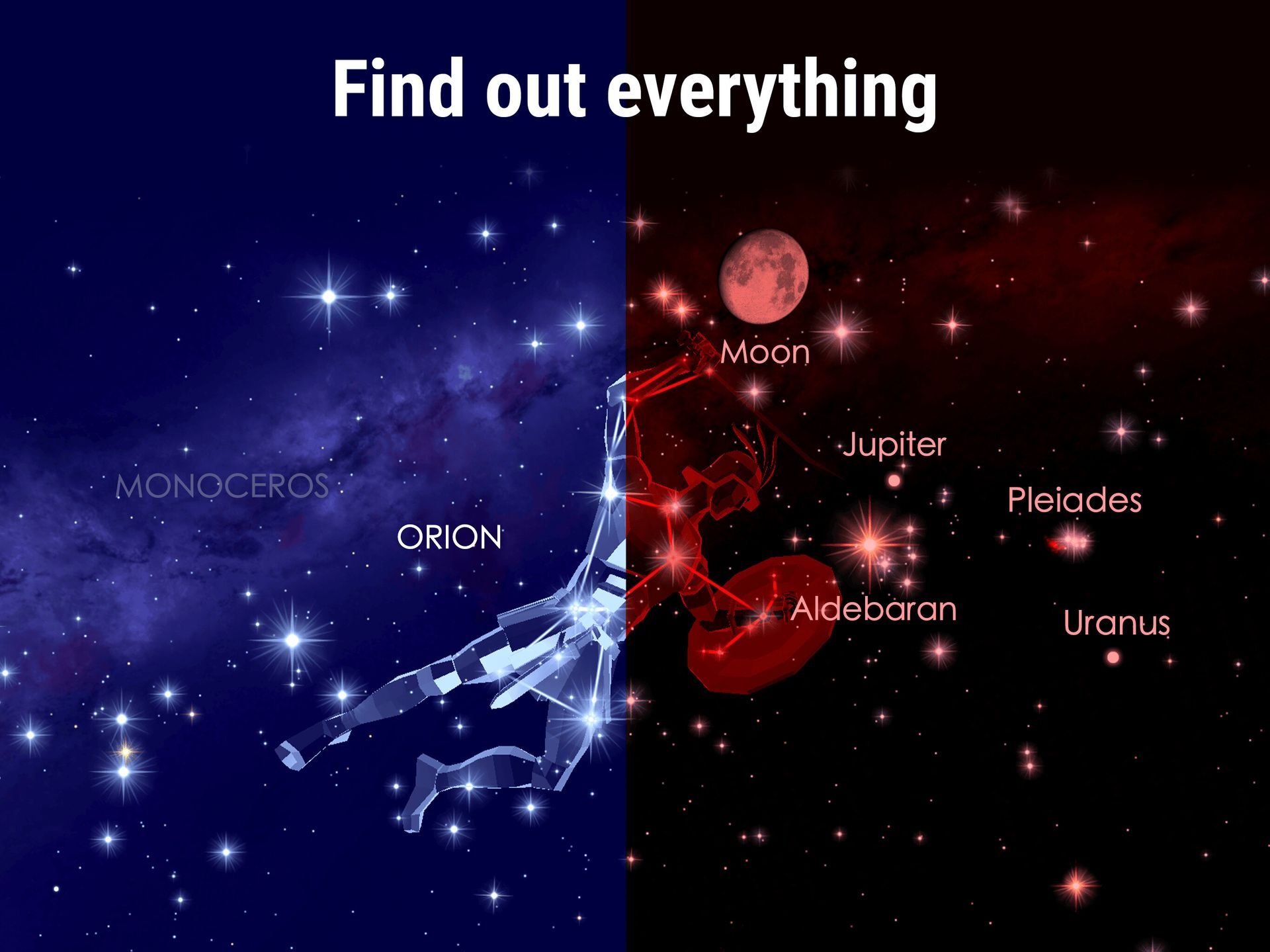
Star Walk 2 is what you’d get if a planetarium and an art studio had a child. It’s visually stunning, highly interactive, and made for users of all levels—from kids who just learned about the Moon to adults rediscovering the sky after years of city life.
The augmented reality (AR) mode lets you overlay constellations and planets onto the sky using your phone’s camera. You can fast-forward time to see how the stars shift, or dive deep into individual celestial objects to learn their distances, mythology, and visibility.
Why it shines:
- User-friendly interface with vibrant, 3D visuals
- AR sky maps and real-time tracking
- Educational content tied to astronomical myths
- Night mode for better dark sky viewing
- Best for: Beginners, families, educators, and visual learners.
Bonus Mention: NASA App
Available on: iOS and Android
Free
Not a sky map, but a space lover’s dream. The official NASA app offers real-time mission updates, launch coverage, HD images from space telescopes, and even live video feeds from the ISS. Think of it as your direct line to humanity’s space program.
In ancient times, understanding the sky required years of study, observation, and sometimes even building massive observatories. Today, it takes a swipe and a tap.
But while the tools have changed, the wonder remains the same.
These apps don’t replace the awe of seeing Saturn’s rings through a telescope or catching a shooting star in the quiet of the night. But they do amplify it. They help you notice the cosmos, name it, and, slowly, help you understand it.
Because in the end, astronomy isn’t just about stars and planets.
It’s about our place in a vast, unfolding story.
And now, with a device in your hand and curiosity in your heart, you’re part of it.
So tonight, step outside.
Look up.
And let the apps do the rest.