The Sky This Week, July 6 - July 12, 2026
Here's a paradox to start the week: on Monday, in the thick of northern summer, Earth drifts to its farthest point from the Sun all year. The sky has more practical offerings too. The last quarter Moon calls on Saturn, Venus finally catches Regulus after weeks of pursuit, and the waning crescent stages a beautiful dawn rendezvous with Mars and the Pleiades. By Sunday the Moon has nearly vanished, opening the door to the darkest skies of July. Here's what to look for, night by night.
Also Read: 9 night sky events to see in July 2026
July 6 — Earth at Aphelion, Farthest from the Sun
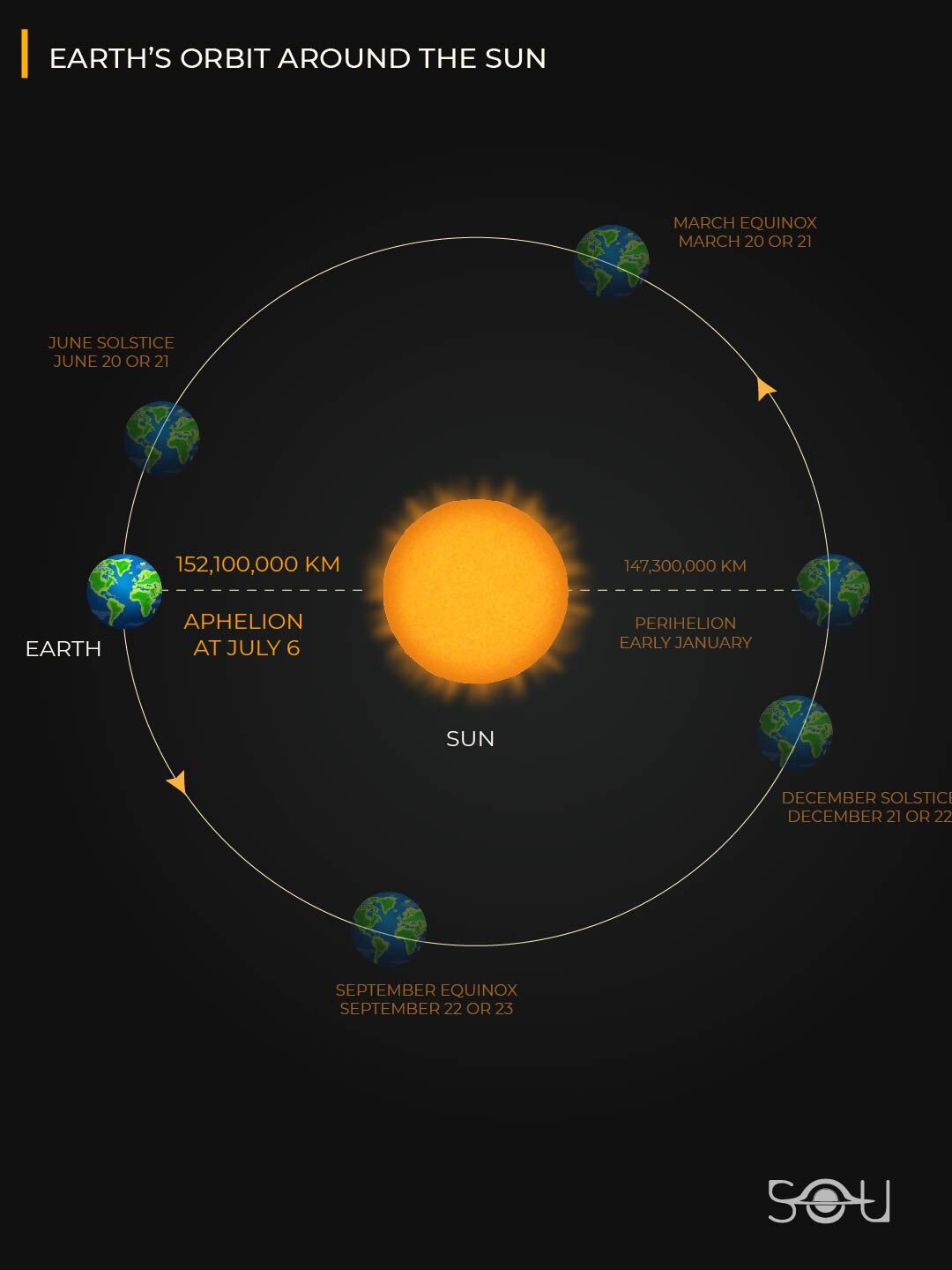
Earth's orbit around the Sun showing aphelion, perihelion, solstice and equinox
Earth reaches aphelion, its greatest distance from the Sun for the year, at 17 UTC on July 6, when it will be 152,087,774 kilometers from the Sun. That is about five million kilometers farther than at perihelion in early January, and it lands squarely in Northern Hemisphere summer, which settles an old classroom misconception for good: distance does not drive the seasons, axial tilt does.
Technically, this marks the moment when the Sun appears smaller in the sky than at any other time of year, and when Earth receives the least radiation from it, though the 3-percent shrinkage is invisible without instruments. There's nothing to observe tonight, but there is something to feel: every sunset this week, you are watching our star from the far end of the orbit.
The dates drift over centuries; in 1246 perihelion fell on the December solstice itself, and the alignment shifts by about a day every 58 years.
July 7 — The Last Quarter Moon Meets Saturn
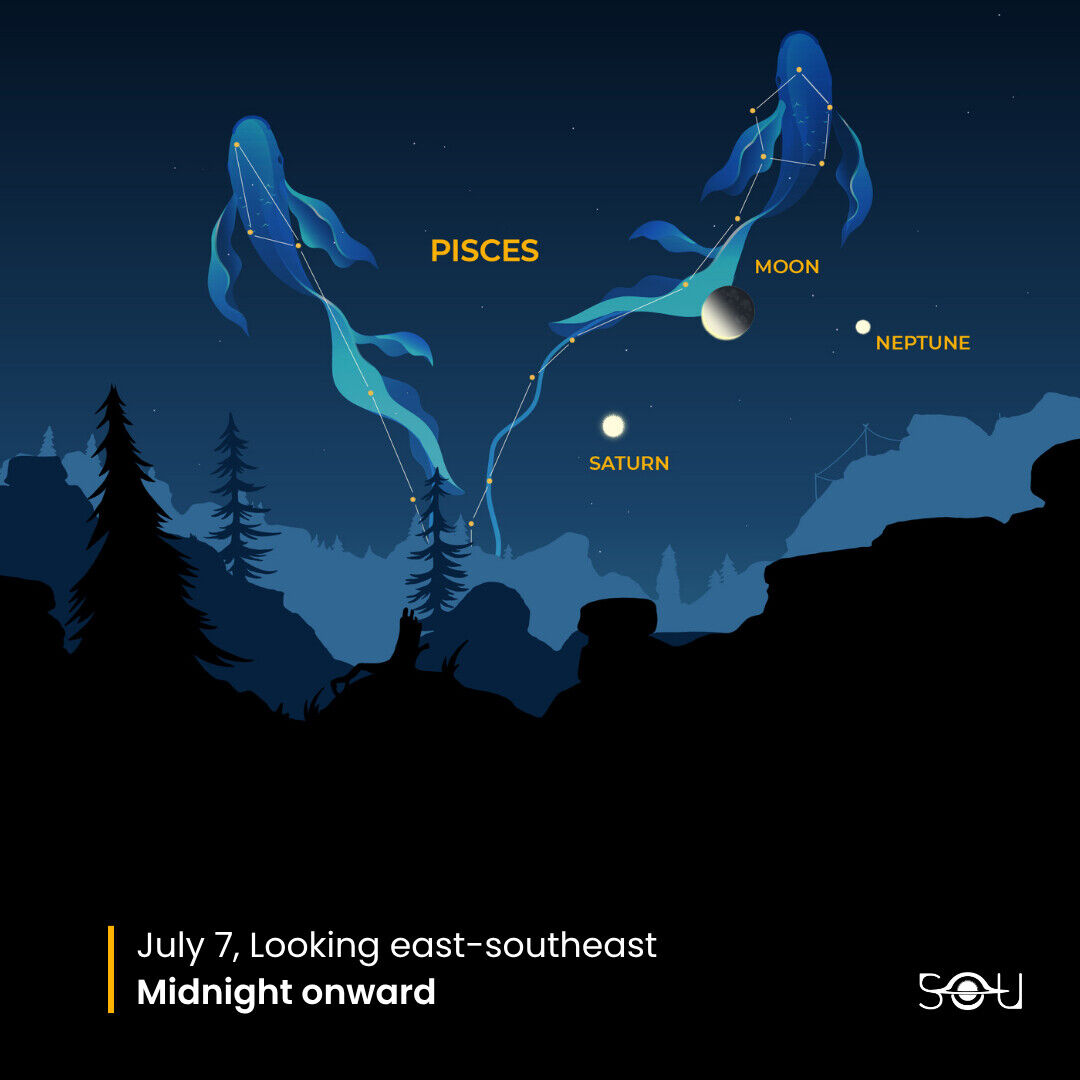
The Moon reaches last quarter today and marks the occasion with the ringed planet. The 51-percent-illuminated Moon stands close to Saturn, at magnitude 0.7, the distance between them 5 degrees 58 minutes, visible to the naked eye or through binoculars in Pisces.
The pair rises around midnight and climbs high into the southeast by dawn, with the Moon acting as an unmissable signpost to the planet. Take a telescope to both. The half-lit Moon throws its cratered terrain into sharp relief along the terminator, and Saturn's rings, opening wider month by month after their 2025 edge-on phase, are heading toward their best presentation at the October 4 opposition. Two of the solar system's finest sights, one eyepiece swing apart.
July 8 — Mercury's Exit, and a Morning Sky in Transition
Mercury is all but gone. The planet that dazzled at dusk in mid-June now sits deep in the evening twilight, plunging toward inferior conjunction on July 13, when it passes between Earth and the Sun. Don't bother hunting it; in two weeks it re-emerges at dawn for a modest morning showing.
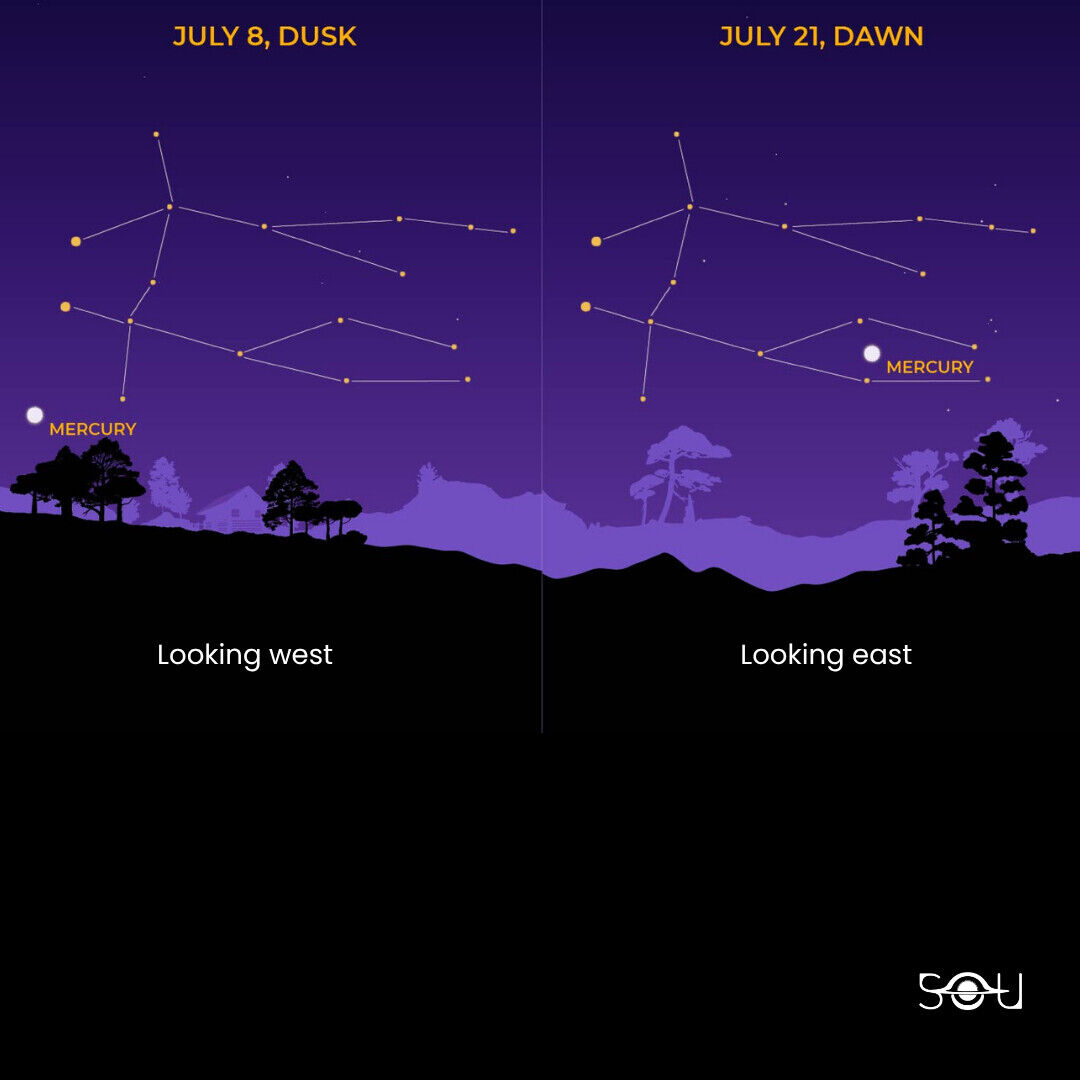
Mercury transitions from being an evening object to a morning object in July 2026
Tonight instead, take stock of a sky changing shifts. Venus alone commands the west after sunset. The midnight hours belong to the Summer Triangle overhead and Scorpius crawling across the south, its red heart Antares flanked by the naked-eye star clusters M6 and M7 near the stinger.
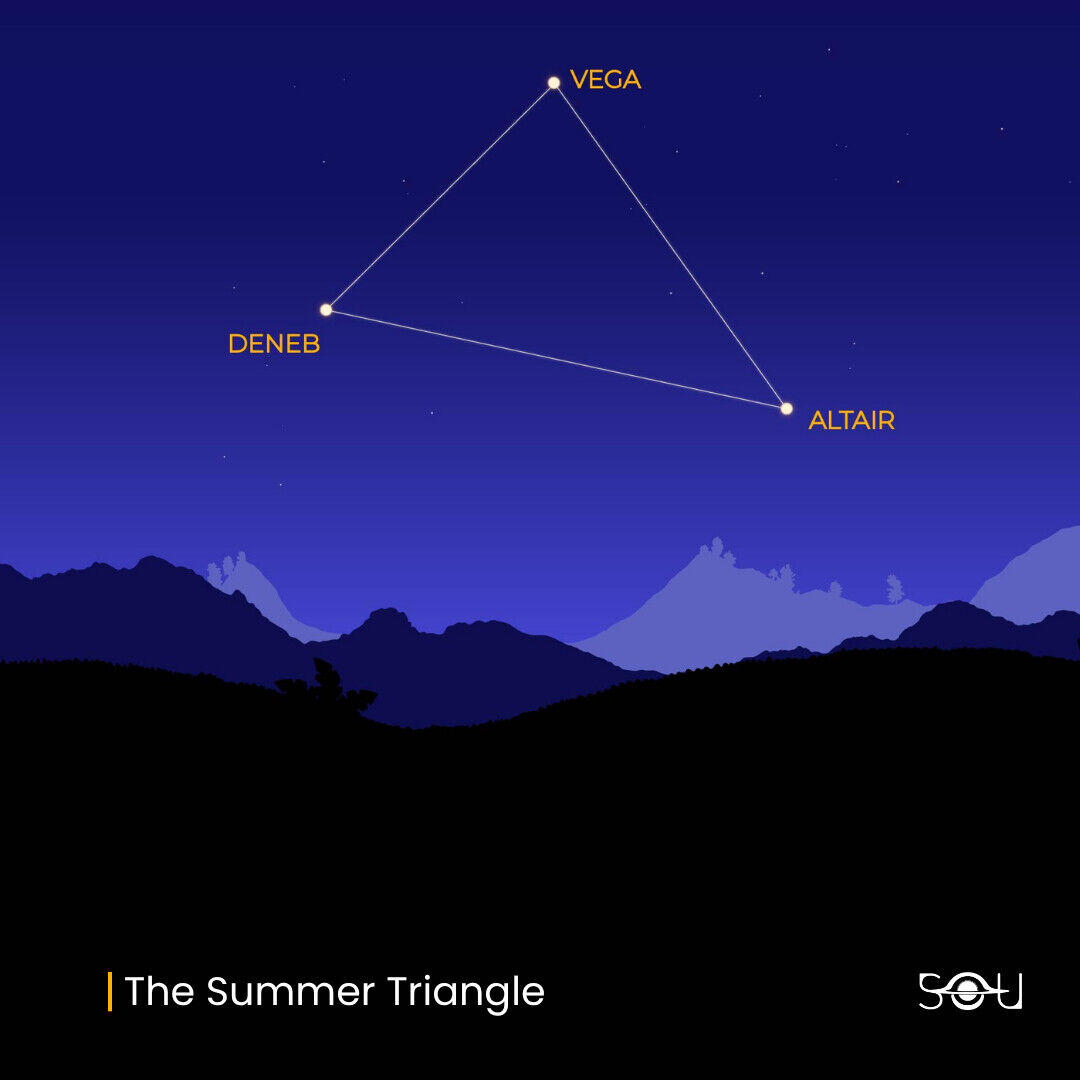
Summer Triangle, a prominent asterism of three stars — Deneb, Vega, and Altair
And the morning planets, Saturn, Mars, and now Uranus, keep gaining altitude. The year's pivot from evening to morning astronomy is underway.
July 9 — Venus Kisses Regulus
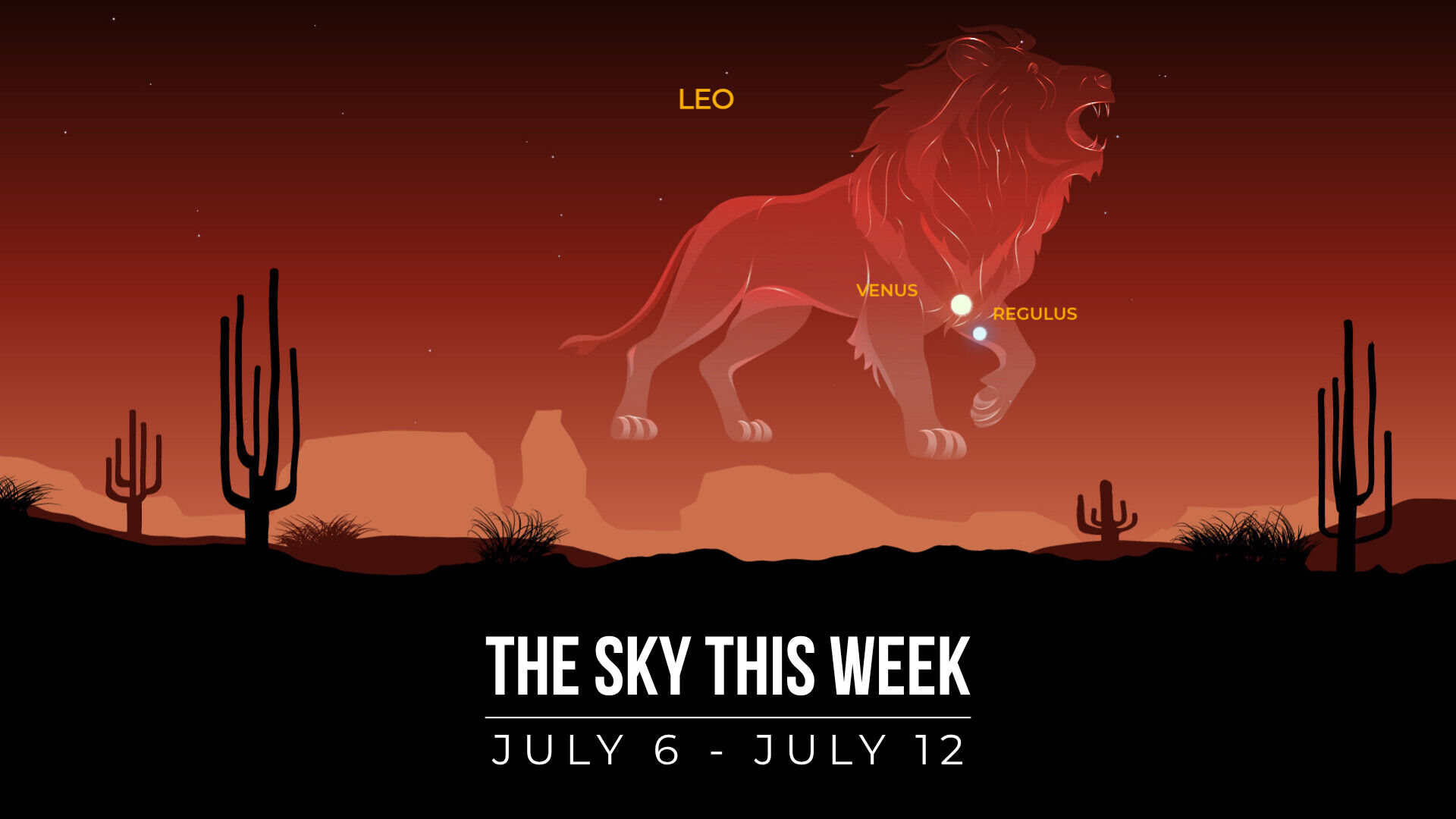
The pursuit ends tonight. Venus, at magnitude minus 4.1, passes close to the star Regulus, magnitude 1.3, in Leo, the distance between them 0 degrees 58 minutes, both visible to the naked eye. Just under a degree apart, a fingertip at arm's length covers them both.
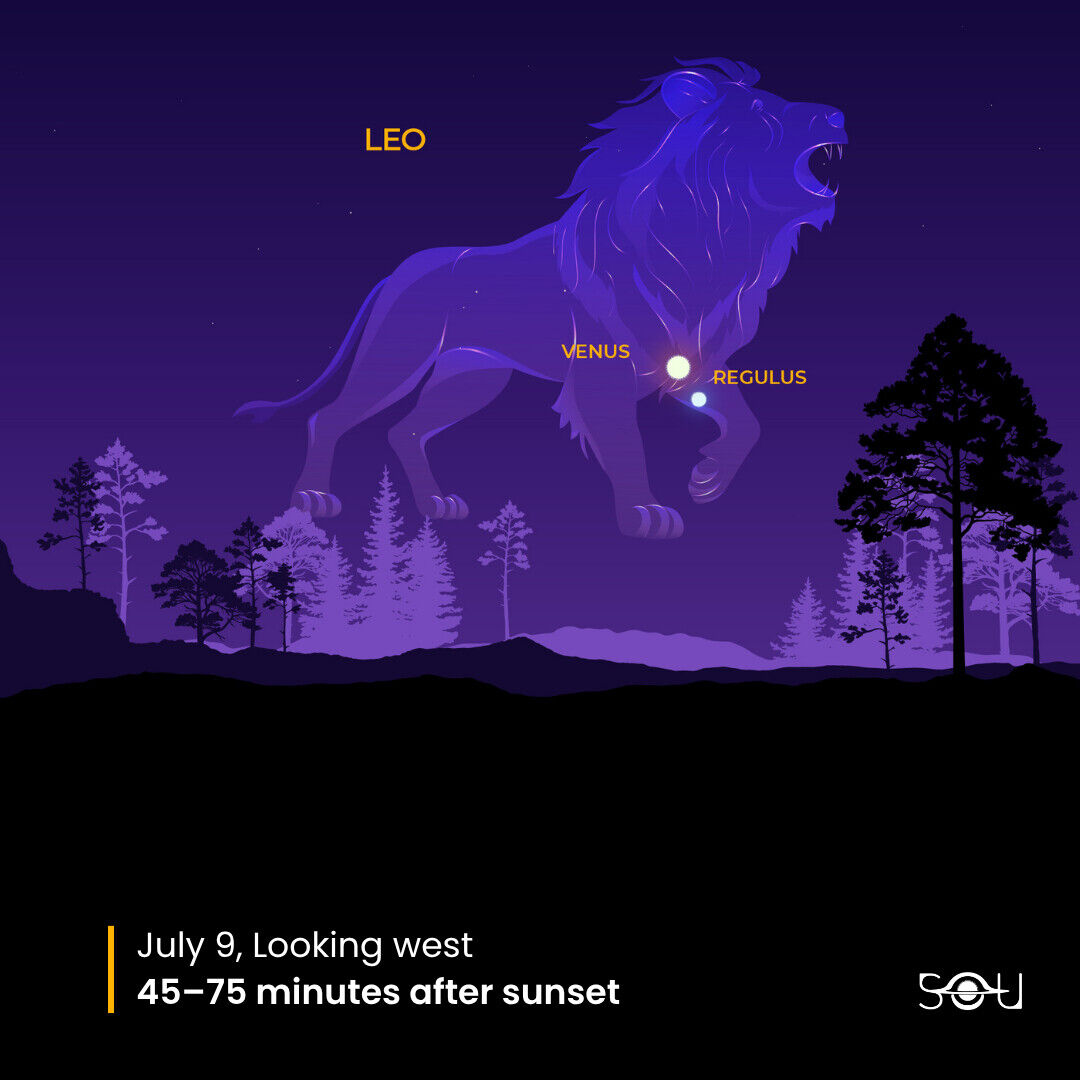
Venus glides past Regulus on July 9, 2026
The contrast is the spectacle: Venus outshines Regulus by roughly a hundredfold, a world of reflective cloud against the blue-white furnace marking the Lion's heart, 79 light-years behind it. Regulus is itself remarkable, spinning so fast it bulges at the equator and completes a rotation in under 16 hours.
Look west starting 45 minutes after sunset, when the sky darkens enough for Regulus to surface beside the blazing planet. Binoculars frame the pair perfectly. The two stay within a few degrees of each other for several evenings, so clouds tonight are not a catastrophe.
July 10 — The Crescent Moon Slides Into the Pleiades' Neighborhood
Set the alarm for the dawn shift. The 17-percent-illuminated Moon stands close to the Pleiades star cluster, the distance between them just 1 degree 3 minutes, in Taurus. A slim crescent pressed almost against the most famous cluster in the sky is one of the prettiest sights the Moon ever offers, and binoculars elevate it further, revealing earthshine on the lunar night side and dozens of Pleiades members spilling around it.
Look east about 90 minutes before sunrise. Mars glimmers a few degrees below, a preview of tomorrow's gathering.
July 11 — Moon, Mars, and the Pleiades Together at Dawn
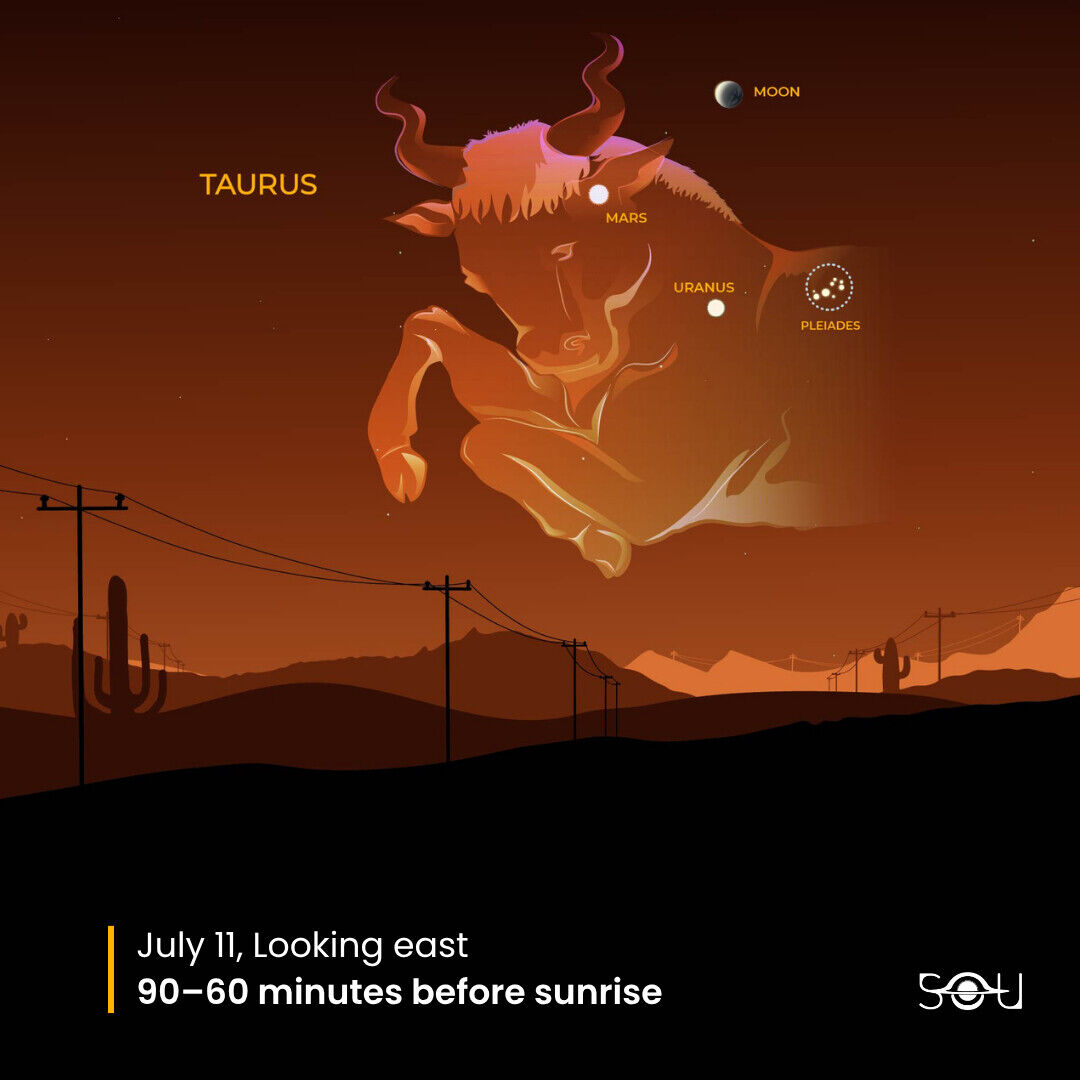
This is the week's postcard. Before dawn on July 11, a slender crescent Moon, about 15 percent illuminated, Mars at magnitude 1.4, and the Pleiades star cluster meet in the constellation Taurus, all three visible to the naked eye, with binoculars recommended to reveal the cluster as a shimmering group of stars.
The trio fits in a single binocular field low in the east-northeast, the kind of compact, layered scene that rewards photographers: a crescent with earthshine, a red planet, and a blue cluster stacked within a few degrees. There's a hidden fourth member too. On July 11, the 15-percent-illuminated Moon also stands close to Uranus, at magnitude 5.8, lurking in the same patch of Taurus for those with optics and patience.
Haze hugs the horizon in many regions this time of year, so altitude and an open eastern view help.
July 12 — The Door Opens to Dark Skies
The Moon is now a fading sliver rising just before the Sun, which means the evening and midnight sky belongs entirely to the stars. This is the night to go somewhere genuinely dark. The Milky Way's core region in Sagittarius and Scorpius stands at its highest in the late evening, the Teapot's spout pouring star clouds toward the zenith through Aquila and Cygnus.
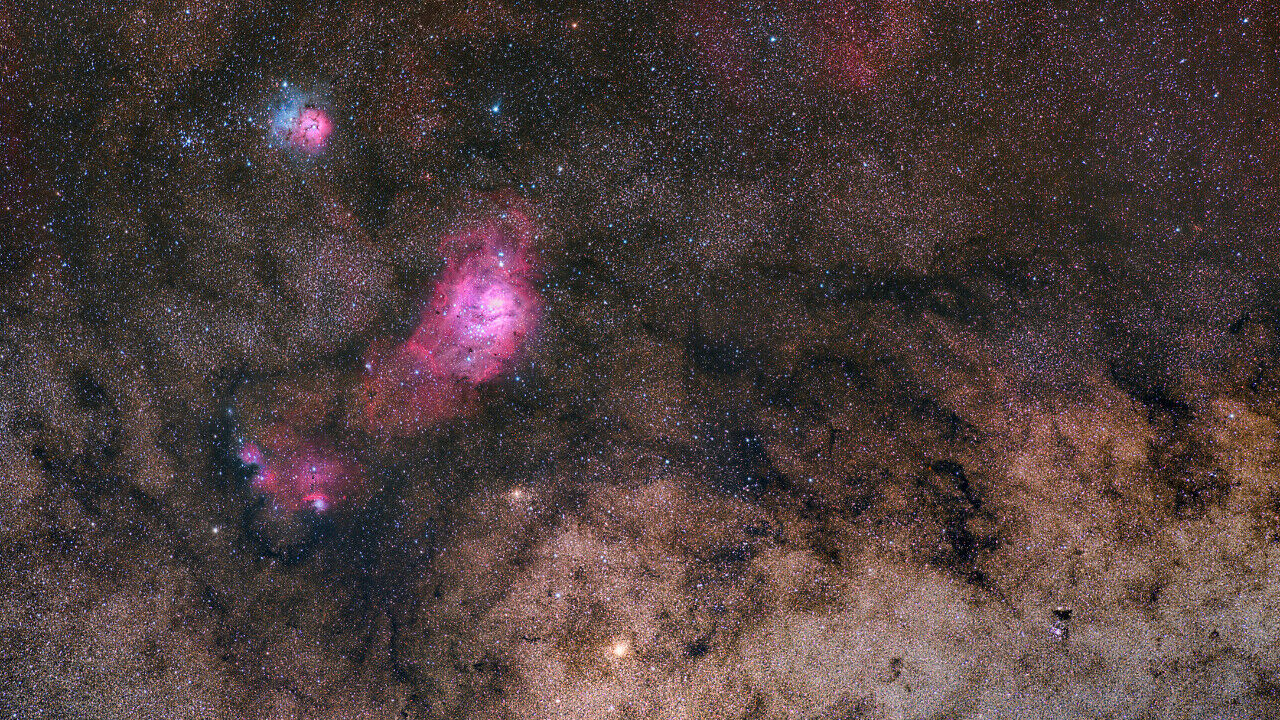
Starfield around the Sagittarius constellation showing three bright nebula: Lagoon Nebula (M8), Trifid Nebula (M20) and NGC 6559. The Lagoon nebula is at centre, the Trifid nebula at upper left, and NGC 6559 at centre left. The red regions are emission nebulae, or clouds of gas ionised by the radiation from hot young stars within them, causing them to glow.
Sweep the area with binoculars and you stumble over showpieces without trying: the Lagoon Nebula, the Swan and Eagle Nebulas in Serpens, the great Sagittarius star cloud M24.
From the Southern Hemisphere, where the galactic center passes overhead on July evenings, the view is simply the finest the night sky offers anywhere. The new Moon arrives July 14; this weekend opens the month's best observing window.
Next week, Mercury passes between Earth and the Sun on July 13 while Mars slips just 5.3 degrees from Aldebaran, the new Moon on July 14 delivers peak summer darkness, and a young crescent returns to the evening sky beside brilliant Venus.