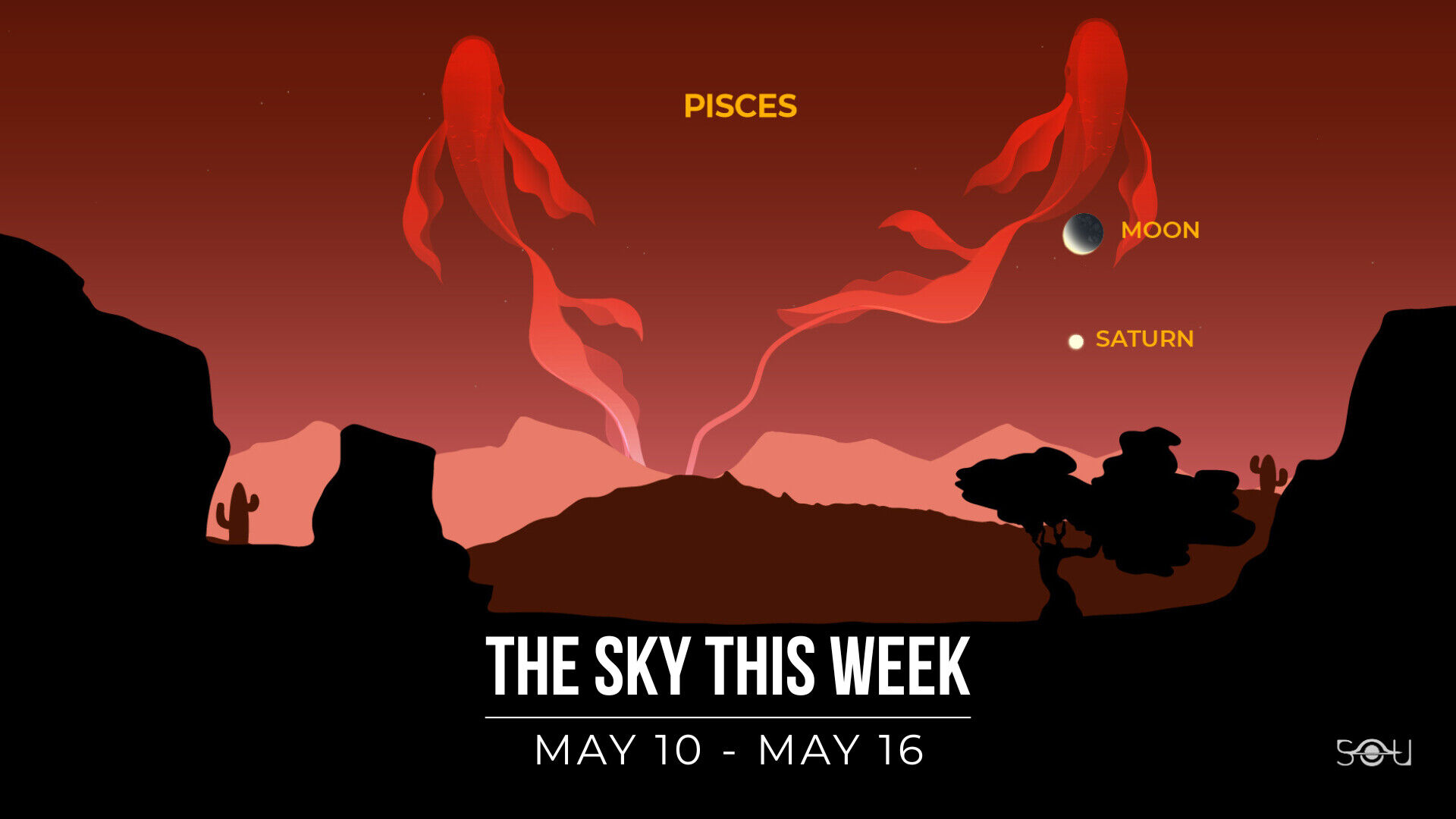
The Sky This Week, May 10 - May 16, 2026
This week, the Moon thins into a predawn crescent, Saturn and Mars return to view before sunrise, Venus slips between the horns of Taurus after sunset, and the sky falls into darkness as May’s new Moon arrives. For observers with access to dark skies, it is also the week when the Milky Way begins to feel like a season again. Here’s what to look for, night by night.
Read the full report on night sky events in May 2026 here
May 10–16 — Milky Way Season Returns
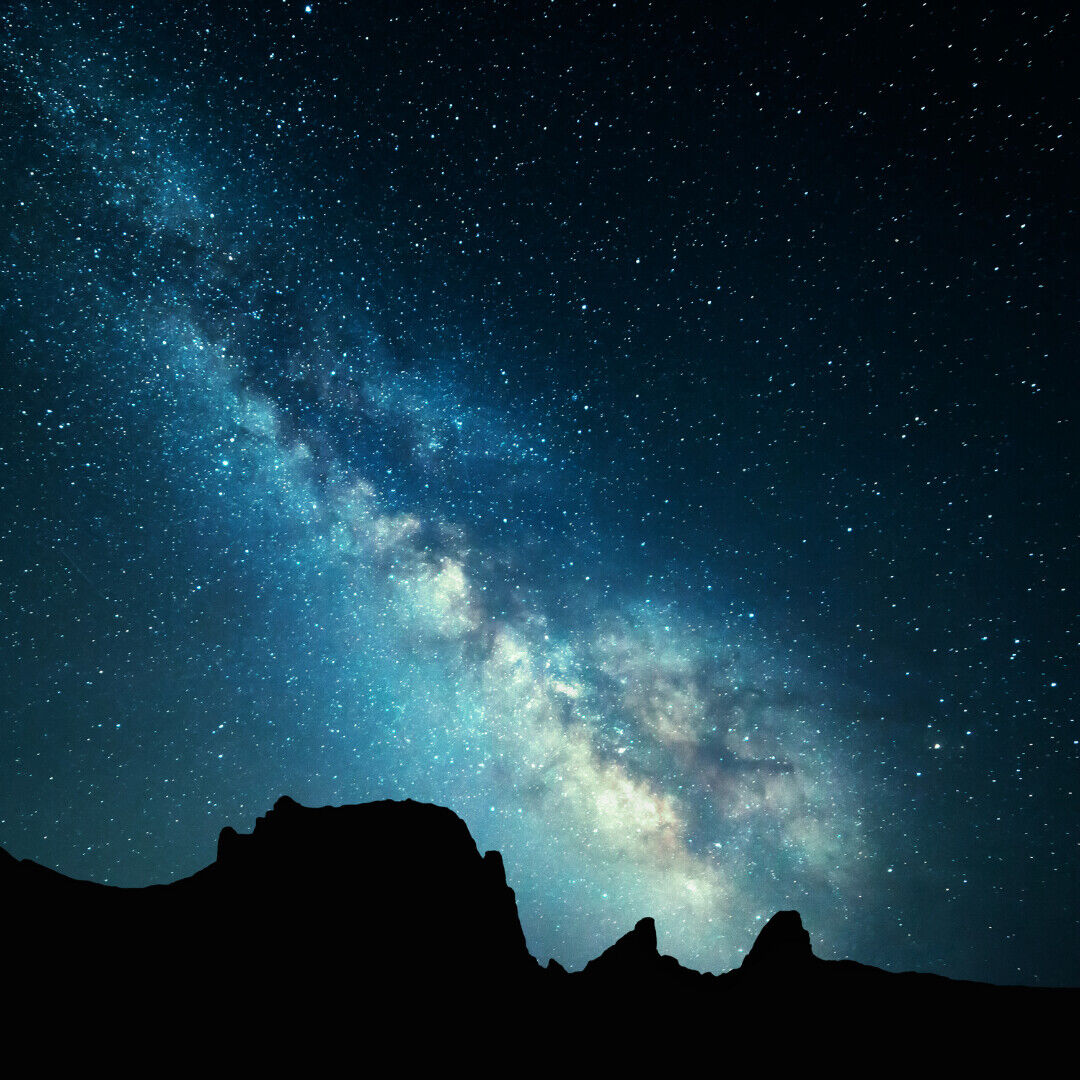
The Milky Way Season Returns
By mid-May, the Moon is fading from the evening sky, and that changes what the night can show.
For Northern Hemisphere observers, May marks the beginning of the better Milky Way season. The bright central regions of our galaxy still rise late, but after midnight — and especially in the hours before dawn — the Milky Way begins to climb across the southeastern sky. From dark rural locations, its dusty lanes become easier to trace, stretching upward from Sagittarius and Scorpius as summer approaches.
For Southern Hemisphere observers, the view is even richer. The galactic center climbs higher and earlier, and the dense star fields around Scorpius and Sagittarius are far better placed. From places with little light pollution, the Milky Way can appear not as a faint band, but as a textured river of starlight, crossed by dark clouds of interstellar dust.
The best nights this week come closer to the new Moon, especially from May 13 onward, when moonlight becomes less intrusive. You will need a dark sky, patience, and time for your eyes to adapt. A camera will reveal far more than the eye, but even without one, this is the week when the galaxy begins to return.
May 12–15 — Venus Threads Taurus’ Horns
While the Milky Way waits for the darker hours, the early evening belongs to Venus.
From May 11 to 15, Venus passes between the horn stars of Taurus: Elnath, the northern horn, and Zeta Tauri, the southern horn. Look west-northwest about an hour after sunset. Venus will be impossible to miss, shining through twilight as the brightest starlike object in the evening sky. On May 13, it sits between the two horn stars; by May 14, it has moved closer to Zeta Tauri.
The sight is subtle but elegant. Taurus itself is setting, its familiar shape sinking into the western horizon, while Venus moves eastward night by night. The planet is also closing its gap with Jupiter, which remains higher in the western sky. Their motion will become more obvious later in May, building toward a much closer Venus–Jupiter conjunction on June 9.
No telescope is needed. This is a naked-eye event, best appreciated as a slow celestial motion: return to the same spot for several evenings, and Venus will appear to step across the Bull’s horns.
Download one of these space apps to easily locate all the planets according to your place.
May 13 — The Moon Meets Saturn
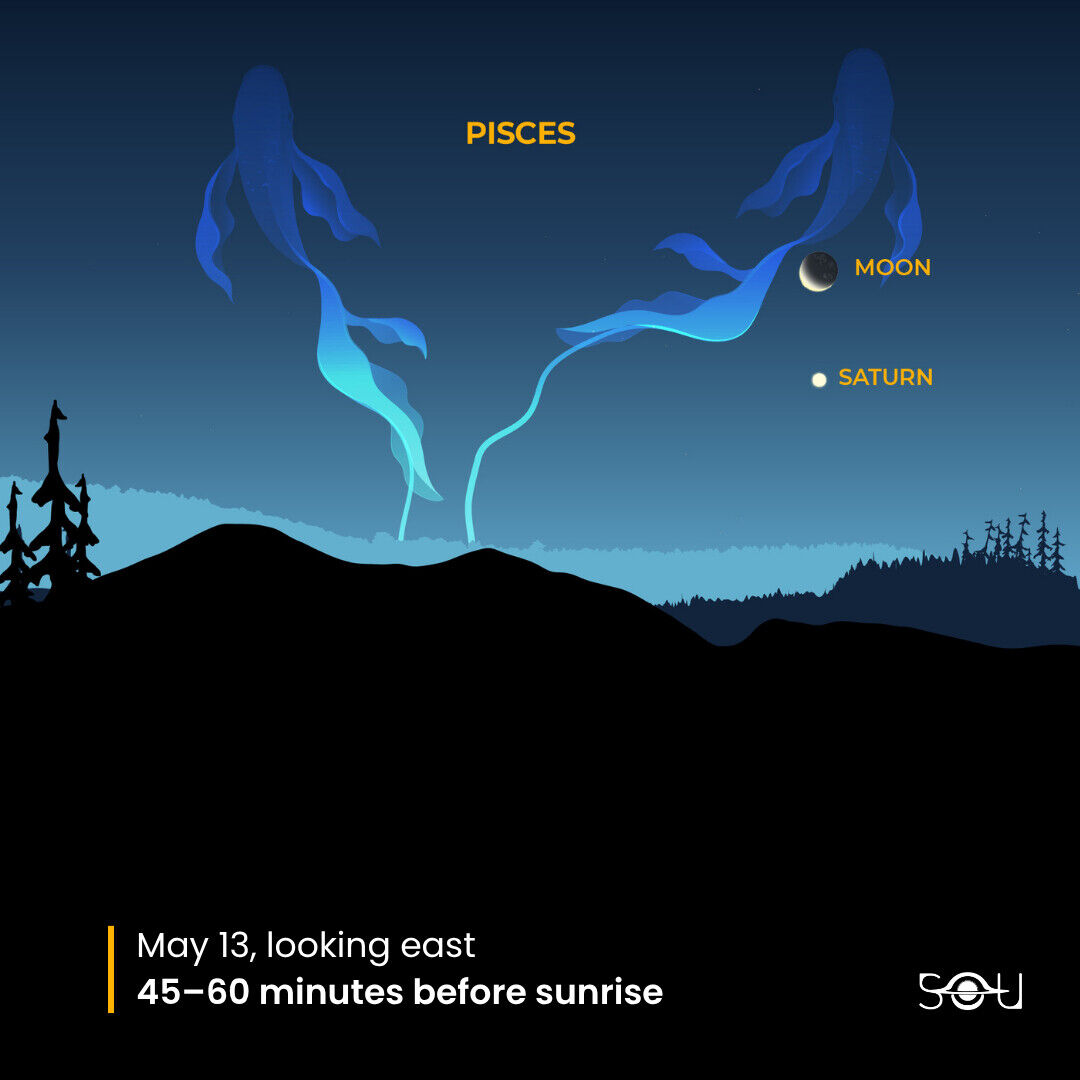
The Moon glides past Saturn in the eastern predawn sky on May 13, 2026
Before sunrise on May 13, a thin waning crescent Moon appears low in the eastern sky near Saturn. The closest approach occurs at 17:33 UTC (1:33 p.m. EDT), followed by conjunction at 21:58 UTC (5:58 p.m. EDT), but for skywatchers, the best view comes in the local predawn sky, about an hour before sunrise.
Saturn will not yet be high or dramatic. It is only beginning to return after solar conjunction, so the view requires a clear eastern horizon. The Moon, about 16 percent illuminated around this date, acts as a guide, making the ringed planet easier to identify in the brightening morning twilight.
Mars is nearby too, though fainter and harder to pick out, especially through haze or low-altitude twilight. From lower latitudes and the Southern Hemisphere, the geometry is more forgiving; from higher northern latitudes, the scene stays lower and more challenging.
May 14 — The Moon Meets Mars
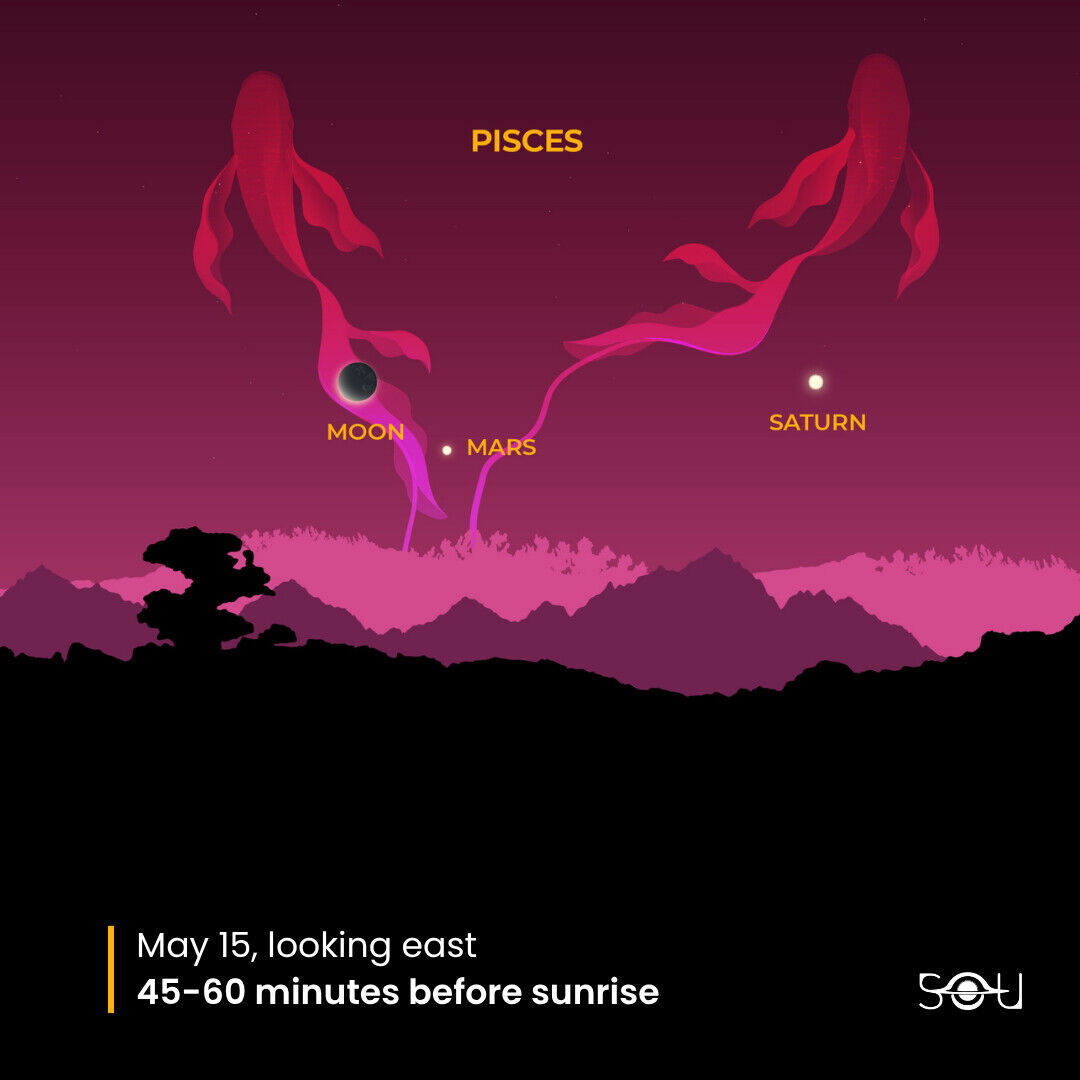
The Moon glides past Mars in the eastern predawn sky on May 14-15, 2026
The following morning, the Moon shifts closer to Mars. The closest approach occurs at 21:06 UTC (5:06 p.m. EDT) on May 14, with conjunction following at 00:44 UTC on May 15 (8:44 p.m. EDT on May 14). Again, the exact moment is not the observing moment for most people; the visual scene belongs to the predawn sky on May 14 and 15.
Mars is still modest this month, shining around magnitude 1.3 and sitting low before sunrise. It will not look like the brilliant orange planet people remember from opposition seasons, but its warm tone can still separate it from nearby stars if the sky is clear. Saturn remains in the same broad region, giving observers a compact morning lineup of the Moon, Mars, and Saturn.
This is not a spectacle in the dramatic sense. It is a quiet early-morning arrangement — the kind of event that rewards those who step outside before the day begins.
May 12–16 — The Earthshine Window
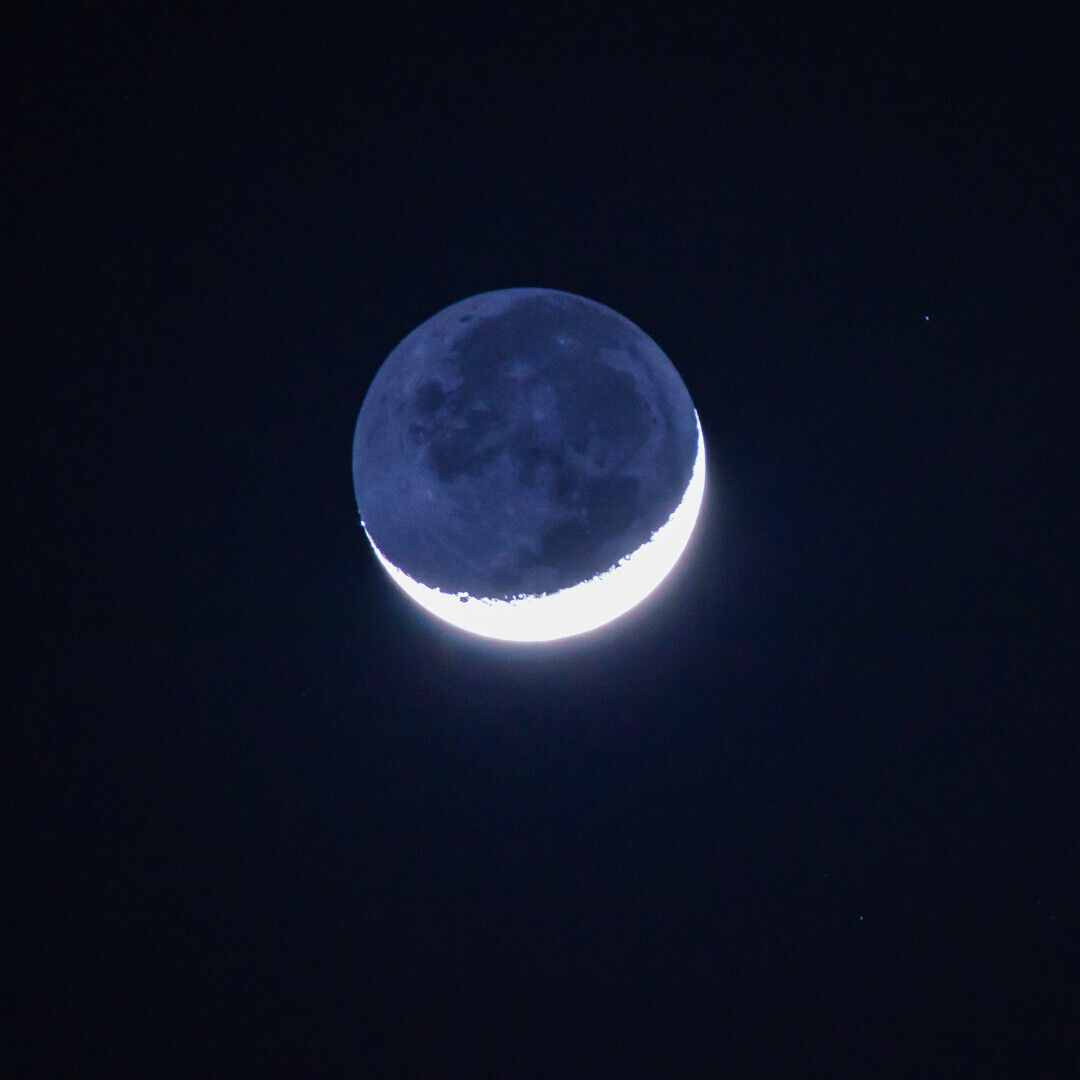
Earthshine, also known as the Da Vinci glow
As the Moon wanes toward new phase, its sunlit crescent becomes thinner each morning. That makes this week a good time to look for earthshine, sometimes called the Da Vinci glow: the faint illumination on the Moon’s night side caused by sunlight reflecting off Earth and back onto the lunar surface.
This week’s best opportunities come before sunrise from about May 12 to 15, when the waning crescent Moon is visible low in the eastern sky. The effect is subtle — a ghostly outline of the whole Moon wrapped around a bright silver crescent. Binoculars can make it more striking, but the naked eye is enough under clear skies.
Earthshine is one of the most beautiful examples of astronomy hiding in plain sight. You are seeing the Moon lit not directly by the Sun, but by Earth itself — our planet acting as a mirror in space.
May 16 — New Moon
The Moon reaches new phase on May 16 at 20:01 UTC (4:01 p.m. EDT). At new Moon, the lunar disk lies near the Sun in the sky and is generally invisible to observers on Earth.
For skywatchers, the importance of new Moon is darkness. With moonlight removed, faint objects become easier to see: galaxies, nebulae, star clusters, and the wider structure of the Milky Way. This is the best deep-sky window of the week, especially for observers who can reach rural skies.
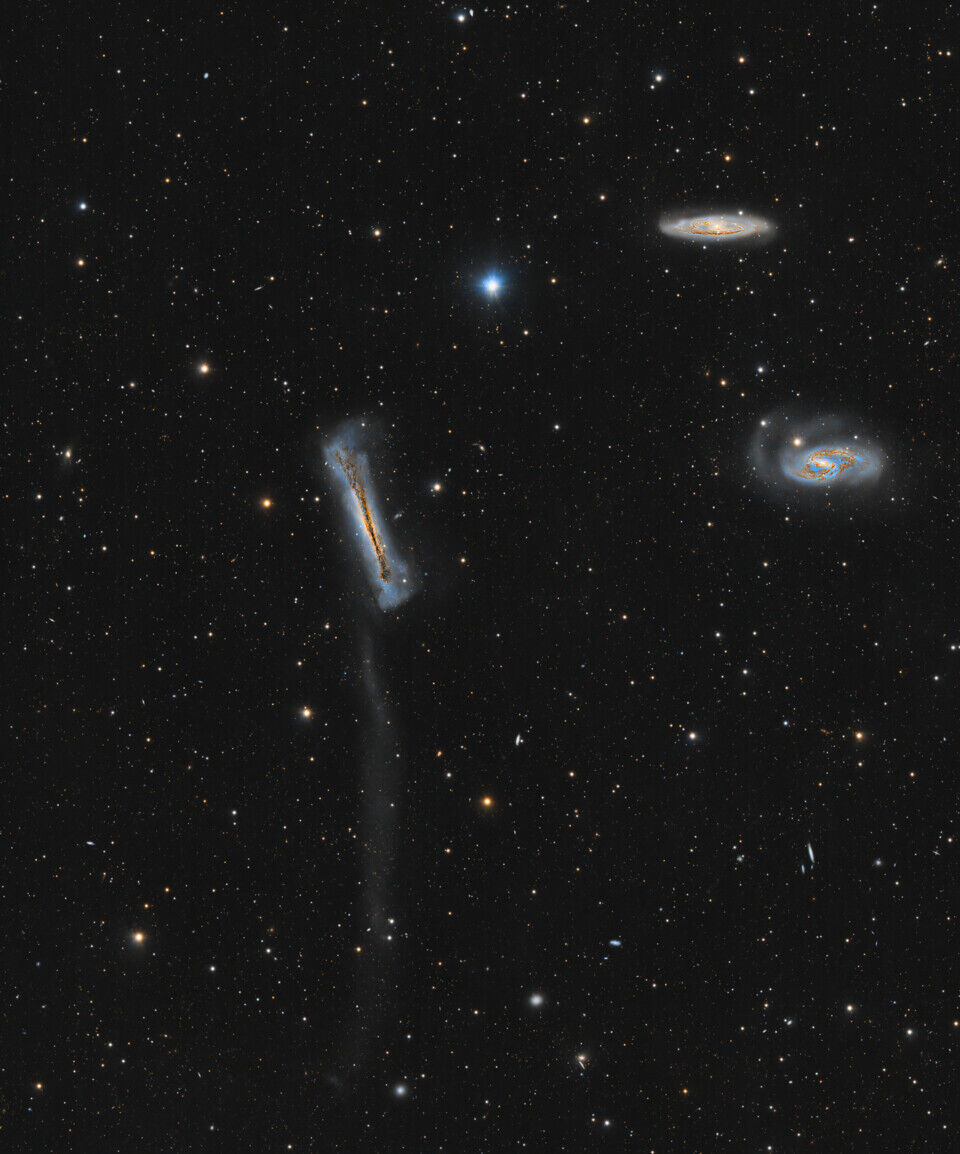
This is the Leo Triplet with the Hamburger Galaxy sporting a nice tail (which spans 300,000 light-years long) by amateur astronomer Chuck Ayoub. Target: Leo Triplet Imaging Telescope: Celestron RASA (400 focal length) Focuser: Celestron Electronic Focuser Mount: Sky-Watcher EQ6-R Pro Imaging Camera: ZWO ASI533MC Color Total Exposure Time: 16 hours
In the Northern Hemisphere, spring galaxies remain well placed in the evening, especially in Leo, Virgo, Coma Berenices, and Canes Venatici. Later in the night, the Milky Way rises stronger. In the Southern Hemisphere, the galactic center is already becoming a showpiece, climbing higher into the night and offering some of the richest naked-eye star fields on Earth.
New Moon is not something to watch directly. It is an invitation to watch everything else.
Next week, the Moon returns to the evening sky as a young crescent, passing Venus and Jupiter while the two brightest planets continue closing in on their dazzling June conjunction.