10 Night Sky Events to Watch in May 2026 — From Halley’s Meteors to a Blue Micromoon
May 2026 belongs to the Moon.
The month opens with a micromoon, closes with another micromoon, and in between, it threads itself past some of the brightest markers of the night: Antares, Saturn, Mars, Venus, Jupiter, and Regulus. Add the Eta Aquariid meteor shower, dust from Halley’s Comet entering Earth’s atmosphere, and May becomes one of the most rewarding months of the year for casual skywatchers.
Before we begin, make sure to download one of these space apps so that you can easily locate the planets, stars, and constellations according to your location.
May 1 — The Micro Flower Moon
May begins with a full Moon, but not an ordinary one.
The Moon reaches its full phase on May 1 at 17:23 UTC (1:23 p.m. EDT). This is the first of two full Moons in May 2026, and it occurs only a few days before lunar apogee, the point in the Moon’s orbit when it is farthest from Earth. As a result, this full Moon is a micromoon, appearing slightly smaller and dimmer than an average full Moon.
The difference is subtle to the unaided eye. No one looking up casually will see the Moon suddenly shrink. But physically, the geometry is real: a micromoon sits farther from Earth, reducing its apparent size and brightness compared with a closer full Moon.
The May full Moon is traditionally known as the Flower Moon, a name tied to the abundance of wildflowers blooming across North America at this time of year. For the Northern Hemisphere, it is a spring Moon. For the Southern Hemisphere, it rises during autumn, carrying the same astronomical meaning but a very different seasonal feeling.
When & Where: Rises around sunset on May 1 and remains visible through the night.
Best View: Global.
Gear: None required.
May 3-4 — The Moon Meets Antares
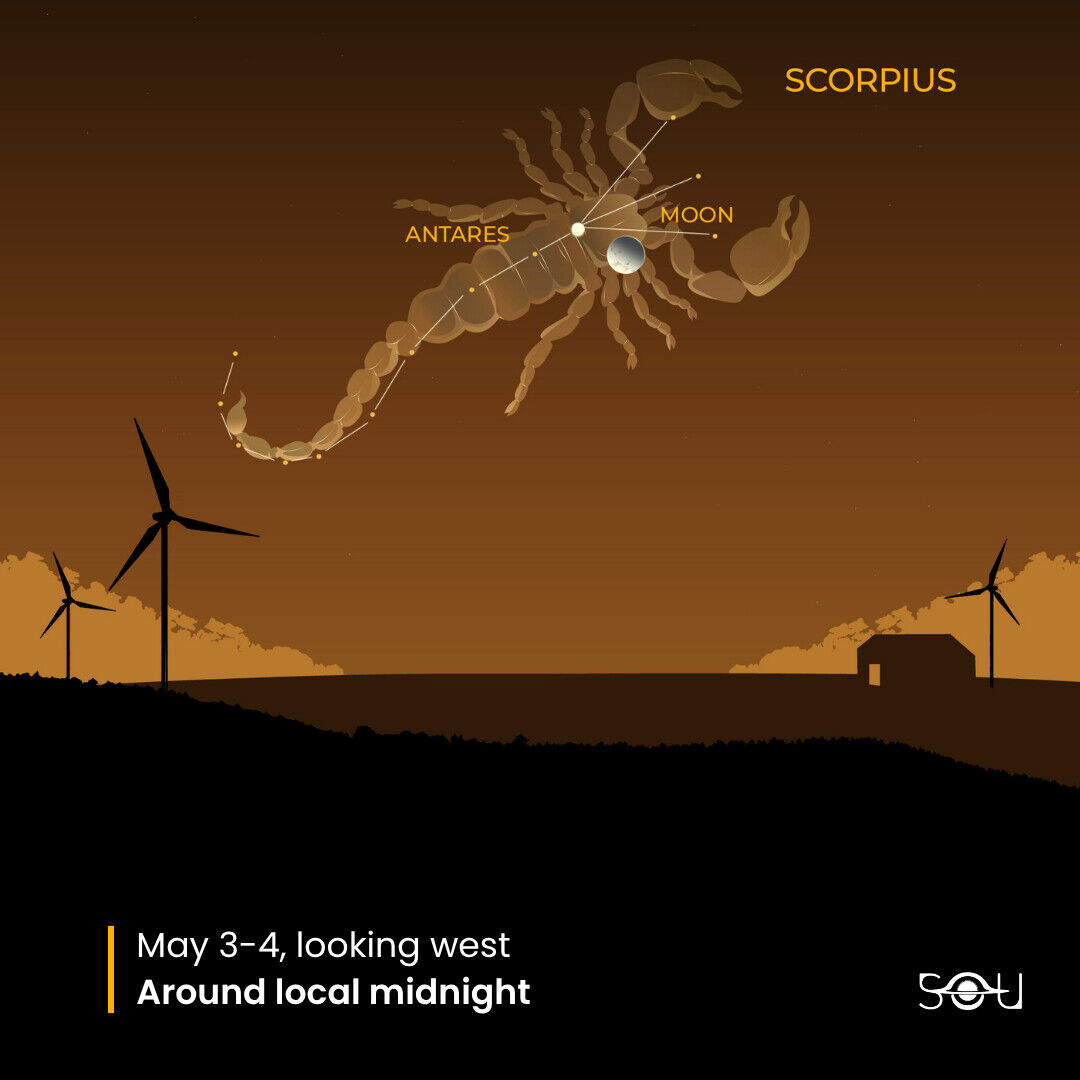
The Moon glides past Antares in Scorpius on May 3, 2026
On May 4, the waning gibbous Moon passes close to Antares, the bright red heart of Scorpius. The closest approach occurs around 02:20 UTC (10:20 p.m. EDT on May 3), with the Moon passing about half a degree from the star.
Antares is one of the most recognizable stars of the warm-season sky in the Northern Hemisphere and a commanding presence in Southern Hemisphere skies. Its reddish color comes from its nature as a red supergiant — a star so large that if placed at the center of our solar system, it would extend far beyond the orbit of Mars.
When & Where: Late evening of May 3 in the Americas; May 4 elsewhere. Look toward Scorpius.
Best View: Better from southern and tropical latitudes, where Scorpius climbs higher.
Gear: Naked eye; binoculars improve the contrast.
May 5–6 — The Eta Aquariid Meteor Shower Peaks
The Eta Aquariids are one of the great gifts of Halley’s Comet.
Each May, Earth passes through debris left behind by the famous comet, and tiny grains of dust burn up in our atmosphere as swift meteors. The shower is active from about April 19 to May 28, with peak activity around May 5–6. In 2026, the predicted peak falls near 08:00 UTC on May 5 (4:00 a.m. EDT), though the mornings around May 5 and 6 are both worth watching.
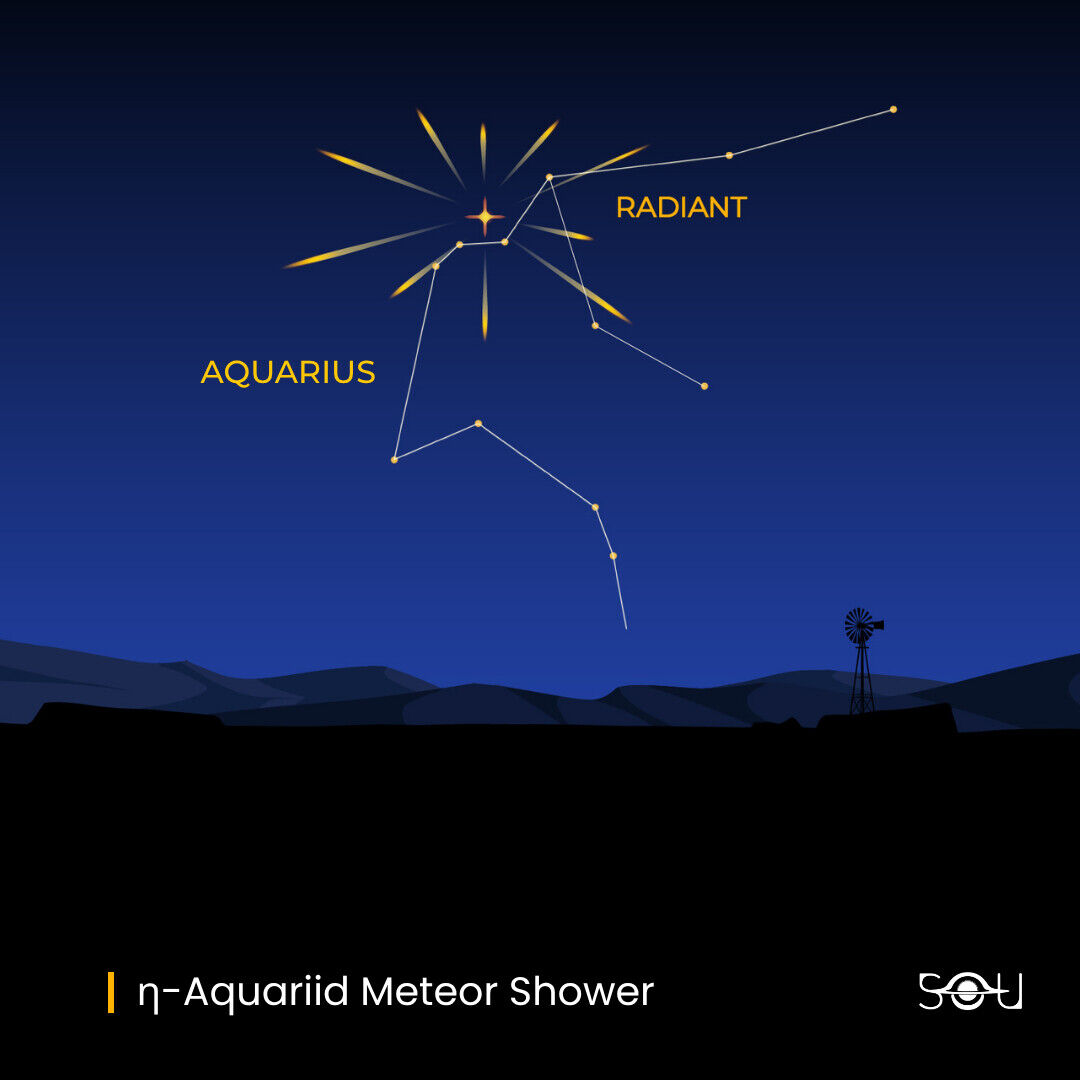
The radiant of the Eta-Aquariid Meteor Shower lies in the constellation Aquarius
This shower strongly favors the Southern Hemisphere. From the equator to about 30° south latitude, the radiant in Aquarius climbs higher before dawn, allowing more meteors to appear across the sky. Under ideal conditions, the Eta Aquariids can produce around 50 meteors per hour. From mid-northern latitudes, the radiant stays lower, so observed rates are usually much lower.
There is one important caveat in 2026: moonlight. A waning gibbous Moon will brighten the sky around the peak, washing out some fainter meteors. The best strategy is to observe in the darkest available location and place the Moon behind a building, tree, or hill if possible.
When & Where: Predawn hours of May 5 and 6; look broadly across the sky, not directly at Aquarius.
Best View: Southern Hemisphere and tropical latitudes.
Gear: None. Lie back, give your eyes 20–30 minutes to adapt, and avoid phone screens.
May 13 — The Moon Meets Saturn
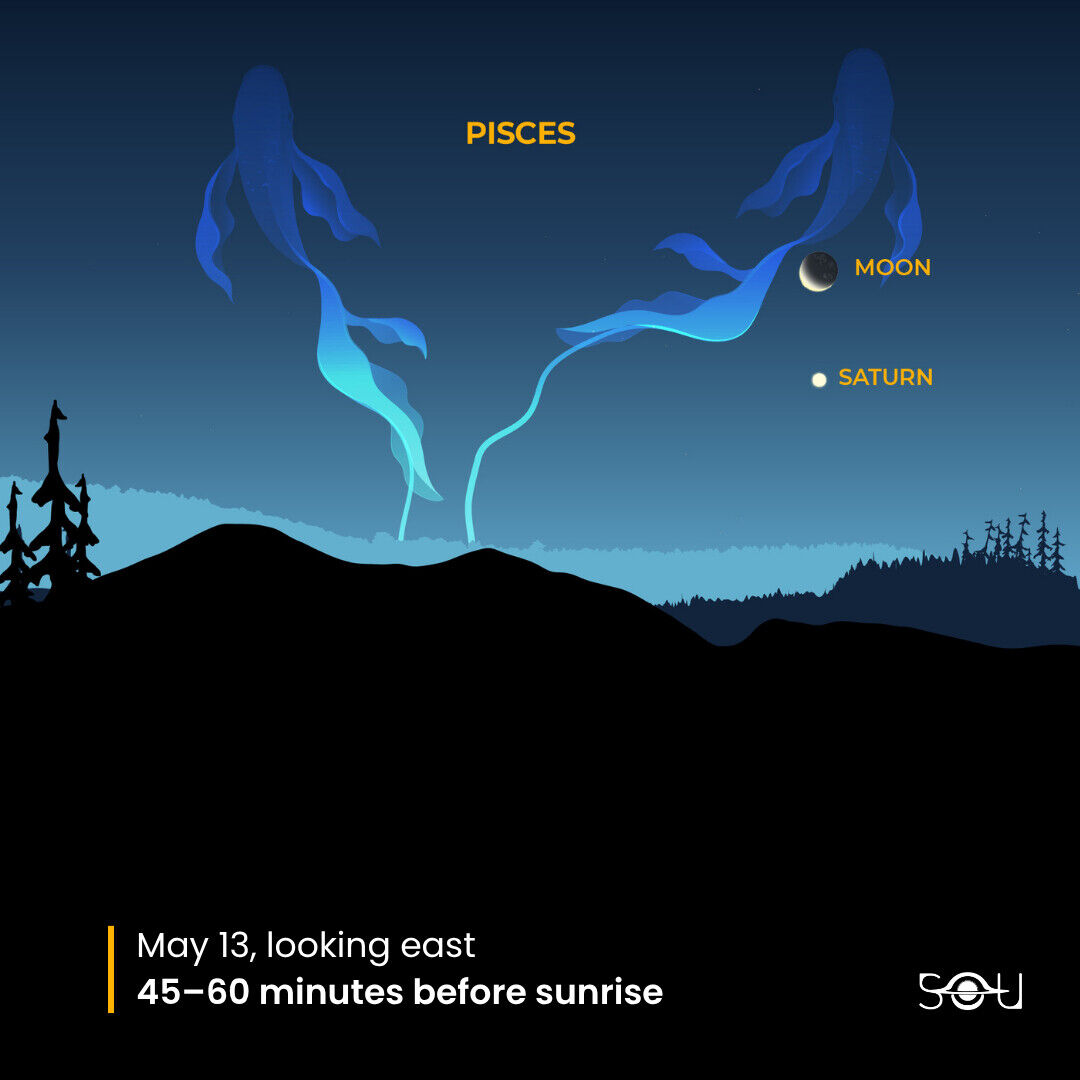
The Moon glides past Saturn in the eastern predawn sky on May 13, 2026
By mid-May, Saturn is returning to the predawn sky.
On May 13, a thin waning crescent Moon passes near Saturn, close to the border region of Cetus and Pisces. Saturn will not yet be a dominant evening object; this is a quiet, early-morning event, best seen low in the eastern sky before sunrise.
The Moon will be only a slim crescent, making the scene more delicate than dramatic. For observers with a clear eastern horizon, Saturn will appear as a steady, pale point of light near the Moon. Through a telescope, its rings are visible, though in 2026 they appear relatively narrow because Earth is viewing the ring plane at a shallow angle.
Southern Hemisphere observers may get a slightly more favorable view of this predawn region than many northern observers, where the planets sit lower in morning twilight.
When & Where: Eastern predawn sky, about 45–60 minutes before sunrise.
Best View: Clear eastern horizon; somewhat better from lower latitudes.
Gear: Naked eye for Saturn; telescope for the rings.
May 14-15 — A Predawn Moon, Saturn, and Mars Lineup
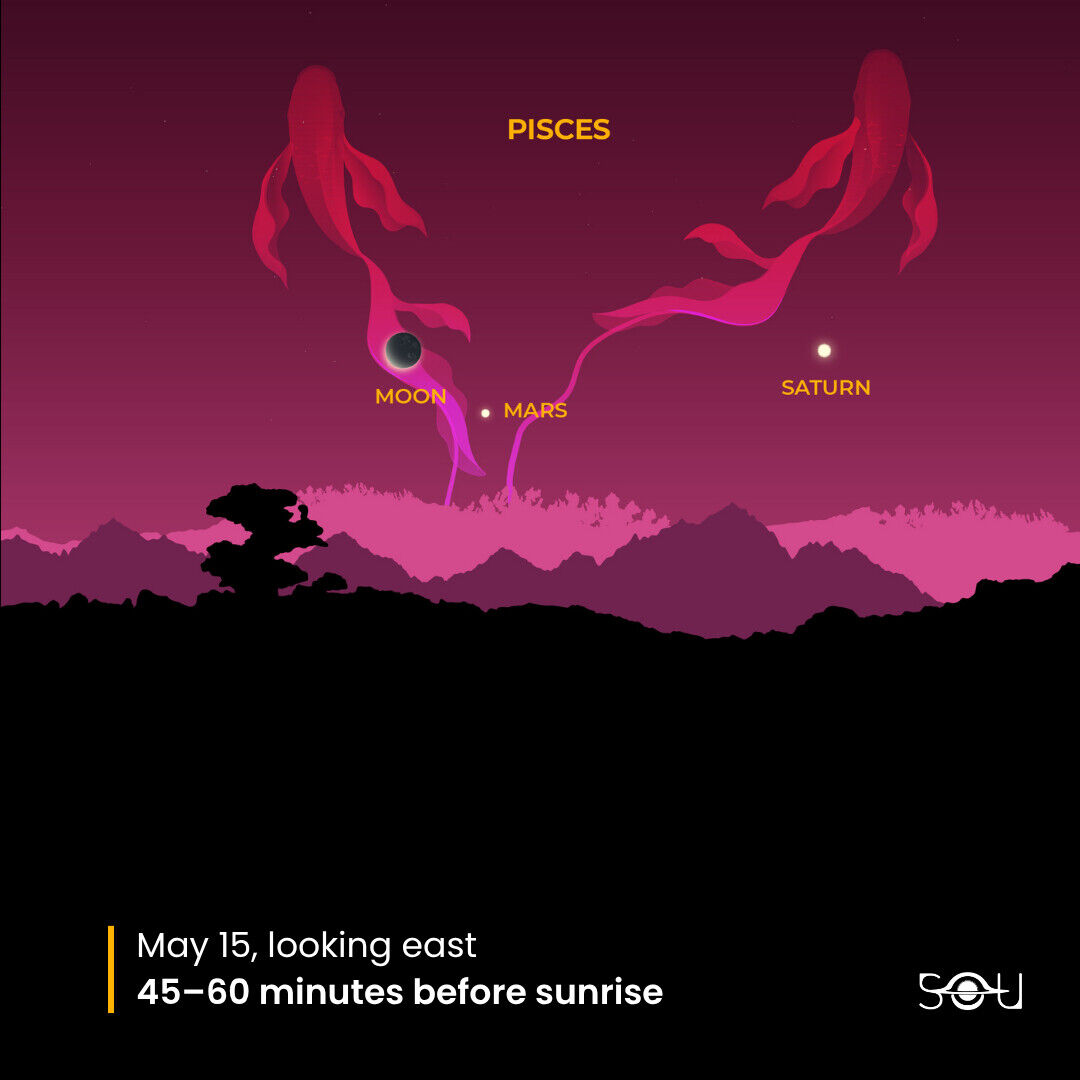
A crescent Moon glides past Mars and Saturn in the eastern predawn sky on May 14-15, 2026
The following morning, the crescent Moon shifts closer to Mars, while Saturn remains nearby in the same predawn region of sky. This creates a simple but satisfying alignment: the Moon, Saturn, and Mars spread low above the eastern horizon before sunrise.
Mars will not be at its brightest this month. It is still recovering from solar conjunction and appears modest compared with the brilliant Mars displays that occur near opposition. But its warm color still gives it away, especially when contrasted with Saturn’s steadier, softer glow.
When & Where: Eastern sky before sunrise on May 14 and 15.
Best View: Low latitudes and Southern Hemisphere observers may have a cleaner view.
Gear: Naked eye; binoculars help in twilight.
May 16 — New Moon and Dark Skies
The Moon reaches its new phase on May 16 at 20:01 UTC (4:01 p.m. EDT), giving skywatchers the darkest nights of the month.
A new Moon is not something to observe directly. Its value is what it removes: moonlight. Around this date, faint deep-sky objects become easier to see, especially from rural skies. In the Northern Hemisphere, May is still a good time for galaxy hunting in Virgo, Coma Berenices, and Canes Venatici. In the Southern Hemisphere, richer Milky Way regions begin to climb into better view, along with showpiece objects such as the Carina Nebula and bright southern star clusters.
This is the night for binoculars, telescopes, and long exposures, or simply for standing under a darker sky and noticing how much the Moon usually hides.
When & Where: Darkest skies around May 15–19.
Best View: Global, weather permitting.
Gear: Binoculars or telescope for deep-sky objects; none for naked-eye stargazing.
May 19 — The Moon Meets Venus
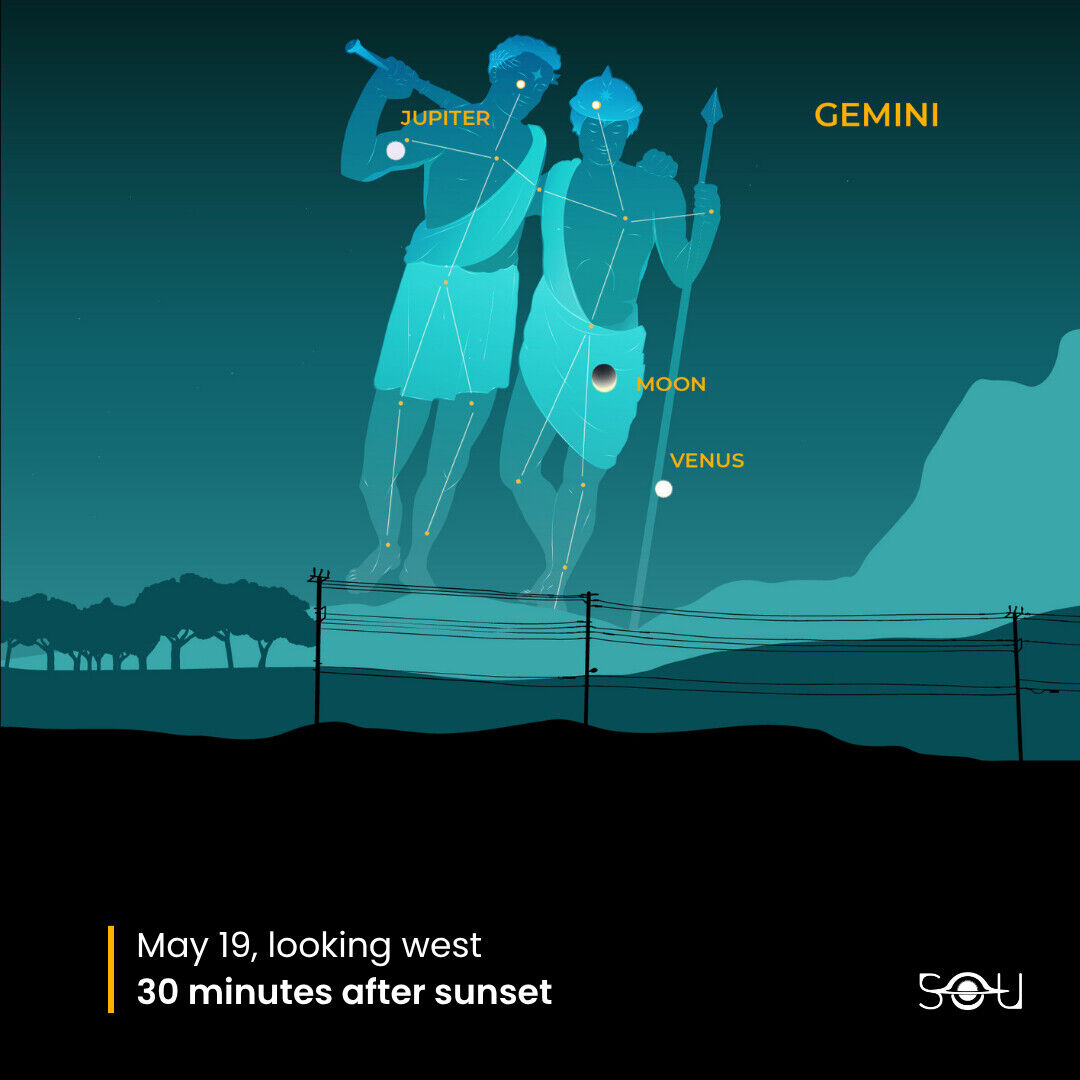
A crescent Moon will meet the dazzing Venus in the western twilight sky on May 19, 2026
After new Moon, the crescent returns to the evening sky.
Around May 18–19, a young waxing crescent Moon appears near Venus, the brilliant Evening Star. The exact Moon–Venus conjunction occurs on May 19 at 01:50 UTC, which is 9:50 p.m. EDT on May 18. That means U.S. observers should watch on the evening of May 18, while many observers farther east will see the pairing best on May 19.
Venus is the easiest planet to identify this month. It shines in the western sky after sunset and outshines every star. Near a thin crescent Moon, it becomes one of the most photogenic sights in the sky — simple, bright, and visible even from cities.
For Northern Hemisphere observers, the pair will be in the western twilight. From parts of the Southern Hemisphere, Venus may sit lower, so a clear western horizon becomes more important.
When & Where: Western sky after sunset; May 18 in the Americas, May 19 for many other regions.
Best View: Clear western horizon.
Gear: None required.
May 20 — The Moon Meets Jupiter
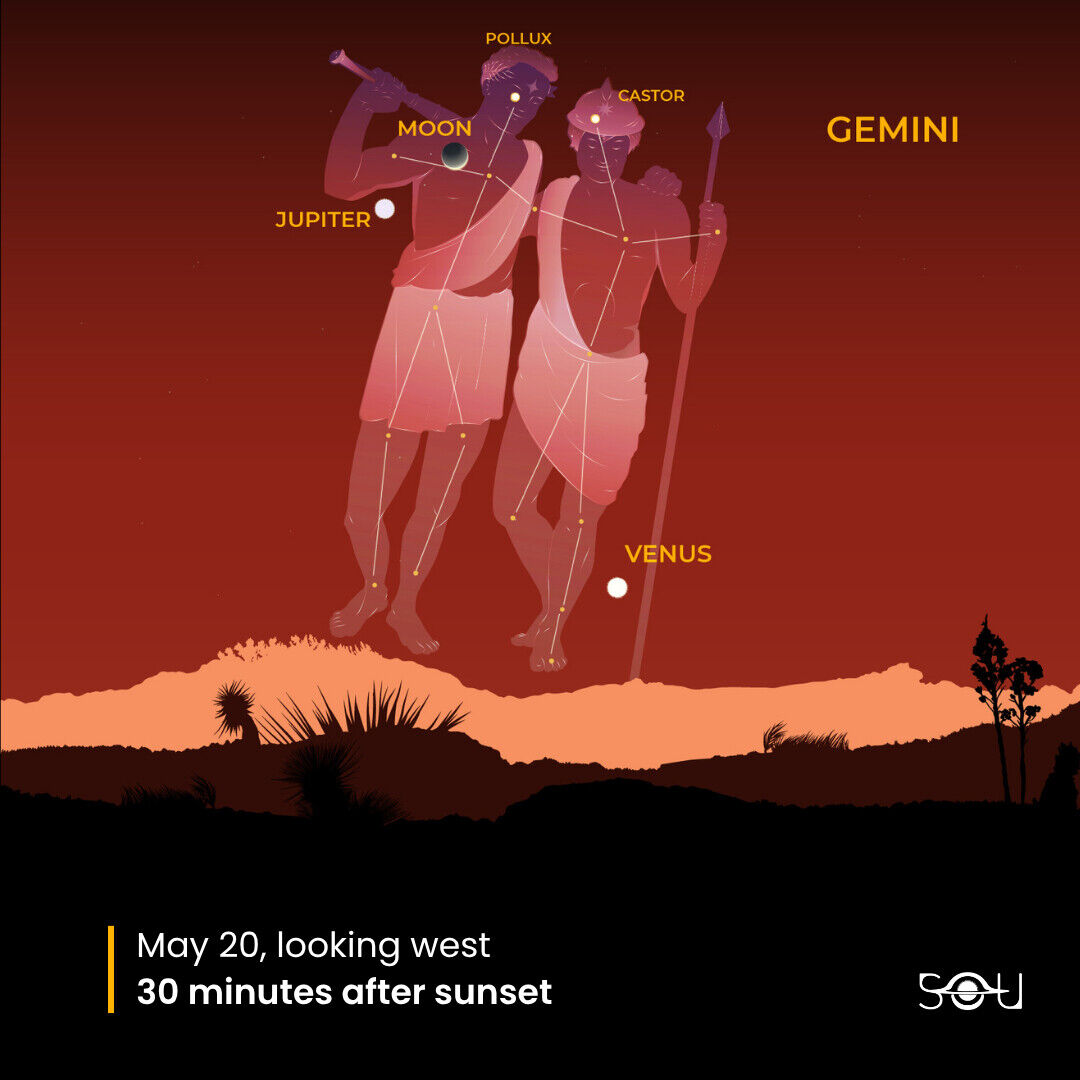
The Moon glides past Jupiter in Gemini on May 20, 2026
One evening after passing Venus, the crescent Moon moves close to Jupiter in Gemini.
The Moon passes near Jupiter on May 20 at 12:39 UTC (8:39 a.m. EDT), but the best visual scene comes after sunset, when Jupiter, the Moon, and nearby stars of Gemini decorate the western sky.
Jupiter has been a dominant evening planet for months, but by May it is slowly sinking toward the Sun’s glare. This makes the Moon’s visit feel like a farewell marker. It is still bright, still easy to find, and still rewarding in binoculars or a small telescope, where its four Galilean moons can often be seen as tiny points of light lined up beside it.
Venus will also be nearby in the broader western sky, creating a graceful evening arrangement of the two brightest planets and the crescent Moon. Venus and Jupiter will appear to draw closer to each other each evening, setting up a dazzling conjunction on June 9.
When & Where: Western sky after sunset on May 20.
Best View: Global, with a clear western horizon.
Gear: Naked eye; binoculars or telescope for Jupiter’s moons.
May 22 — Uranus at Solar Conjunction
On May 22, Uranus passes through solar conjunction, placing it on the far side of the Sun from Earth. Around this time, the planet is lost in solar glare and effectively unobservable for skywatchers.
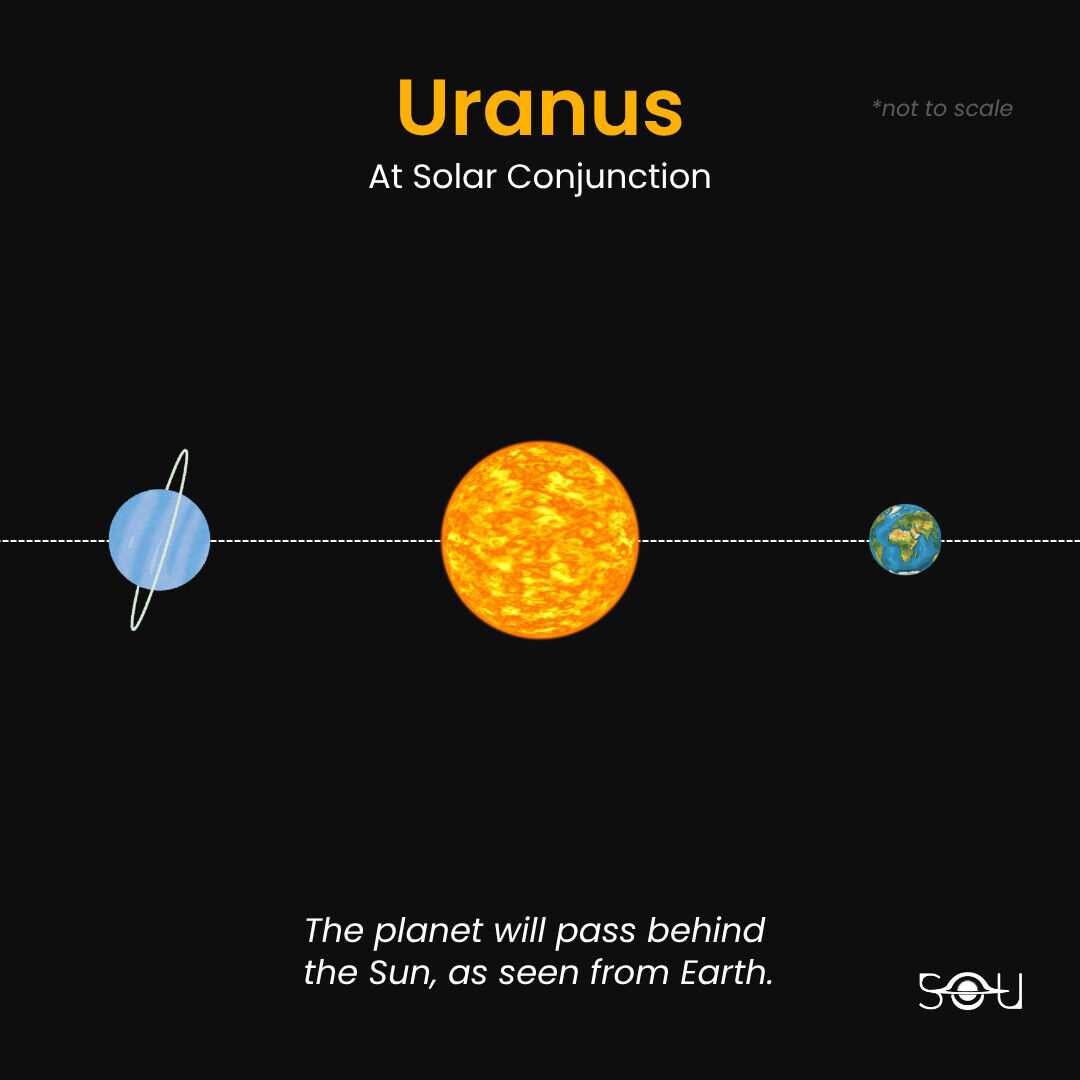
Uranus at Solar Conjunction
This is not a visual event, but it is useful for understanding the rhythm of planetary visibility. After conjunction, Uranus will slowly transition into the morning sky, eventually becoming observable again before dawn later in the year.
When & Where: Not observable; too close to the Sun.
Best View: None.
Gear: Do not attempt to observe objects close to the Sun.
May 31 — The Blue Micromoon Meets Antares
May ends the way it began: with a micromoon.
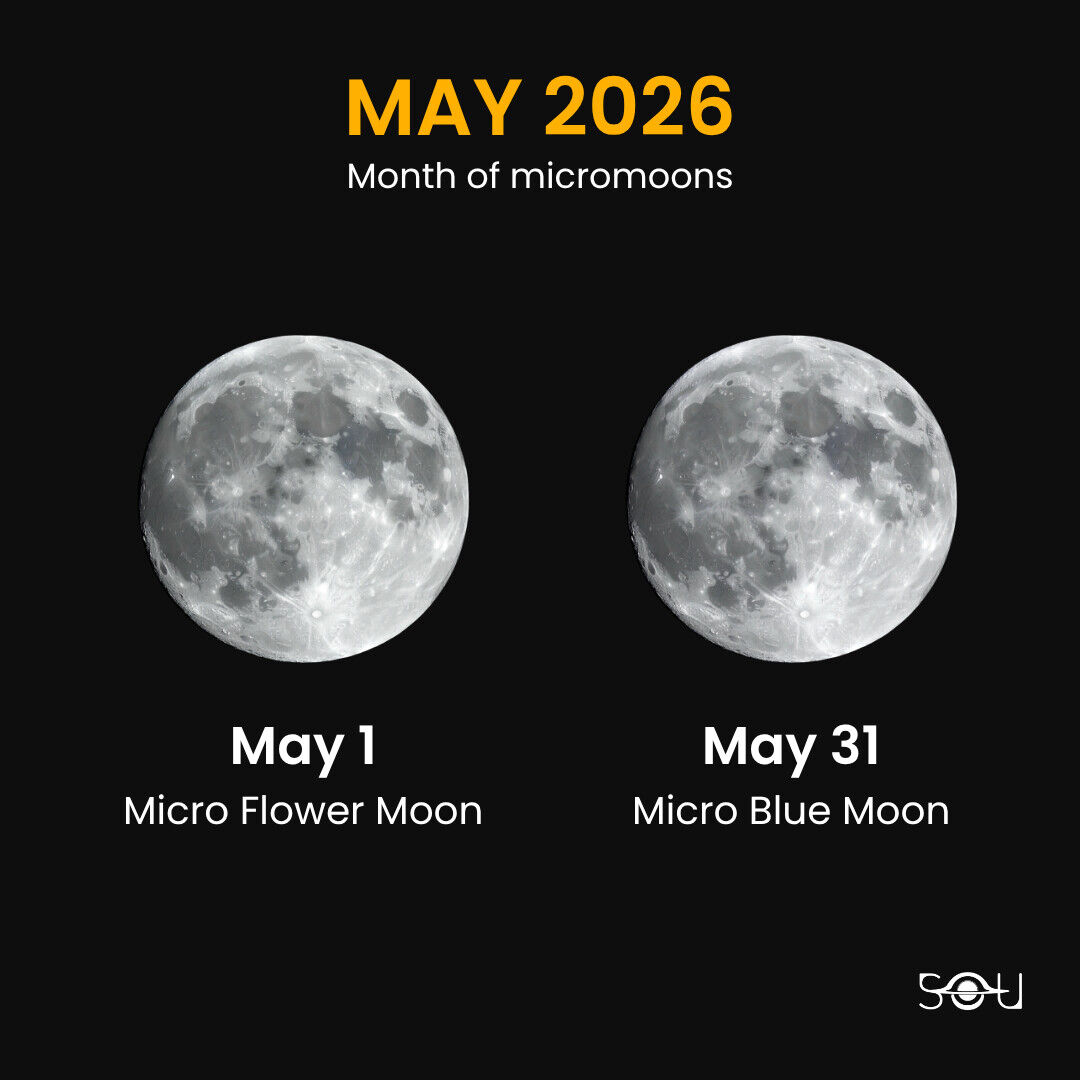
The two full Moons of May 2026 (Micro Flower Moon and Micro Blue Moon)
The second full Moon of the month occurs on May 31 at 08:45 UTC (4:45 a.m. EDT). Because it is the second full Moon in a single calendar month, it is called a Blue Moon. It will not appear blue; the name refers to timing, not color.
This full Moon is also near apogee, with lunar apogee following on June 1. That makes it a Blue Micromoon, and one of the smallest-looking full Moons of the year.
The scene gains another layer because the Moon will lie close to Antares in Scorpius. The closest approach occurs around 08:32 UTC (4:32 a.m. EDT), just minutes before the full Moon moment.
The contrast is beautiful in principle: a bright full Moon near a red supergiant star. In practice, the Moon’s glare will make Antares harder to appreciate, especially in light-polluted skies. Binoculars can help, though the best view may simply be the full Moon rising near the stars of Scorpius.
When & Where: Night of May 30–31, depending on location.
Best View: Southern Hemisphere and lower northern latitudes, where Scorpius rises higher.
Gear: Naked eye; binoculars may help locate Antares through moonlight.
May 2026 Planet Round-up
Mercury is difficult for most of May, reaching superior conjunction with the Sun on May 14 and remaining poorly placed for observation.
Venus dominates the western evening sky throughout May, shining as the brightest point of light after sunset. It climbs gradually higher as the month progresses, reaching its peak altitude on May 22.
Mars is a modest predawn object, visible low in the eastern sky and slowly becoming easier to observe as it moves away from the Sun.
Jupiter remains visible in the evening sky in Gemini, though it sinks lower toward the western horizon each week.
Saturn returns to the eastern predawn sky, still low but improving through the month.
Uranus reaches solar conjunction on May 22 and is not observable.
Neptune is a telescope-only object in the predawn sky and remains challenging for casual observers.