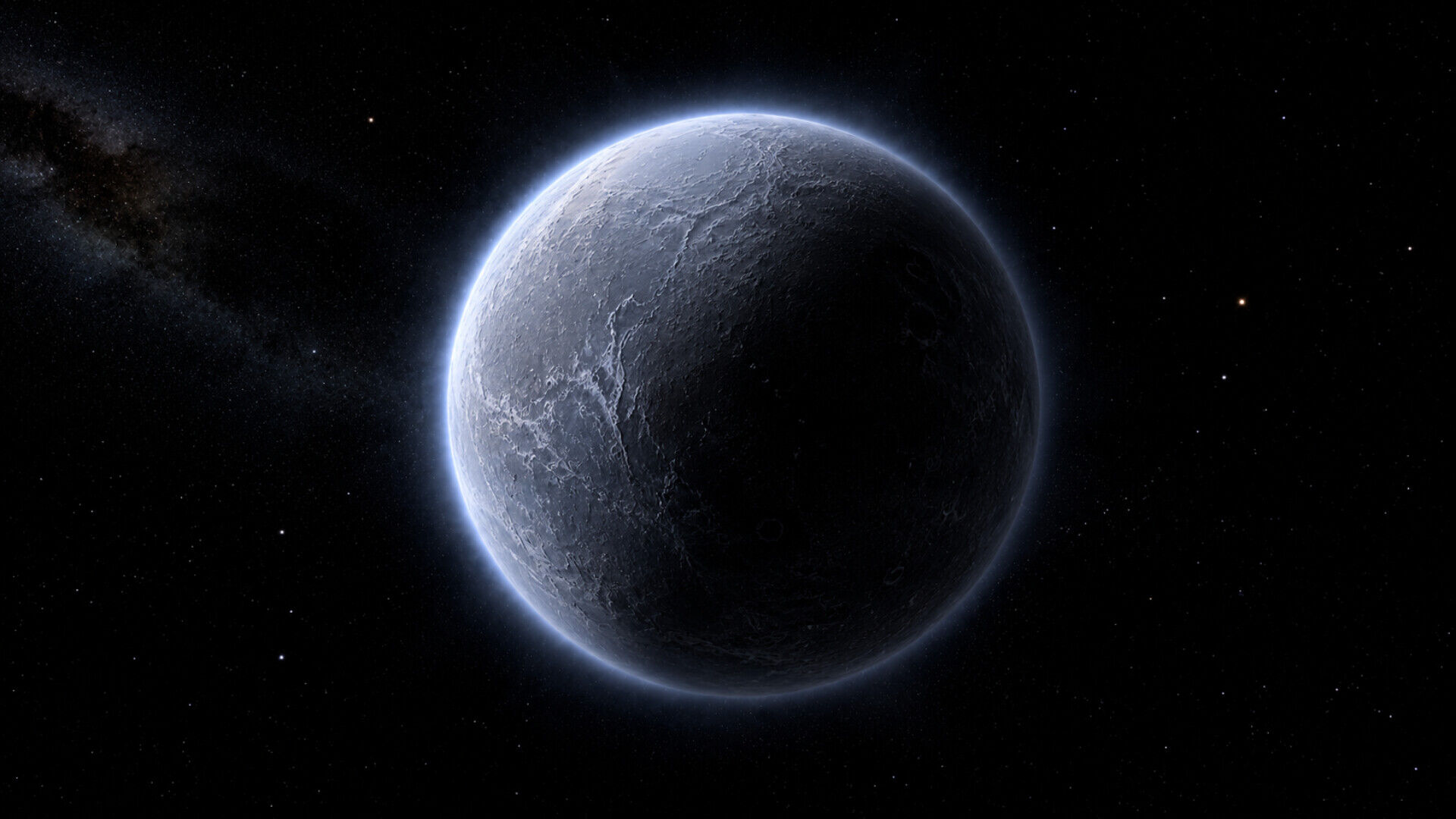
Tiny Object Beyond Neptune Found With Mysterious Atmosphere
In the outermost reaches of the Solar System, well beyond the orbit of Neptune, a small icy body designated 2002 XV93 has been found to possess something that current scientific understanding suggests it should not: an atmosphere.
The object sits about 38 times farther from the Sun than Earth, in a region of the Solar System littered with thousands of similar frozen bodies known as trans-Neptunian objects. At roughly 470-500 kilometers across, it's roughly five times smaller compared to Pluto. At this size, in this cold outer space, with gravity this weak, atmospheric molecules escape almost as fast as they arrive, fleeing into space. The technical term for this is “hydrodynamic or rapid thermal escape.”
A Surprising Find
On January 10, 2024, a team of professional and citizen astronomers spread across three stations in Japan observed 2002 XV93 as it passed directly in front of a background star — an alignment predicted in advance and visible only from East Asia. Instead of the abrupt extinction of starlight expected from an atmosphere-free body, the observations revealed a gradual dimming at the shadow's boundary, consistent with light being progressively attenuated as it passed through a refractive medium surrounding the object. The team interpreted this as a tenuous atmosphere refracting the light as it passed through.
The team, led by Ko Arimatsu at the National Astronomical Observatory of Japan, describe detecting "a refractive signature, indicating the presence of a thin atmosphere" in their paper published in Nature Astronomy on May 4. This is the first time any such signature has been found around a trans-Neptunian object other than Pluto.
The surface pressure they measured sits somewhere between 100 and 200 nanobars. This number is roughly a hundred times lower than Pluto's already tenuous atmosphere, and yet still higher than the upper limits previously established for far larger bodies. Eris, Makemake, Haumea, Quaoar — all bigger than 2002 XV93, all plausible candidates for at least some atmospheric activity — have shown nothing detectable. This object, which should possess no atmosphere whatsoever, appears to have one.
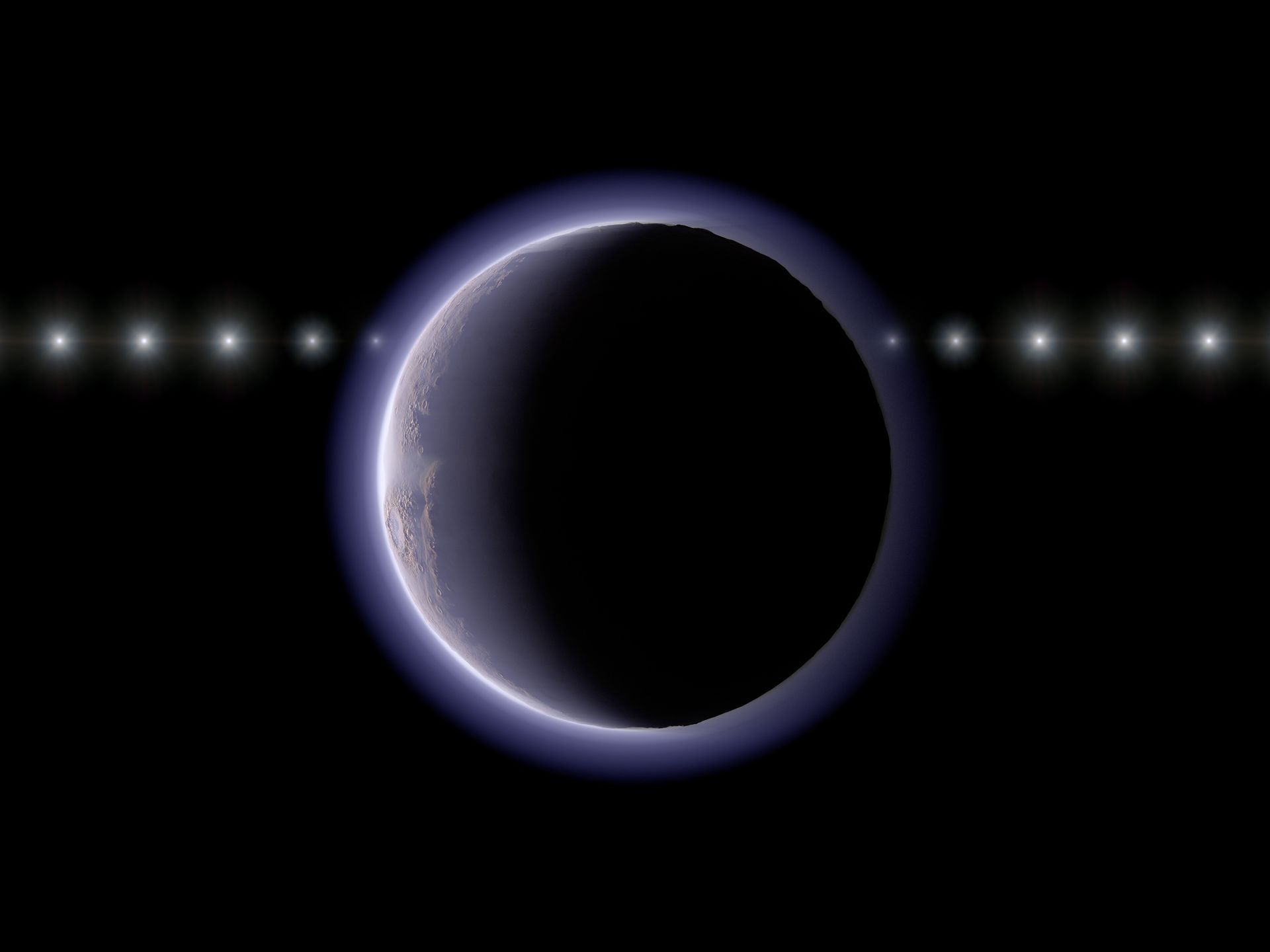
Artist’s impression of this research showing an imagined time sequence as a star passes behind a Trans-Neptunian object with an atmosphere.
Two Possible Causes
What makes the discovery particularly puzzling is that the atmosphere cannot be old. Calculations show it would dissipate within a thousand years, and the James Webb Space Telescope found no frozen gases on the surface that could replenish it. As the paper notes, "sublimation of surface volatiles alone is therefore not expected to sustain a permanent atmosphere." It must have been created or refreshed recently, though by what mechanism remains unclear.
Two explanations are currently under consideration. The first is cryovolcanism, which is a process in which buried fluids or gases force their way to the surface from within the body, analogous to volcanic activity on Earth. While evidence for such internal geological processes has been found on larger Kuiper Belt objects like Sedna and Quaoar, it is considered an unlikely explanation for a body as small as 2002 XV93.
The second explanation is a relatively recent impact: a comet or small icy fragment colliding with 2002 XV93 and releasing a cloud of gas that has yet to fully disperse. The authors calculate that a comet just a few hundred meters wide would carry sufficient volatiles to account for the observed atmosphere. The low relative velocities typical of objects in this region of the Solar System would have helped retain much of that gas around the body rather than scattering it into space. The paper does not zero-in on any one explanation. Further observations are needed to distinguish between these two scenarios.
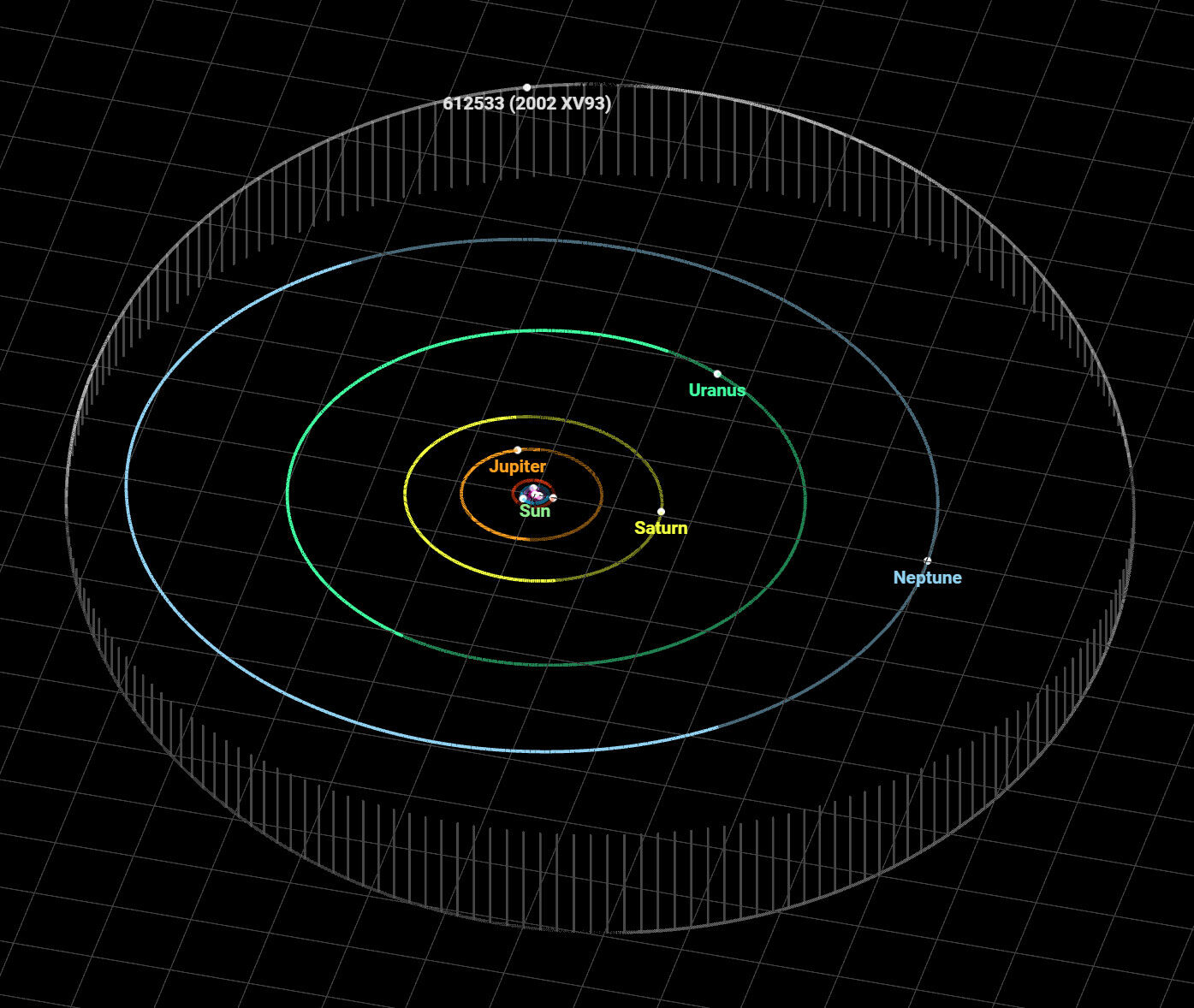
Diagram showing the orbits of 2002 XV93 (white) and the outer planets
Follow-ups
The collision hypothesis carries a testable prediction. An impact-generated atmosphere should be gradually and measurably fading, with surface pressure declining in a way that becomes detectable over the next several years. A stable or seasonally varying atmosphere, by contrast, would favor an internal source. Coordinated follow-up observations by both professional and citizen astronomers are already underway to track exactly this.
It is worth noting how the discovery was made. Among those who contributed data was Katsumasa Hosoi, a citizen scientist operating a commercially available camera on a 25-centimeter telescope in Fukushima. His observations helped confirm a detection that challenges some of the field's most established assumptions about where atmospheres can exist.
At this point, the discovery of an atmosphere around this object raises more questions than it resolves. The outer Solar System contains thousands of objects comparable in size to 2002 XV93, and there may be some significant fraction of them harboring similar transient atmospheres.
Research paper
Ko Arimatsu et al, Detection of an atmosphere on a trans-Neptunian object beyond Pluto, Nature Astronomy (2026). DOI: 10.1038/s41550-026-02846-1