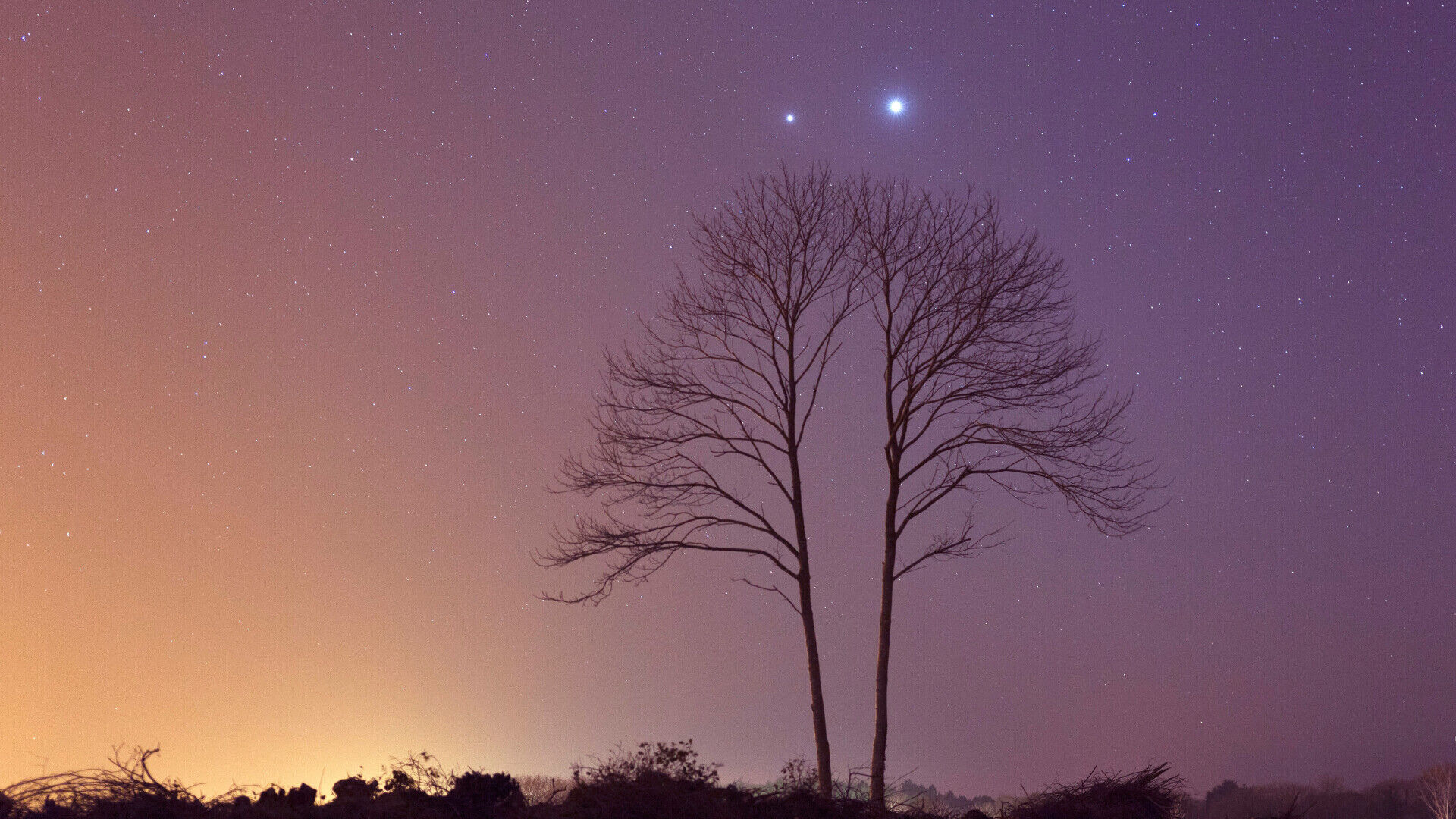
Venus and Jupiter Meet in Gemini: How to See 2026's Brightest Planetary Conjunction
In the first week of June, anyone facing west after sunset has been able to watch two brilliant points of light edge closer night after night. On June 9 they finish the chase. Venus and Jupiter, the two brightest planets in our sky, close to just 1.6° apart, near enough to hide behind your outstretched little finger. It is the closest and brightest planetary pairing of the year.
You need nothing but your eyes and a clear view toward the sunset. But there is more going on here than two bright dots, and the days on either side of the 9th have their own rewards.
Two planets, a line of sight, and a trick of distance
The pairing is an illusion of perspective. In early June, Venus sits roughly 80 million kilometres from Earth. Jupiter lies around 900 million kilometres away — more than ten times farther. The two worlds are nowhere near each other in space. We simply happen to be looking along nearly the same line of sight, with the inner planet and the outer giant stacked one behind the other.
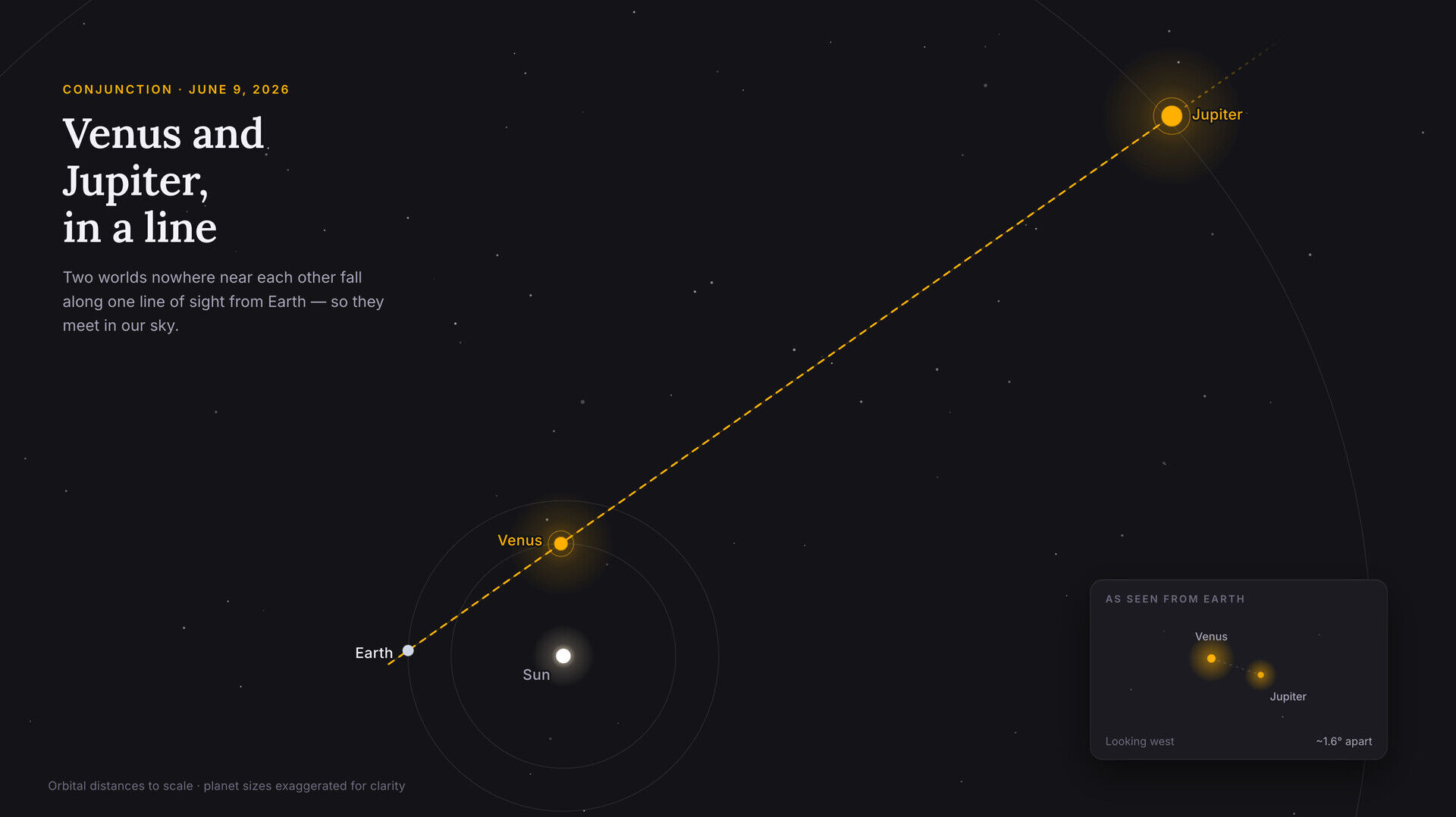
An illustration of what's really happening in the solar system
Both shine so fiercely for the same reason: cloud. Venus is wrapped head to toe in dense, white, sunlight-reflecting cloud, which is why it ranks as the brightest object in the night sky after the Moon.
Jupiter's banded cloud tops are excellent reflectors too. On the 9th Venus blazes at about magnitude –4, roughly eight times brighter than Jupiter at magnitude –1.7. Under a genuinely dark sky, Venus is bright enough to cast faint shadows.
Both planets sit in Gemini, a little below and to the left of the constellation's twin stars, Castor and Pollux. Pollux is the brighter twin. The two stars appear far dimmer and about three times more widely spaced than the planets, so there is no mistaking which lights are which.
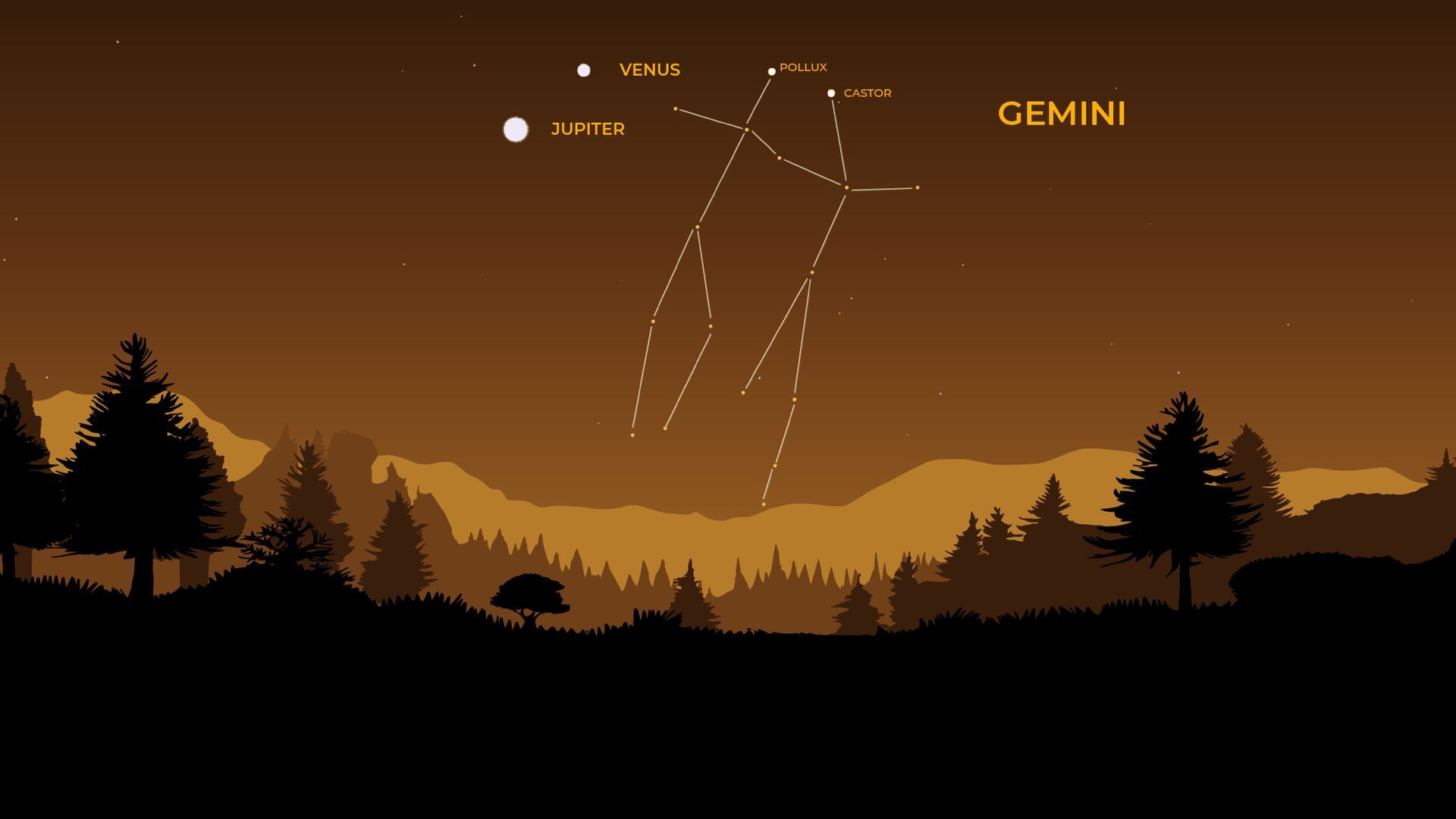
Venus and Jupiter alongside Castor and Pollux, all visible to the naked eye after the evening sky turns dark.
Jupiter, in fact, has owned Gemini all year. This is the same planet that dominated winter evenings, reaching opposition on January 10 at magnitude –2.7. Half a year on, it has faded and shrunk as Earth has pulled ahead of it in orbit, and now it is making its exit, sliding toward the Sun. June 9 is something of a farewell.
When and where to look
Find a spot with a clear, flat western horizon — a coastline, a ridge, an open field, a high rooftop. The planets sit low, and trees or buildings will swallow them.
Wait until the Sun has fully set before you look. That part is not optional. Then start scanning low in the west to west-northwest about 30 to 45 minutes after your local sunset, once the sky has begun to darken. Venus appears first and brightest; Jupiter sits just beside it.
The evening of June 9 is the peak, but you do not have to thread a needle. The 8th and 10th look nearly identical, with the planets within about 2° of each other across all three nights.
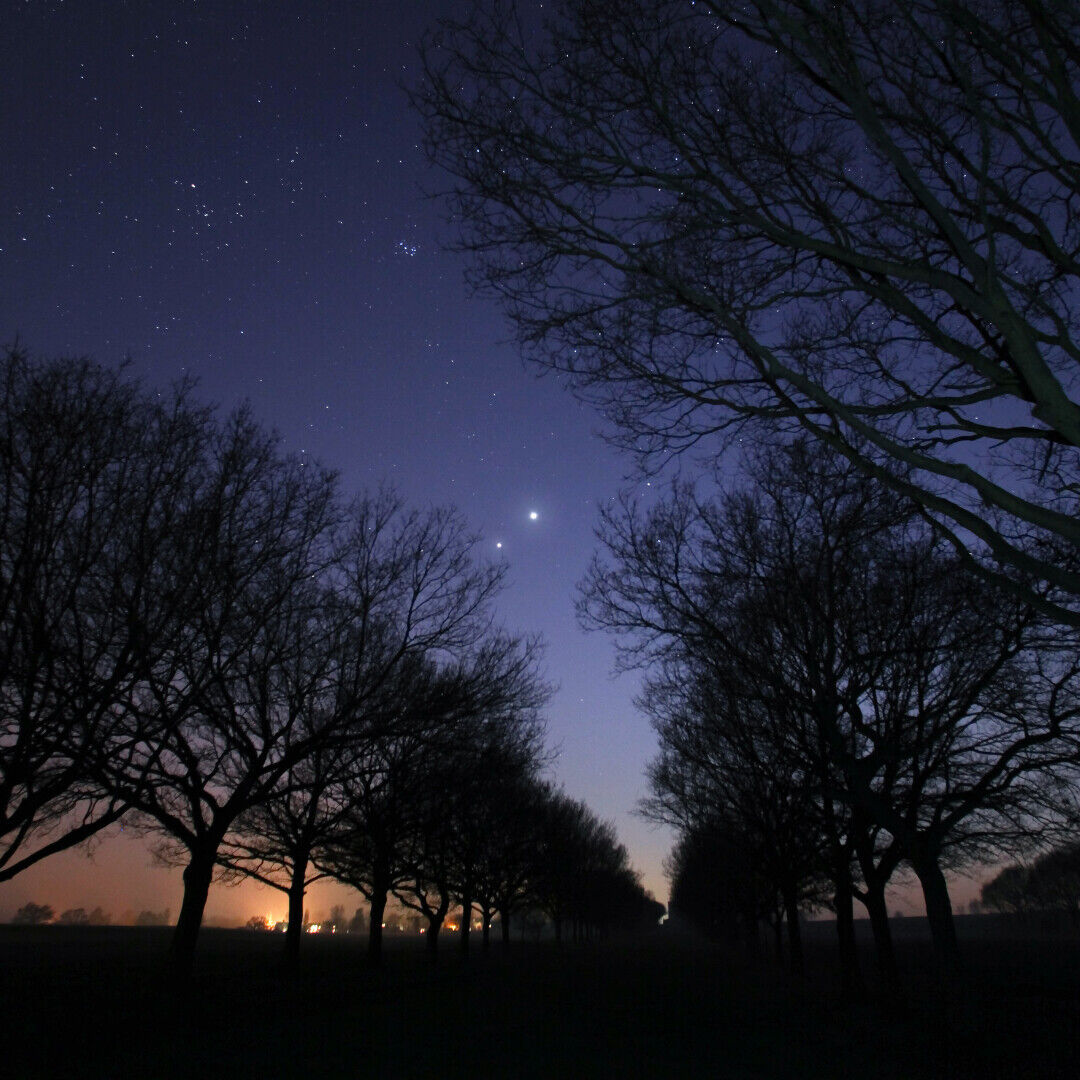
Venus and Jupiter on March 14, 2012
For North American observers, the timing is kind. From the contiguous United States and southern Canada, the pair stands a reasonable height in the west as the sky darkens and lingers well over an hour — closer to two hours from the southern states, where Venus sets roughly two and a half hours after the Sun.
The farther north you are, toward northern Canada, the lower and briefer the show, nearer an hour. Either way, catch the pair while it is still a few degrees up; the lower it sinks, the more horizon haze dims it. Look promptly.
What you'll see through binoculars and a telescope
Ordinary binoculars are the single best way to enjoy this conjunction. At 7× or 10×, both planets sit comfortably in the same field, two unequal beacons against the twilight, with Jupiter's brightest moons strung out beside it as tiny sparks.
A telescope is a different experience. At 1.6° apart, the planets are too far separated to share the view at most magnifications, so you observe each in turn rather than together.
Turn to Venus and you will see a small, fat gibbous disk about 13 arcseconds across and roughly three-quarters lit. It will not narrow to a clean half-phase until it swings out to its greatest distance from the Sun in August.
Turn to Jupiter and you will find a disk near 32 arcseconds wide, crossed by its two dark equatorial belts, flanked by the four Galilean moons — Io, Europa, Ganymede and Callisto — which shuffle into a new arrangement every night.
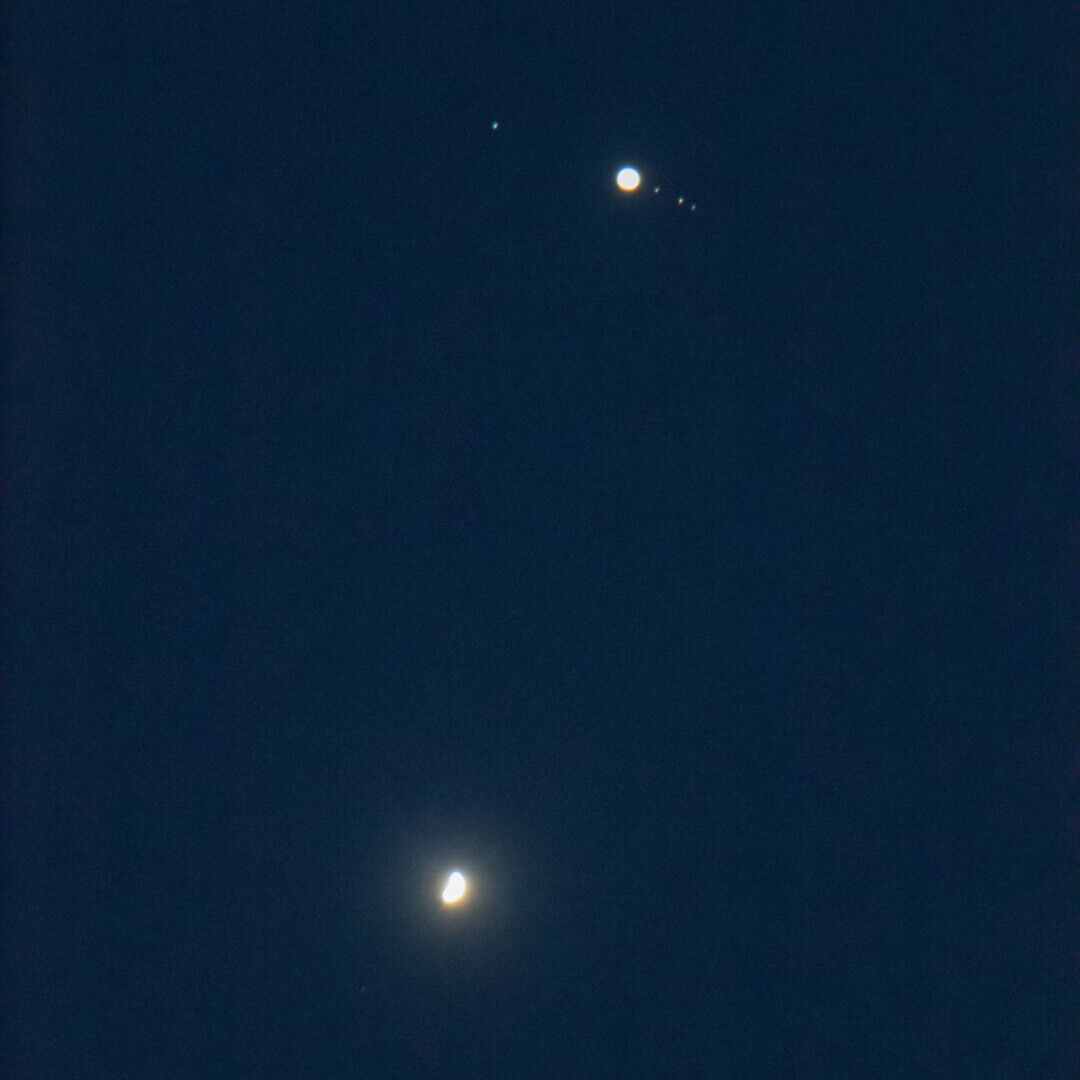
One more target rides low beneath the pair. Mercury, at about magnitude 0, sits roughly 12° to the lower right, a bit more than a fist held at arm's length, down toward the horizon. It is fainter and harder to catch in the bright twilight, so sweep for it with binoculars and give yourself an unobstructed view.
Where the planets go from here
After the 9th, the two go their separate ways, and quickly. Venus climbs higher into the evening sky night after night, growing more prominent until it reaches greatest eastern elongation — its widest apparent gap from the Sun — on August 14–15. After that it thins to a crescent and drops back sunward, passing between Earth and the Sun in October before reappearing as a morning star.
Jupiter falls the other way. Within a couple of weeks it is lost in the solar glare, and on July 29 it reaches solar conjunction, passing directly behind the Sun as seen from Earth. It returns low in the dawn sky from about mid-August, opening its next morning run.
As for the planets meeting again like this: the next Venus–Jupiter conjunction does not come until November 10, 2028, and that one belongs to the morning sky. June 9, 2026, in the comfort of a summer evening, is the one to catch.
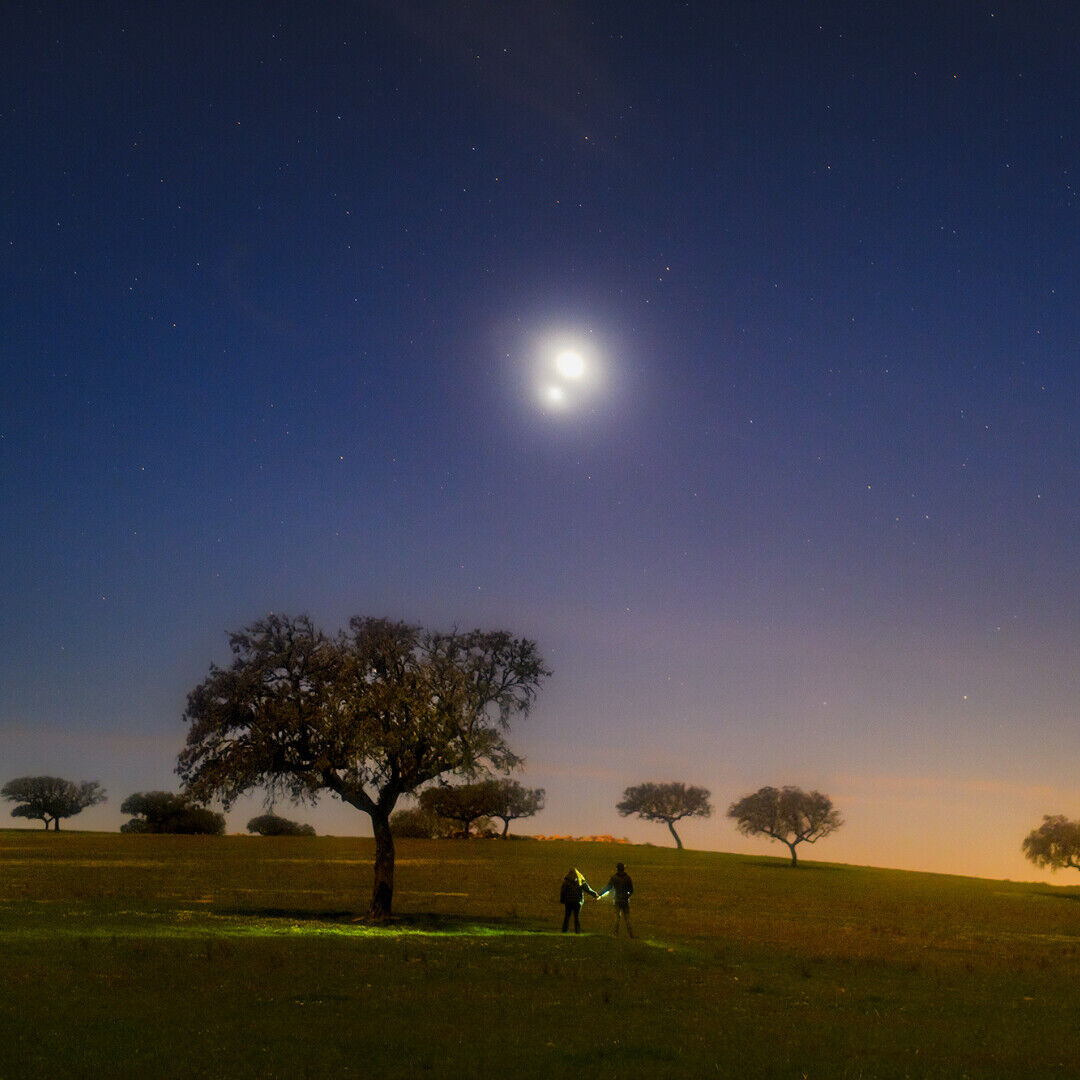
Moonlit scene showing Venus and Jupiter in conjunction at centre left. This was the closest that the two planets will come for viewers from Earth until 2039. Image taken in the Dark Sky Alqueva territory in Portugal.