12 Night Sky Events to Watch in April 2026 — From the Pink Moon to Two Comets
April 2026 does not ease you in gently. The month opens with a full moon bright enough to cast shadows, proceeds through a rare triple planetary conjunction in the predawn darkness, and closes with a meteor shower that traces its origins to one of the oldest comets known to science. Woven throughout are comet apparitions, lunar occultations, and a parade of planets returning to view after months of solar obscurity. For those willing to step outside — whether at dusk or before dawn — April rewards the effort generously.
Here are the twelve events that define the month. Before we begin, make sure to download one of these space apps so that you can easily locate the planets according to your place.
April 1-2 — The Full Pink Moon
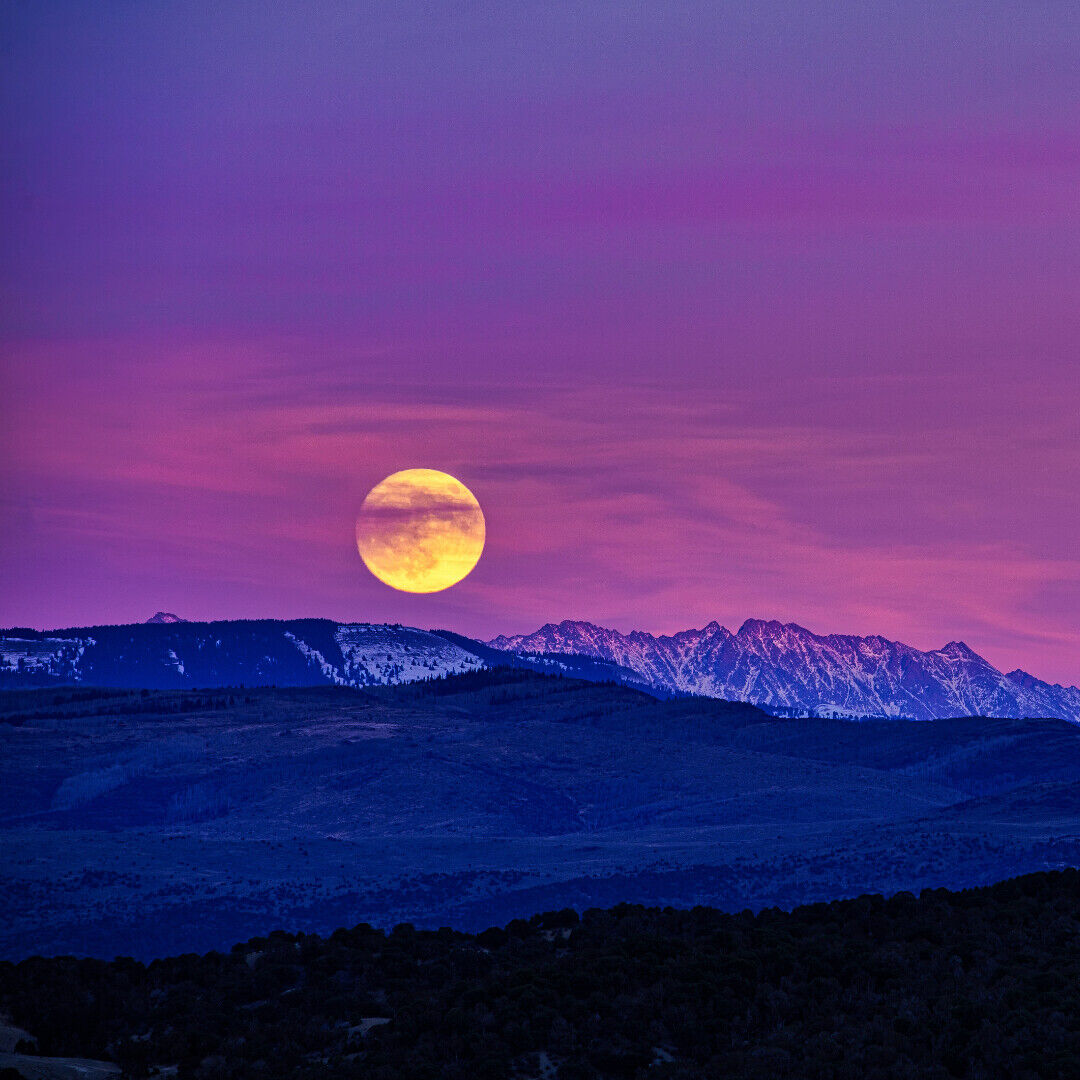
The first full moon of astronomical spring arrives in the early hours of April 2 (02:11 UTC), though for observers in the Americas, it reaches its peak the evening of April 1. Despite its name, the Pink Moon does not actually blush — the moniker derives from the creeping phlox and other wildflowers that carpet the ground across North America at this time of year, a seasonal marker embedded in the lunar calendar by Indigenous peoples long before modern astronomy formalized the sky.
What it lacks in color it makes up for in luminosity. Rising opposite the Sun, a full moon illuminates the landscape with a quality of light that no other astronomical event quite replicates — soft, directionless, and strangely complete.
- When & Where: Rises at sunset; visible globally throughout the night.
- Gear: None required.
April 3 — Mercury at Greatest Elongation
Of all the planets visible to the naked eye, Mercury is the most elusive. Perpetually close to the Sun from Earth's perspective, it surfaces into view only during brief windows each year. April 3 marks one of the best of 2026 — Mercury reaches its greatest western elongation, swinging as far from the Sun as its orbit allows and shining at magnitude +0.2 in the constellation Aquarius.
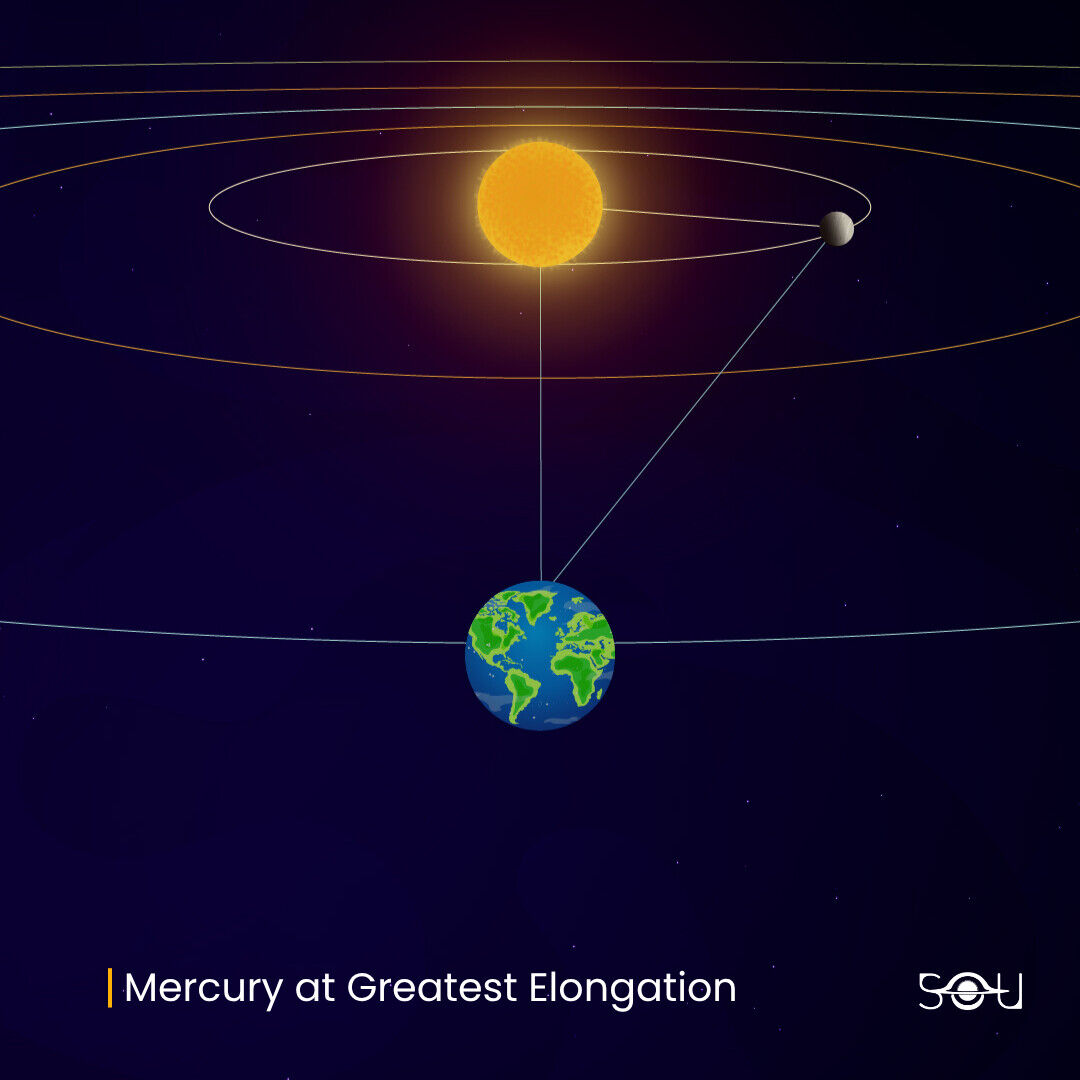
Mercury at Greatest Western Elongation
The planet will be visible in the eastern sky before sunrise, low above the horizon but unmistakable in its steadiness — planets, unlike stars, do not twinkle. This is a fleeting window; Mercury moves swiftly and will retreat back into the Sun's glare within days.
- When & Where: Eastern horizon, predawn; best seen 30–45 minutes before sunrise.
- Gear: Naked eye; a clear, unobstructed horizon is essential.
April 6 — Comet C/2026 A1 (MAPS) at Perigee
On April 6, the Kreutz sungrazer comet C/2026 A1 — catalogued under the name MAPS — makes its closest approach to Earth. Kreutz sungrazers are fragments of a massive progenitor comet that broke apart centuries ago, and they follow trajectories that carry them extraordinarily close to the Sun's surface. Whether C/2026 A1 survives that passage will determine what observers in the Southern Hemisphere see in the days that follow.
If it does, the comet could brighten dramatically and become one of the more memorable naked-eye objects of the year. If it does not, it will join the long list of comets that promised much and delivered only a lesson in humility. Either outcome tells us something true about the solar system.
- When & Where: Best observed from the Southern Hemisphere post-perihelion.
- Gear: Binoculars at minimum; a telescope will resolve the tail if present.
April 13 — Mars Meets Neptune
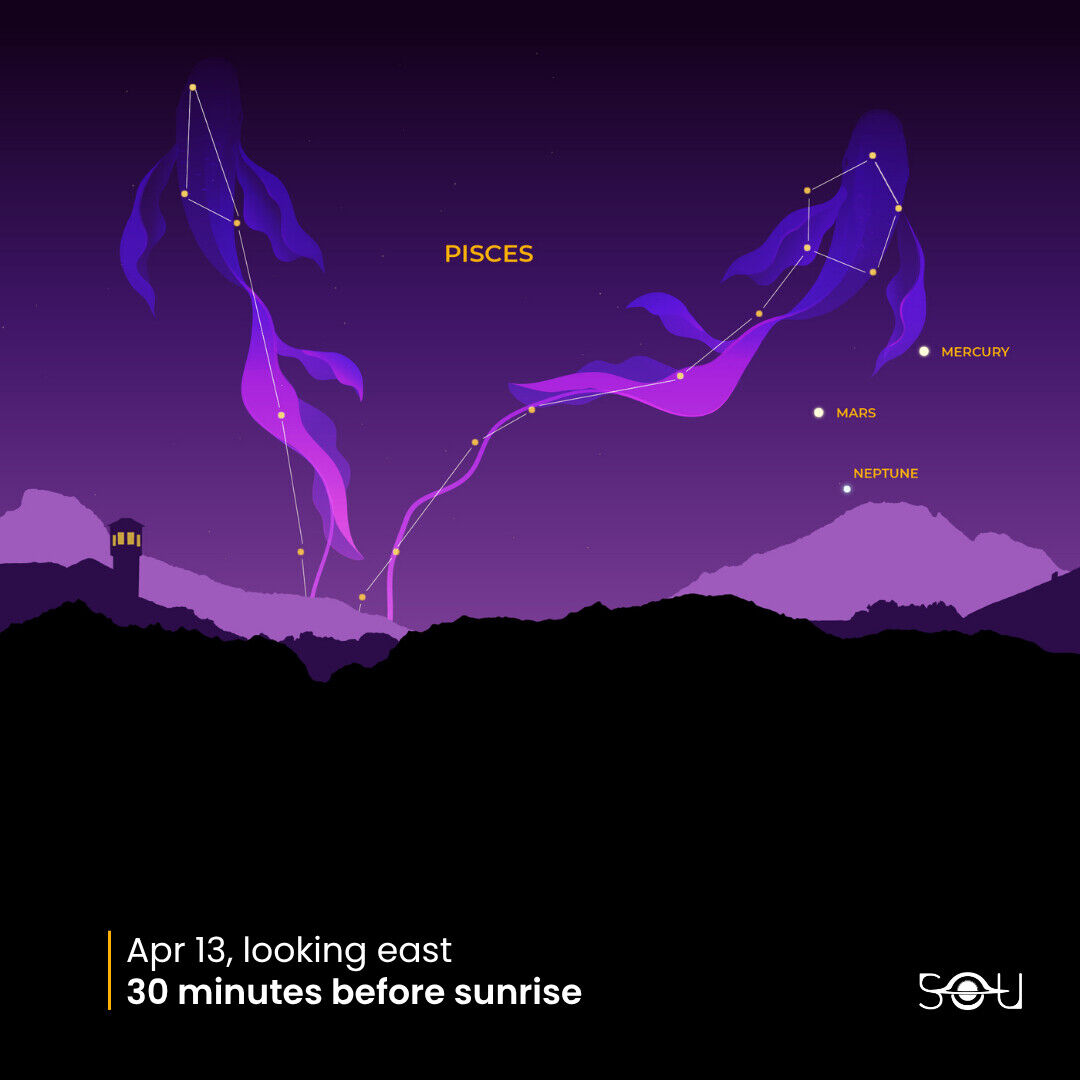
Mars and Neptune converge in Pisces on April 13, 2026, visible 30 minutes before sunrise looking east.
In the predawn sky over the constellation Pisces, an unlikely pairing takes shape. Mars — rust-colored, familiar, and unmistakable — passes within just 20 arcminutes of Neptune, the outermost of the solar system's eight planets and one of the most remote objects a backyard telescope can reach.
The conjunction offers a rare moment of perspective. Mars orbits the Sun at a mean distance of 1.5 astronomical units; Neptune lies at roughly 30. Seeing them occupy the same narrow field of view collapses that distance into something almost comprehensible.
- When & Where: Eastern predawn sky; look toward Pisces.
- Gear: A telescope is required to resolve Neptune as a pale blue disk.
April 16 — A Predawn Gathering in Pisces
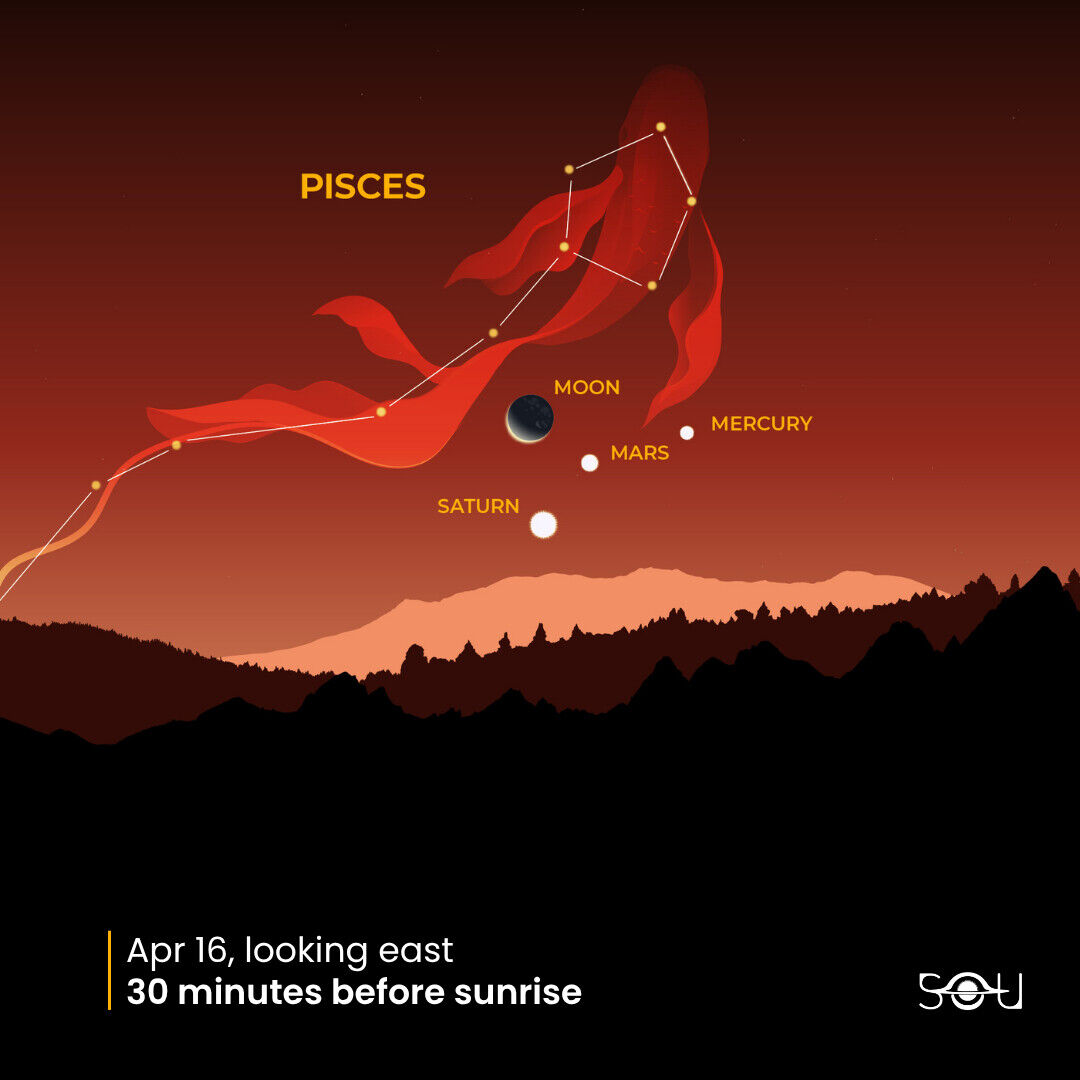
The Moon, Mars, Mercury, and Saturn gather in Pisces on April 16, 2026, visible 30 minutes before sunrise looking east.
Before sunrise on April 16, four solar system objects will occupy a tight region of the eastern sky: a waning crescent Moon, Mars, Mercury, and Saturn, all rising together above the horizon in Pisces. Gatherings of this kind — where multiple planets converge in a single sweep of sky — occur only a handful of times each year.
The planets will be low, and the sky will not be fully dark, so a clear and unobstructed eastern horizon is not optional — it is essential. The Moon will serve as the anchor, with the planets arrayed around it in the gathering twilight.
- When & Where: Eastern horizon, roughly 60–90 minutes before sunrise.
- Gear: Naked eye; binoculars will help lift the planets from the brightening sky.
April 17 — Comet C/2025 R3 (PanSTARRS) Under Dark Skies
The new moon on April 17 eliminates lunar interference entirely, and the timing is fortuitous: Comet C/2025 R3, discovered by the PanSTARRS survey system, is approaching its closest point to the Sun (perihelion) on April 19 and is currently positioned near Pisces.
_on_29_March_2026-1920x1280.jpg)
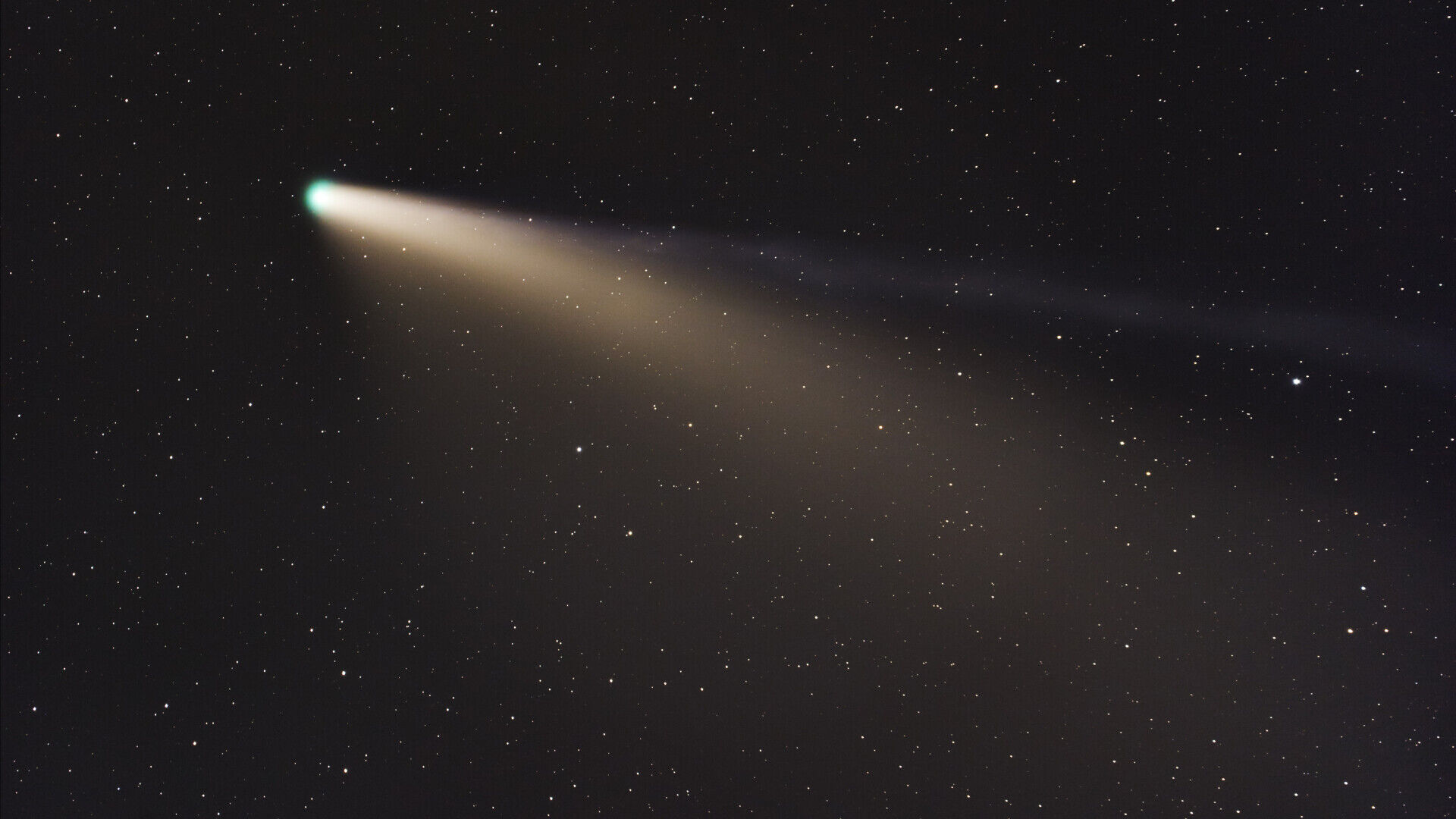
Comet C/2025 R3 (PanSTARRS) on 29 March 2026, 2:45 (UTC). The comet features a round, green coma and a nice ion tail, over a degree long, extending beyond the edge of the frame. Coma is about 7 arcminutes across. The two brightest stars visible are 40 and 41 Pegasi. GSO N203/800 with coma corrector, unmodified M4/3 camera. 50x30s from B4 skies, eastern Crete. Edited with DSS, SIRIL and Ps.
Under normal circumstances, C/2025 R3 is expected to reach around magnitude +8 — within reach of binoculars under dark skies, but not a spectacle for the casual observer. However, comets approaching perihelion can experience a phenomenon known as forward scattering, where sunlight passes through the coma and tail at precise angles, temporarily amplifying the comet's brightness by a factor of up to 100. If that occurs, C/2025 R3 could briefly rival the brightness of the planets themselves.
Comets rarely fulfill their most optimistic forecasts, but they rarely disappoint those who look.
- When & Where: Evening sky near Pisces; best visibility under dark, rural skies.
- Gear: Binoculars or a telescope; a dark sky site significantly improves the view.
April 19 — Crescent Moon and Venus in Taurus

A crescent Moon joins Venus, the Pleiades, and Uranus in Taurus on April 19, 2026, visible 30 minutes after sunset looking west.
Two days after new moon, a delicate 2-day-old crescent hangs low in the western sky at dusk, positioned close to Venus in the constellation Taurus. Venus is currently the brightest point of light in the evening sky — not by a small margin, but dramatically so — and the pairing of a thin crescent with that intensity of light is among the most visually compelling sights the naked eye can encounter.
Nearby, though invisible without a telescope, Uranus drifts close to the Pleiades star cluster. The two sights — one effortless, one requiring effort — make this a productive evening for observers of any experience level.
- When & Where: Western sky at dusk; look low on the horizon shortly after sunset.
- Gear: Naked eye for Venus and Moon; telescope required for Uranus.
April 20–22 — A Triple Planetary Conjunction
Over three consecutive mornings, Mercury, Saturn, and Mars converge in the eastern predawn sky into one of the month's most geometrically striking events. At their closest, the three planets will fit within a circle just over one degree wide — small enough that a single binocular field of view will contain all three simultaneously.
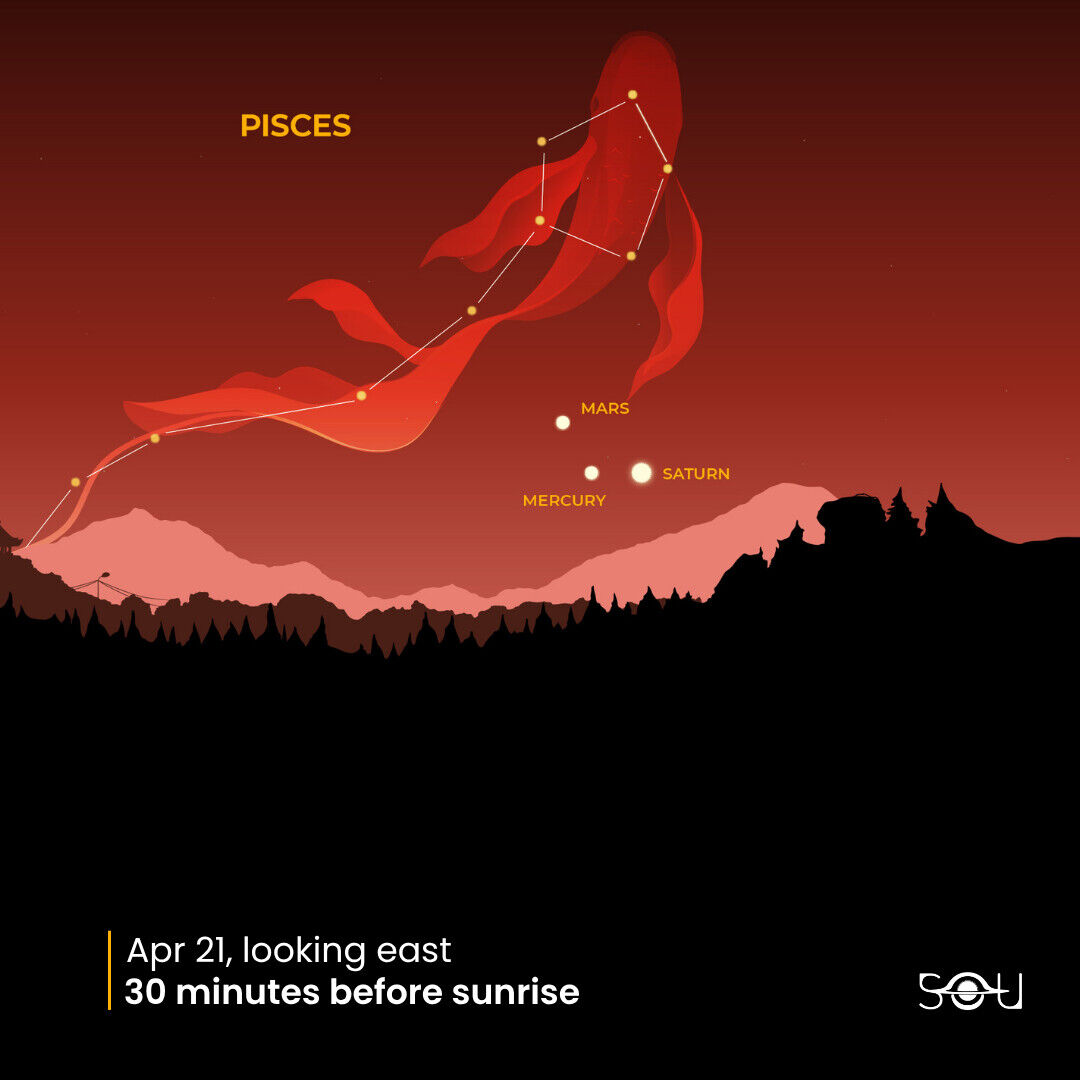
Mercury, Mars, and Saturn converge in Pisces on April 21, 2026, visible 30 minutes before sunrise looking east.
Planetary conjunctions of two objects are common enough. Three planets in such proximity at once is rarer, and the predawn setting adds an element of commitment that makes the reward feel proportionate. The window of best visibility is narrow; the planets will be low and the sky will be brightening, so observers who arrive early will be rewarded most.
- When & Where: Eastern predawn sky; best observed 60–90 minutes before sunrise.
- Gear: Naked eye; binoculars bring all three into a single satisfying frame.
April 22 — The Lyrid Meteor Shower Peaks
The Lyrids are among the oldest known meteor showers in recorded history — Chinese astronomers documented a display in 687 BCE — and they return each April as Earth passes through the debris trail of Comet Thatcher. This year, the shower peaks on the night of April 22 into the early hours of April 23, with the radiant point rising in the northeast after midnight.
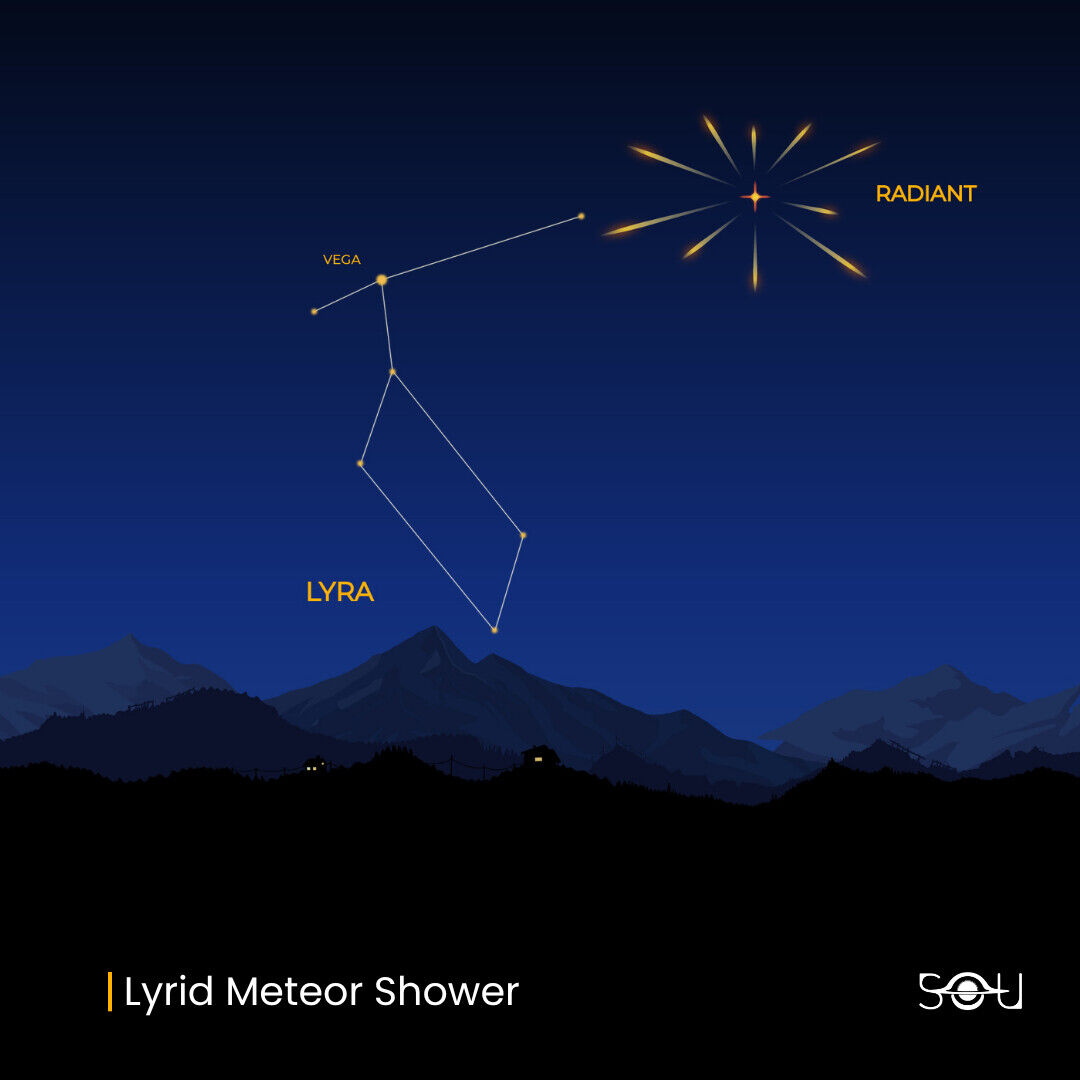
The radiant point of the Lyrid Meteor Shower, located near Vega in the constellation Lyra.
Under ideal conditions, the Lyrids produce roughly 18 meteors per hour, though occasional outbursts have historically exceeded that figure. The 5-day-old crescent Moon will set early, leaving the later hours of the night genuinely dark. The Lyrids are known for producing bright, fast meteors that occasionally leave persistent trains — glowing ionized trails that linger for several seconds after the meteor itself has gone.
No optical aid is needed or helpful. The shower is best experienced lying flat, eyes wide open, with as much of the sky in view as possible.
- When & Where: All night, but best after midnight; radiant in Lyra, near Vega.
- Gear: None; dark skies and patience are the only requirements.
April 22–23 — The Moon Meets Jupiter
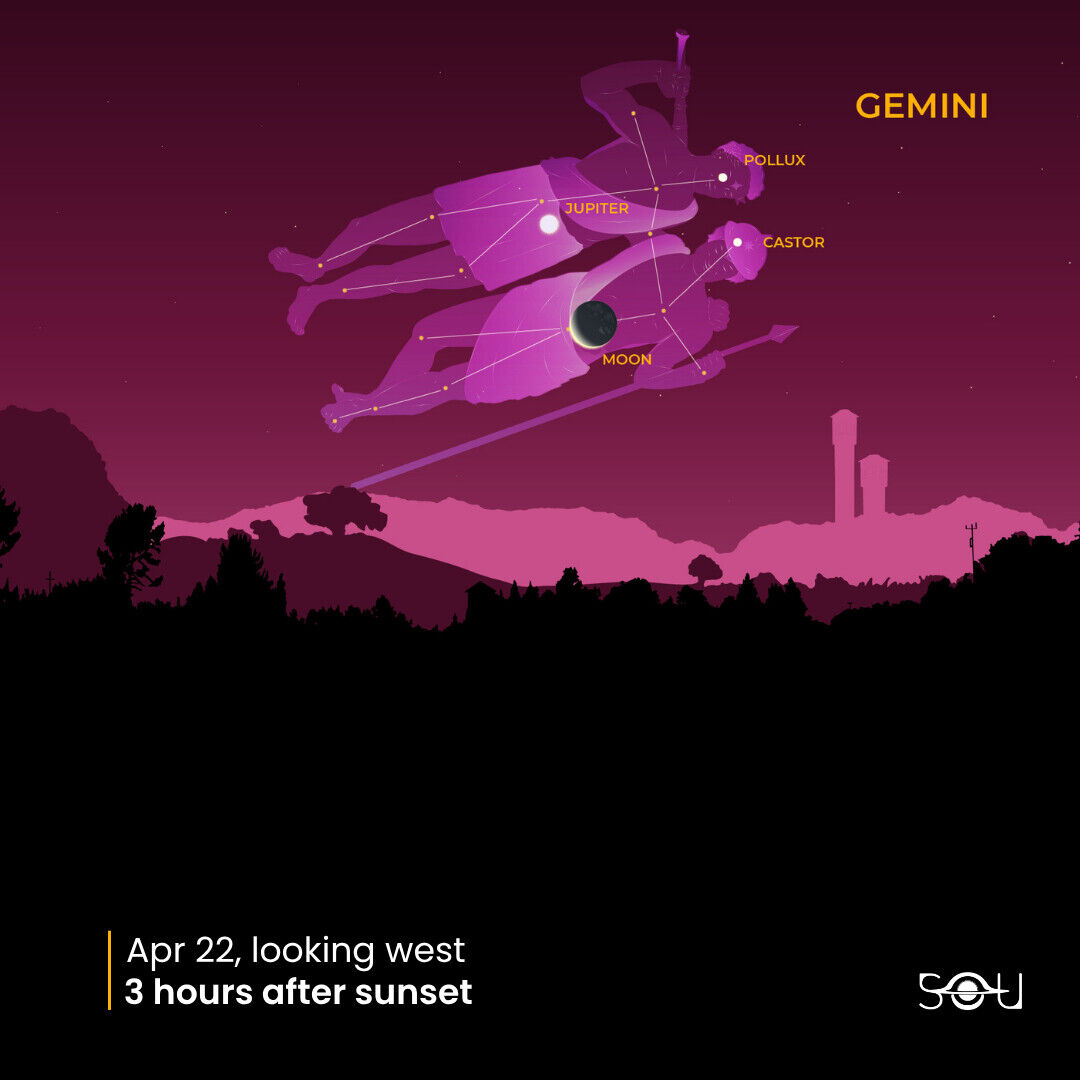
The Moon passes close to Jupiter amid the twin stars Castor and Pollux in Gemini on April 22, 2026, visible 3 hours after sunset looking west.
On the same night as the Lyrid peak, a 5-day-old crescent Moon drifts close to Jupiter in the constellation Gemini, framed by the twin stars Castor and Pollux. Jupiter has been the dominant planet of the evening sky for months, and while it will begin to drift westward as April closes, it remains brilliant — the brightest point of light after Venus in the current sky.
The pairing is undemanding. No special equipment, no unusual timing. It is the kind of event that asks only that you step outside and look up.
- When & Where: Evening sky; high overhead by mid-evening.
- Gear: Naked eye; binoculars will reveal Jupiter's four Galilean moons.
April 24 — Venus Meets Uranus
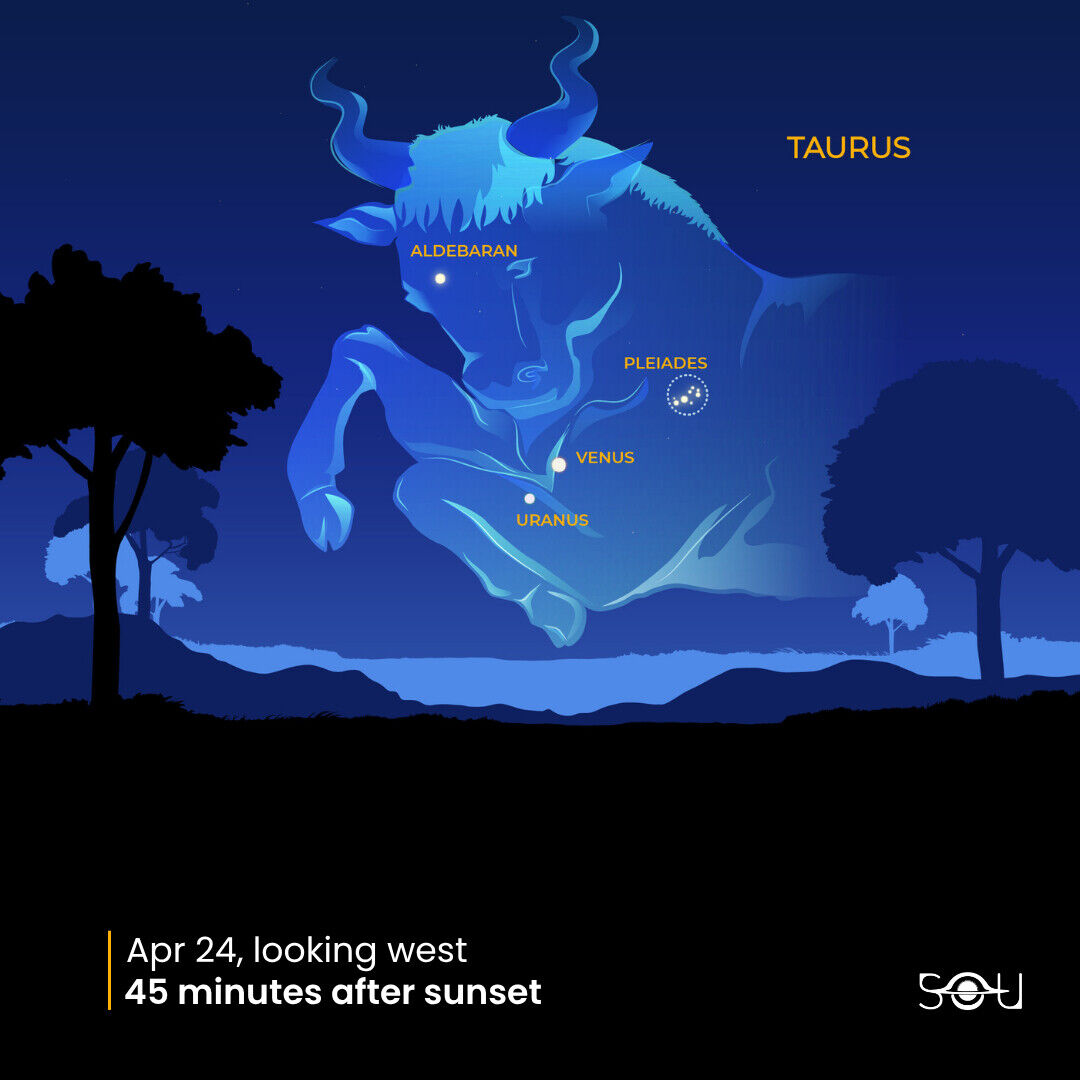
Venus passes close to Uranus near the Pleiades in Taurus on April 24, 2026, visible 45 minutes after sunset looking west.
In the western sky after sunset, Venus draws close to Uranus in the constellation Taurus, with the Pleiades star cluster glittering nearby. Venus is currently the brightest object in the evening sky by a considerable margin — its brilliance makes it an ideal signpost for locating its far more elusive neighbor.
Uranus, at magnitude +5.8, sits right at the edge of naked-eye visibility under ideal dark-sky conditions, but the proximity of Venus removes all guesswork. A pair of binoculars pointed at Venus will bring Uranus into the same field of view as a pale, blue-green dot — a color that distinguishes it immediately from the white pinpoints of background stars. The Pleiades, hovering nearby, complete a scene that rewards even a casual glance westward after dusk.
- When & Where: Western sky after sunset; look toward Taurus.
- Gear: Naked eye for Venus; binoculars needed to identify Uranus.
April 30 — The Moon Meets Spica
April closes with an elegant pairing in the constellation Virgo. A nearly full Moon — illuminated to 98% — will pass close to Spica, one of the brightest stars in the night sky, with just under two degrees separating the pair. he waxing gibbous Moon will be near Spica on the late evenings of April 29, and 30, but the closest approach comes on the 30th, making it the most rewarding night to observe.
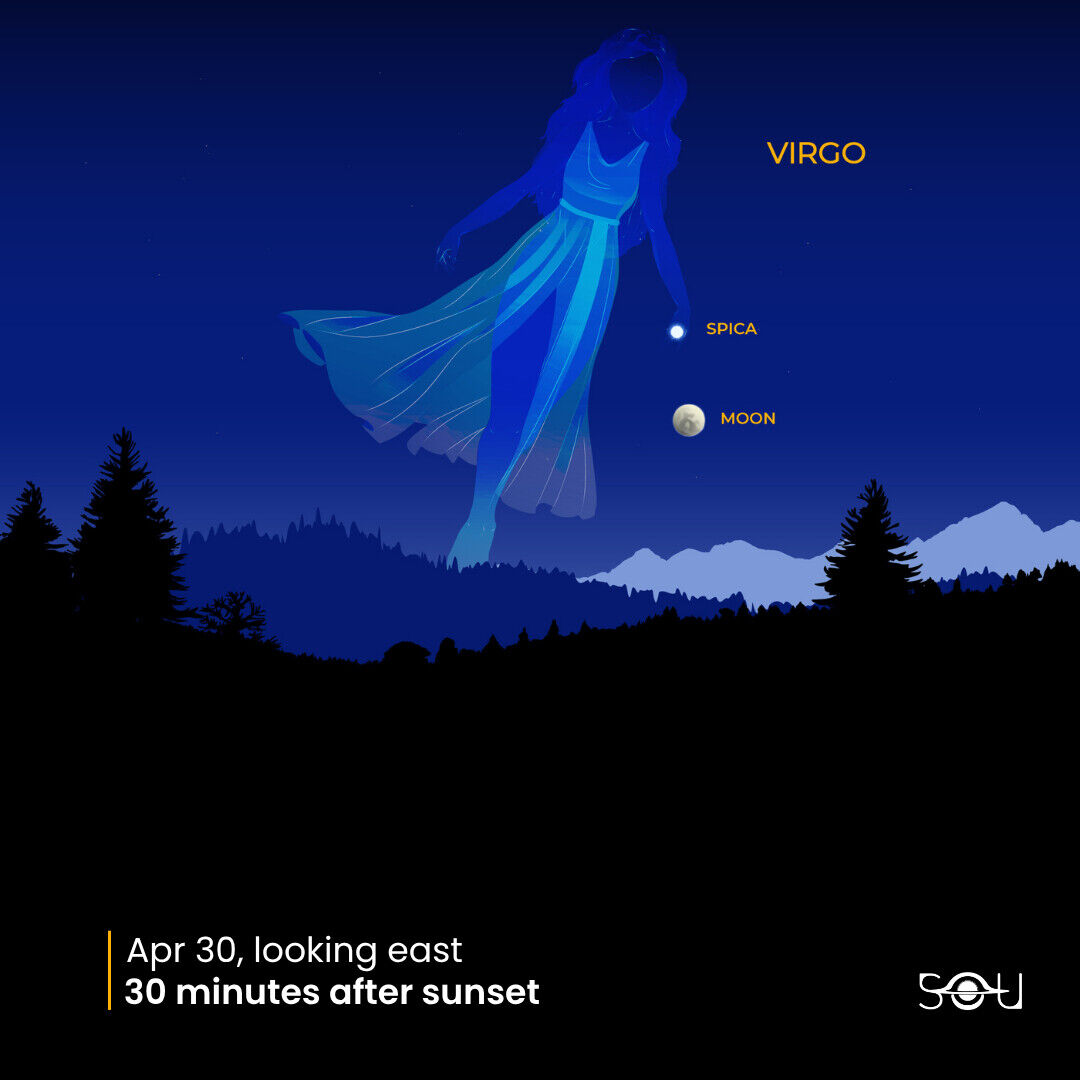
The Moon rises alongside Spica in Virgo on April 30, 2026, visible 30 minutes after sunset looking east.
For observers learning the spring sky, the pairing also serves a practical purpose. The traditional guide to finding Spica runs from the handle of the Big Dipper, arcing to the bright orange star Arcturus, then continuing the same curve down to Spica — a technique known as "arc to Arcturus, spike to Spica." With the Moon sitting beside it on April 30, no technique is needed at all.
- When & Where: Evening sky; visible globally throughout the night in Virgo.
- Gear: Naked eye; binoculars will bring both objects into a single satisfying field of view.
Planet Round-Up — April 2026
Mercury becomes visible as a morning planet during the first half of April, reaching peak elongation on the 3rd before retreating toward the Sun.
Venus continues to dominate the western evening sky after sunset, brightening steadily as it draws closer to Earth in its orbit.
Mars returns to the predawn sky in mid-April, appearing low in the east alongside Mercury and Saturn before sunrise.
Jupiter remains the anchor of the evening sky in Gemini throughout the month, though it will drift noticeably westward as April gives way to May.
Saturn re-emerges from behind the Sun and becomes visible in the eastern predawn sky from mid-April onward.
Uranus sits near the Pleiades in Taurus and can be located shortly after sunset with binoculars under reasonably dark skies.
Neptune remains too close to the Sun for observation this month, having passed solar conjunction in late March.