New Research Suggests Dark Matter Isn’t Completely Dark After All
For decades, dark matter has lived up to its name — invisible, undetectable, and known only through its gravitational pull. But a new study suggests that this mysterious substance might not be completely dark after all. Under the right conditions, it could leave behind a faint “fingerprint” of red or blue light.
The research by physicists at the University of York and published in Physics Letters B, proposes that light traveling through regions rich in dark matter could pick up a subtle color shift — a tint that depends on the properties of the dark matter itself.
A Faint Signature
Dark matter is thought to make up about 27% of the universe, dominating all visible matter combined. Yet, because it doesn’t emit, absorb, or scatter light, scientists have so far been able to detect it only through its gravitational effects — how it shapes galaxies and bends light from distant stars.

Content of the Universe according to standard cosmology
The new analysis challenges the long-held assumption that dark matter and light never interact. Instead, the researchers suggest that dark matter might subtly influence photons as they pass through dark matter-dominant regions, shifting their color ever so slightly toward the red or blue end of the spectrum.
“It’s a fairly unusual question to ask in the scientific world, because most researchers would agree that dark matter is dark,” Dr. Mikhail Bashkanov from the University of York’s School of Physics, Engineering and Technology, and a member of the study said in a statement. “But we’ve shown that even dark matter that is the darkest kind imaginable could still have a kind of color signature.”
“Six Handshakes”
To explore how this could happen, the team drew inspiration from the “six handshake rule” — the idea that any two people on Earth are connected through a short chain of acquaintances. In a similar way, particles may be connected through indirect interactions, even if they don’t interact directly.
If dark matter doesn’t couple to light itself, it might still influence it through other particles. For example, weakly interacting massive particles (WIMPs) that communicate with photons via a chain involving the Higgs boson or the top quark.
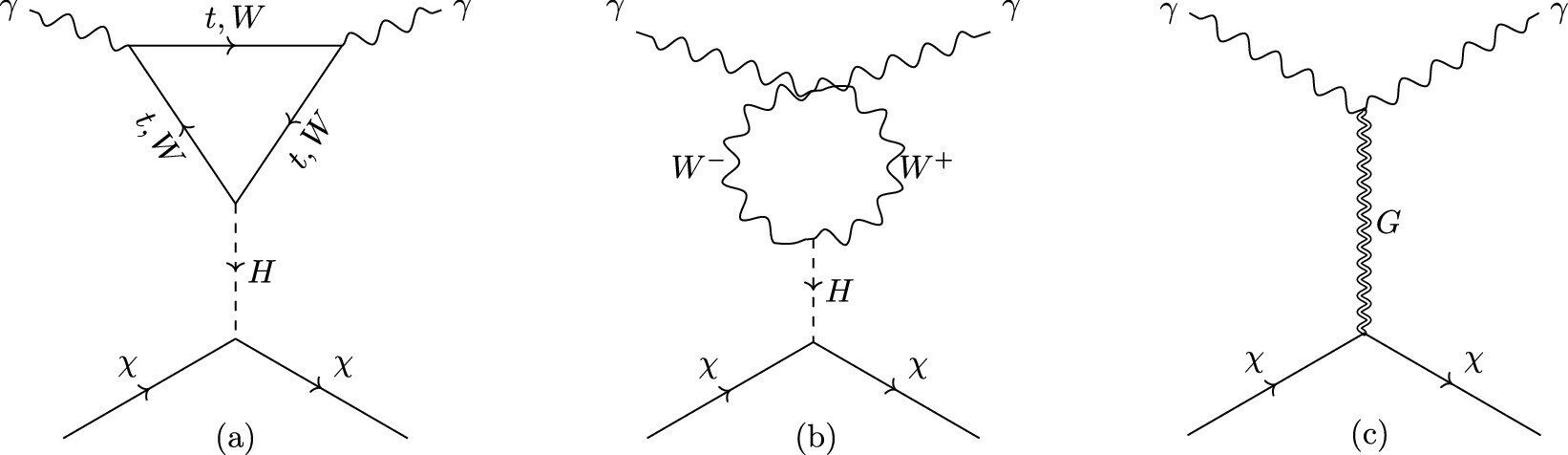
All possible diagrams for dark matter-photon scattering propagated by the Higgs boson and Graviton in the unitary gauge.
The researchers examined all the possible ways these indirect “handshakes” could occur or theoretical pathways — known as scattering diagrams — by which dark matter might interact with photons through intermediaries such as the Higgs boson and graviton. Their findings suggest that these effects, though subtle, might be measurable with next-generation telescopes or future high-precision detectors.
Hunting the Invisible
“It’s a fascinating idea, and what is even more exciting is that, under certain conditions, this ‘color’ might actually be detectable,” said Bashkanov. “With the right kind of next-generation telescopes, we could measure it. That means astronomy could tell us something completely new about the nature of dark matter.”
The results could help scientists achieve a significant step in dark matter search by narrowing down which dark matter candidates to focus on. Additionally, if this theory is confirmed, instead of searching for dark matter through gravity alone, astronomers could focus on tracing its presence through the faintest shades of color imprinted on light.
“Right now, scientists are spending billions building different experiments,” Bashkanov added. “Our results show we can narrow down where and how we should look in the sky, potentially saving time and helping to focus those efforts.”
Research paper
A. Acar et al, Dark matter: Red or blue?, Physics Letters B (2025). DOI: 10.1016/j.physletb.2025.139920