The Rare Micro Blue Moon Rises on May 31, 2026 — Here's How to Watch
On the last night of May, a full moon will rise that carries two names — and lives up to neither of them. It will not be blue. It will not be enormous. But it will be the rarest and smallest full moon of 2026, and the story behind it stretches back centuries.
What Is a Micro Blue Moon?
A Micro Blue Moon is what happens when two distinct lunar phenomena line up on the same night — a coincidence that does not happen often, and never in quite the same way twice.
The first ingredient is a Blue Moon. Despite the name, the Moon does not actually turn blue. In modern usage, a Blue Moon is the second full moon to occur within a single calendar month. It is an extra full moon, squeezed into a month that would normally have just one. The phrase "once in a blue moon" — meaning something rare — comes directly from how seldom this happens.
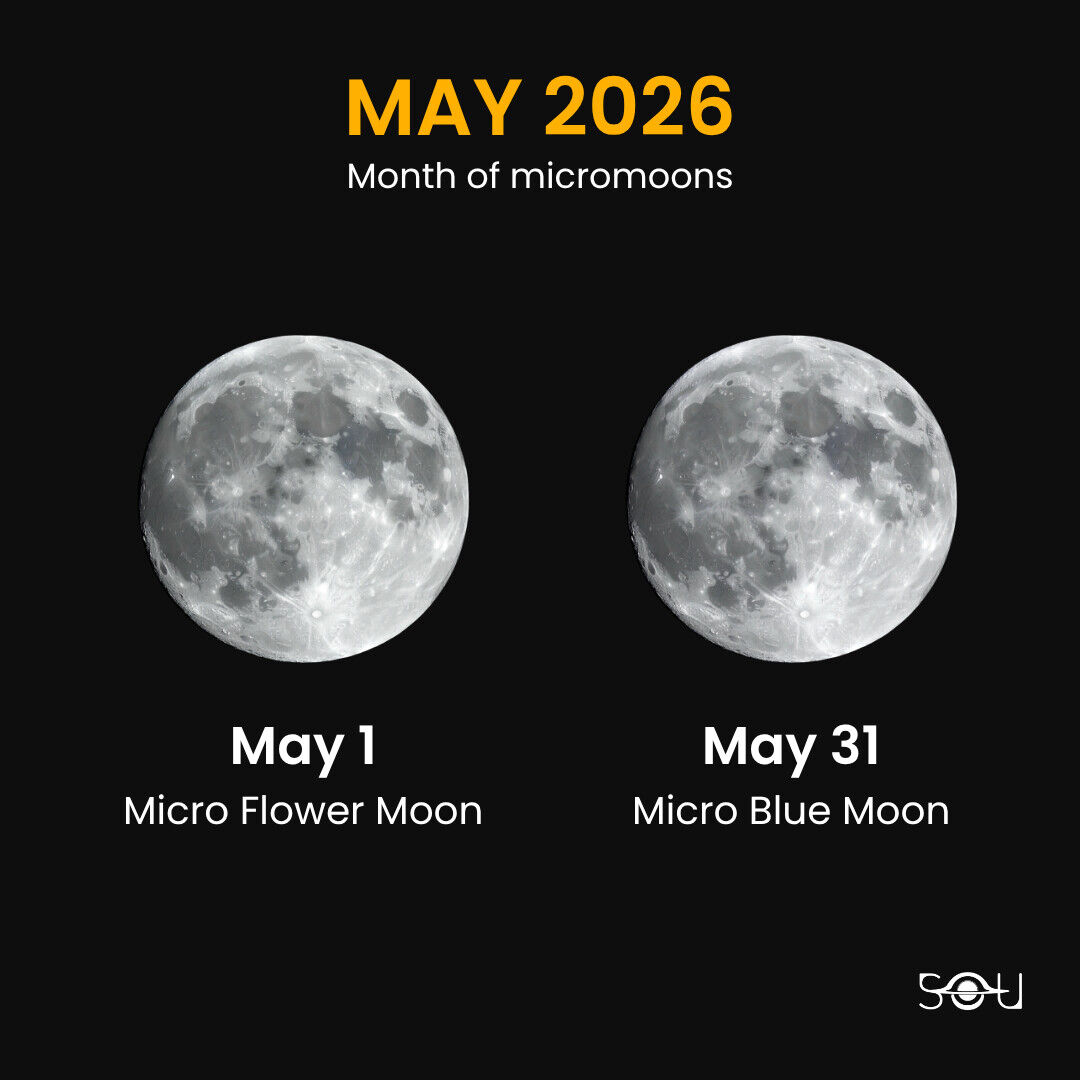
The two full Moons of May 2026 (Micro Flower Moon and Micro Blue Moon)
The second ingredient is a Micromoon. This occurs when a full moon coincides with the Moon's farthest point from Earth in its elliptical orbit, called apogee. At apogee, the Moon sits roughly 50,000 kilometres farther from us than it does at its closest approach. The result is a full moon that appears slightly smaller and dimmer than average.
Put them together, and you have a Micro Blue Moon — a rare, distant, second-of-the-month full moon. May 31, 2026 will deliver exactly that.
When Is the Micro Blue Moon in 2026?
Mark the date: Sunday, May 31, 2026.
The Micro Blue Moon will reach peak illumination at 08:45 UTC on May 31, 2026. Here is when that translates to local time around the world:
- United States (East Coast): 4:45 AM EDT, May 31
- United States (Central): 3:45 AM CDT, May 31
- United States (Pacific): 1:45 AM PDT, May 31
- United Kingdom: 9:45 AM BST, May 31
- India: 2:15 PM IST, May 31
- Australia (East): 6:45 PM AEST, May 31
For most people, the best time to watch will not be at the exact instant of full Moon, but around moonrise on the evening of May 30 or May 31, depending on your location. A full Moon always rises near sunset and remains visible through the night, making it one of the easiest sky events to observe.
From India and much of Asia, the full Moon will be best seen on the evening of May 31. In the Americas, the Moon will appear full overnight from May 30 into May 31, with the exact full phase occurring before sunrise on May 31.
How Small Will the Micro Blue Moon Look?
This is the part that makes the May 2026 Blue Moon scientifically interesting.
The Blue Moon on May 31, 2026 occurs near apogee — and it is the smallest Micromoon of 2026. During this full moon, the Moon will sit 252,360 miles from Earth, compared to its average distance of 238,855 miles.
The result: it will appear about 6 to 7 percent smaller than an average full moon, and roughly 12 to 14 percent smaller than a supermoon.
That difference sounds dramatic on paper. In reality, the human eye struggles to detect it without a direct comparison. What is far more striking is the so-called Moon illusion — the optical phenomenon that makes any full moon, micro or otherwise, appear enormous when it sits near the horizon. If you want to feel the size of this Moon, watch it rise.
Why Is It Called a Blue Moon?
The name is a beautiful mess of folklore and accident.
The original definition was seasonal. Each season — spring, summer, autumn, winter — typically contains three full moons. But because of a quirk in the lunar calendar, some seasons end up with four. The third of those four full moons was historically called a Blue Moon. This older definition still appears in almanacs and astronomy circles.
The more familiar definition — the second full moon in a single calendar month — actually came from a mistake. A 1946 article in Sky and Telescope inadvertently simplified the older definition from the Maine Farmer's Almanac, and the modern interpretation stuck.
As for the colour: a true blue-tinted Moon is exceedingly rare and unrelated to either definition. It usually requires specific atmospheric conditions — large amounts of smoke or dust from volcanic eruptions or wildfires scattering red light and leaving the Moon with a bluish cast.
How Often Does a Calendar-Month Blue Moon Happen?
Calendar-month Blue Moons occur about seven times every 19 years — roughly every two and a half to three years on average. The previous calendar-month Blue Moon occurred on August 31, 2023. After May 31, 2026, the next calendar-month Blue Moon will fall on December 31, 2028. A seasonal Blue Moon will arrive sooner, on May 20, 2027 — but they are two different phenomena entirely.
The net micro blue moon, however, will arrive 27 years later, on July 30, 2053.
A Bright Companion: The Star Antares
The May 2026 Blue Moon will not be alone in the sky. During the full moon's crest, it will be positioned near Antares, the brightest star in the constellation Scorpius, the Scorpion.
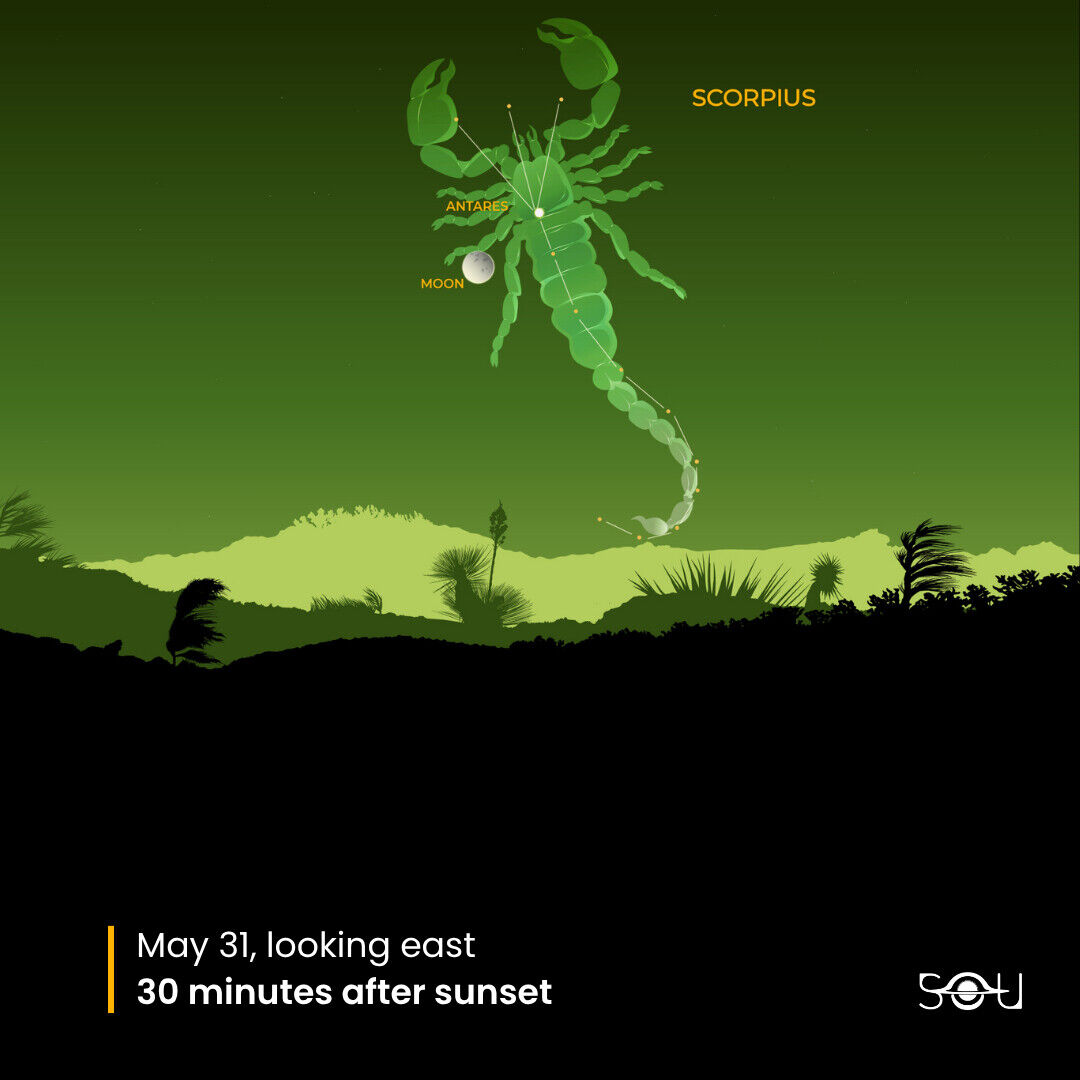
The Micro Blue Moon will glide past Antares, the brightest star of Scorpius
Antares is one of the night sky's most distinctive stars — a red supergiant some 550 light-years from Earth, glowing with the same warm, reddish hue that gave it its name (Antares means "rival of Mars"). Seeing it shine close to a full moon is a treat in itself. The Moon's brightness will wash out fainter stars, but Antares will hold its own.
How to Watch the Micro Blue Moon
No equipment required. The Moon is the most generous of celestial objects — visible to anyone with a clear view of the sky.
That said, a few small steps will dramatically improve the experience:
- Find an unobstructed horizon. The Moon looks largest and most photogenic at moonrise and moonset.
- Check your local moonrise time. Apps like Sky Tonight, Stellarium, and SkySafari will pinpoint the exact moment for your location.
- Bring binoculars if you have them. They reveal the lunar maria — the dark "seas" — and the larger craters in stunning detail.
- Photograph carefully. Lower your camera's exposure to avoid blowing out the Moon's surface details. Manual focus set to infinity produces the sharpest results.
The Micro Blue Moon will not look spectacular at first glance. It will not be enormous. It will not glow with unusual colour. But it carries within it a centuries-old phrase, a calendar quirk, an orbital geometry, and a partnership with the brightest star in Scorpius.