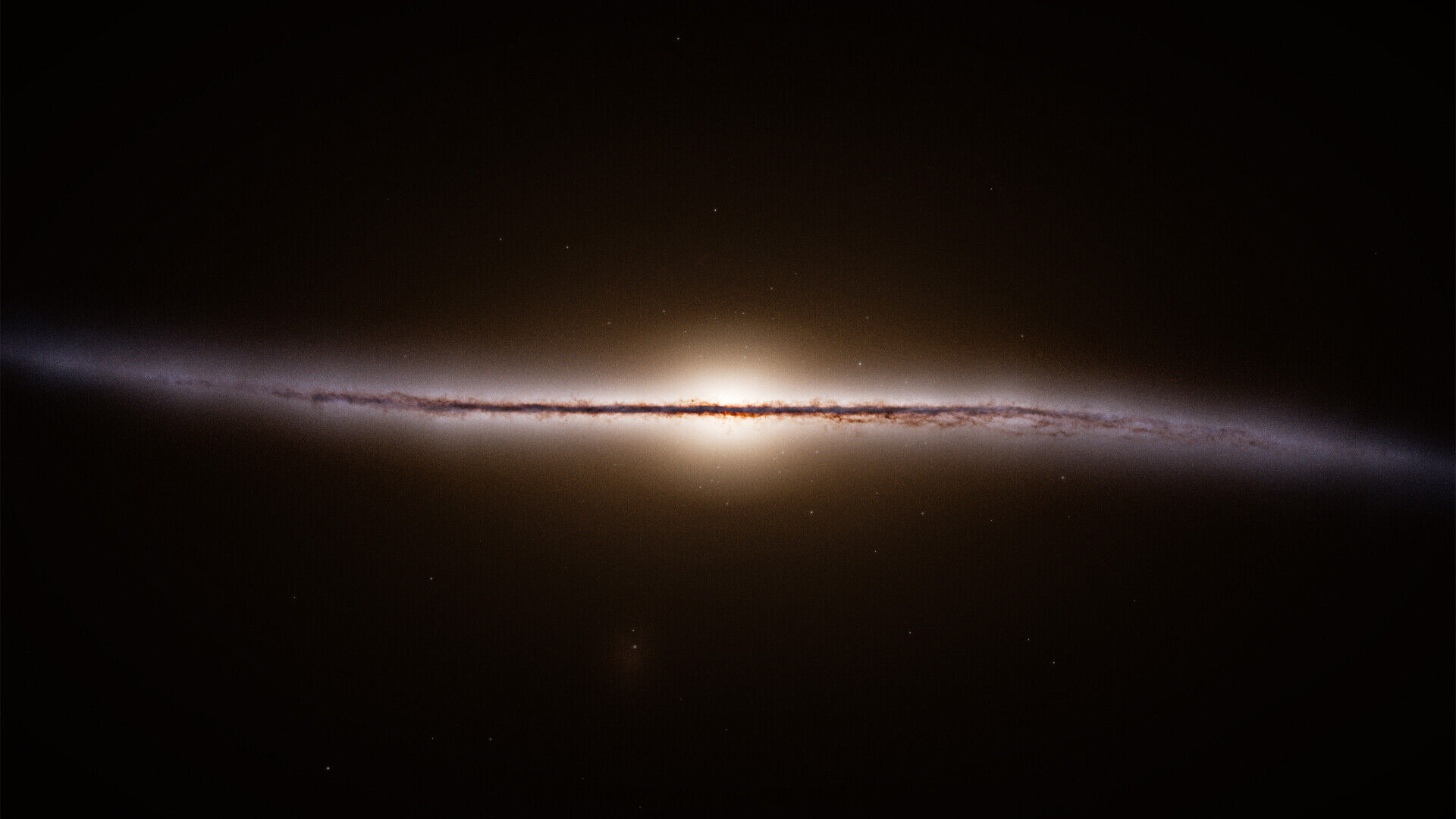
The Milky Way Has an Edge, And Astronomers May Have Just Found It.
What defines the boundary of a galaxy? A galaxy's disc does not stop at once. It becomes less dense with the distance from the center, and gradually fades into space. Astronomers think a galaxy's edge can be defines as the point where star formation simply stops. Now, an international team of researchers have pinned down the boundary of the Milky Way galaxy.
The paper outlining the findings was published in the Astronomy & Astrophysics journal on April 13.
A U-shaped Hint
Researchers analyzed the ages of thousands of giant stars spread across the Milky Way's outer disc, drawing on two major stellar surveys — LAMOST and APOGEE — and combined it with measurements from the Gaia telescope. Using this, they built the most detailed picture yet of how stellar ages vary with distance from the galactic center.
"The extent of the Milky Way's star-forming disc has long been an open question in Galactic archaeology; by mapping how stellar ages change across the disc, we now have a clear, quantitative answer," the lead author of the study, Dr. Karl Fiteni of the University of Insubria said in a statement.
They found that the age distribution traces a U-shape. Stars get younger as you move outward through the inner disc, then at a certain point the trend flips, and stars start getting older again the further out you go.
The turning point, where the youngest stars sit, was pinned down to between 11.28 and 12.15 kiloparsecs (35,000 to 40,000 light-years ) from the galactic center. According to the team, this point where the trend flips is the end of the galaxy's star-forming region, and therefore, the edge of our home galaxy.
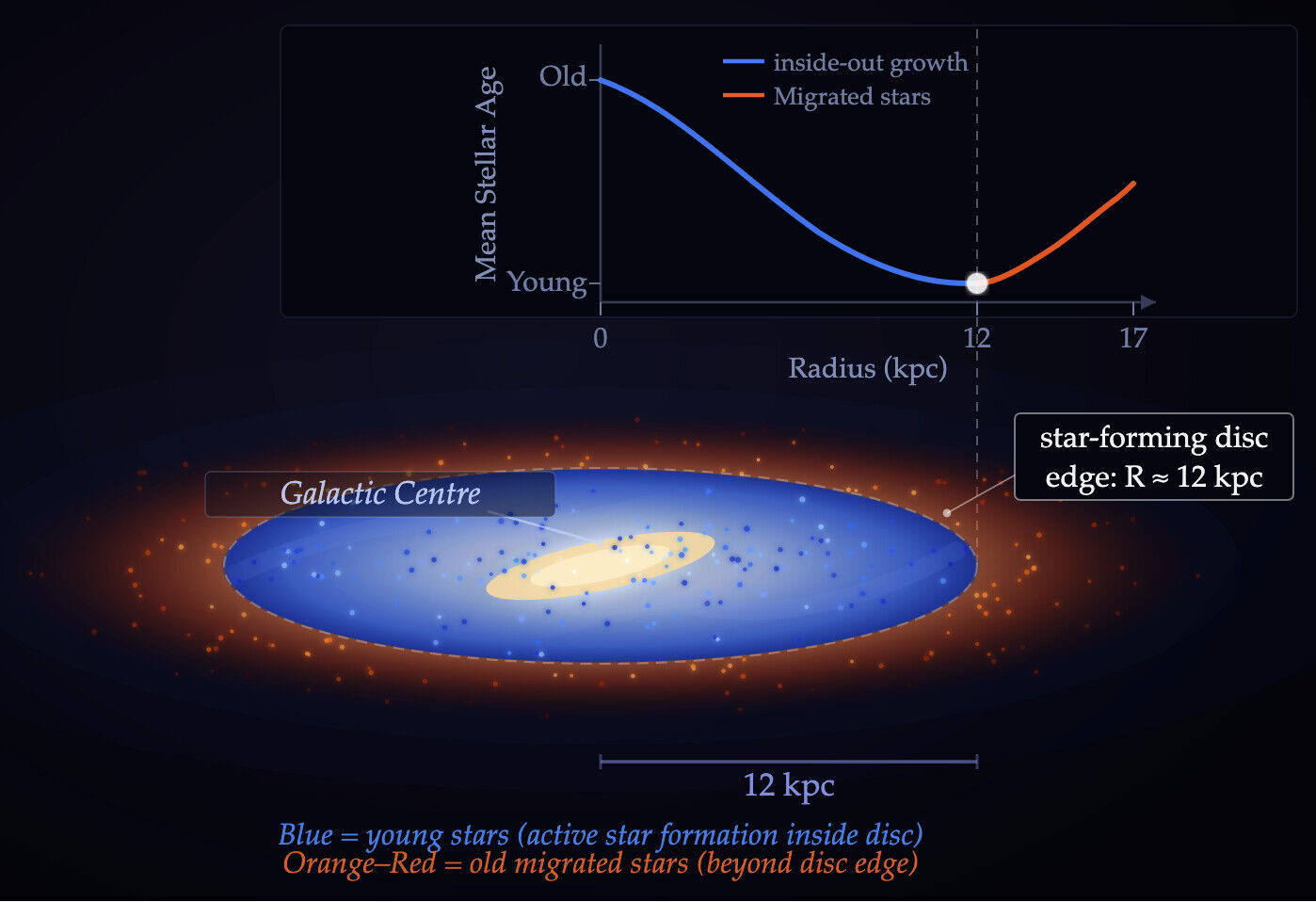
The relationship between stellar age and distance from the center yields a U-shaped curve.
The team ran state-of-the-art galaxy simulations and found that the age minimum lines up precisely with a sharp drop in star formation — marking the point where the Milky Way's star-forming disc effectively ends.
"The data now available allow increasingly precise stellar ages to serve as powerful tools for decoding the story of the Milky Way, ushering in a new era of discovery about our home Galaxy", said Prof. Joseph Caruana, co-author and supervisor of the project based at the University of Malta.
Why and How?
Beyond this point, star formation drops off sharply, and the older stars found after that radius are not locally born. They were born closer to the galactic center billions of years ago and gradually nudged outward by gravitational interactions . As a result, they migrated outward from the inner disc over time. This is called "radial migration."
“In astrophysics, we use simulations run on supercomputers to identify the physical mechanisms responsible for the features we observe in galaxies”, co-author Dr. João A. S. Amarante, from Shanghai Jiao Tong University explained. In this study, he added, “they allowed us to demonstrate how stellar migration shapes the age profile of the disc and to identify where the star-forming region ends.”
Inside the break radius, the disc behaves as expected — gas cools, clouds collapse, and new stars ignite regularly.
"The root cause of the star-formation drop beyond the break radius remains unclear," the team writes in the paper. The exact reason star formation shuts down at this boundary remains open: the bar's gravitational resonance, the galactic warp, or heating from intergalactic radiation are all plausible candidates.
The next generation of sky surveys — including 4MOST and WEAVE — will deliver richer and more precise data, giving astronomers the tools to sharpen these measurements and, hopefully, pin down exactly what causes star formation to switch off at the galaxy's edge.
Research paper
Karl Fiteni et al, The edge of the Milky Way’s star-forming disc: Evidence from a ’U-shaped’ stellar age profile, Astronomy & Astrophysics(2026). DOI: 10.1051/0004-6361/202558144