The Orionid Meteor Shower Peaks Soon — Here’s When and How to Watch
Every October, the night sky comes alive with streaks of light that trace their origin back to one of the most famous travelers in the solar system — Halley’s Comet. These streaks are the Orionid meteor shower, an annual celestial display that reminds us of our planet’s continuing encounter with the ancient debris of a passing comet.
Born From Halley’s Comet
Each Orionid meteor is a tiny fragment shed by Comet 1P/Halley, which swings through the inner solar system once every 76 years. Long after the comet has disappeared from view, its dust trail lingers — and every October, Earth plows through that stream of cosmic rubble.
As these grains slam into our atmosphere at nearly 66 kilometers per second (41 miles per second), they vaporize in flashes of light, producing the swift, bright meteors we call the Orionids.
What Makes the Orionids Special
Few meteor showers can rival the Orionids for speed and beauty. These meteors are not only fast and brilliant, but they often leave behind glowing trains — persistent streaks that hang in the air for seconds after the meteor vanishes. Occasionally, a fireball flares across the sky, bright enough to cast shadows in the dark.

The radiant of the Orionids
The shower’s radiant — the point from which the meteors seem to emerge — lies near the shoulder of Orion the Hunter, one of the most recognizable constellations in the sky. This backdrop of bright stars makes the Orionids as photogenic as they are spectacular.
Orionid Meteor Shower 2025: When and Where to Watch
The Orionid meteor shower is active from September 26 to November 7, but the best viewing comes in the early morning hours of October 21, after midnight until dawn.
At the time of the peak — around 00:00 UTC on October 21 — Earth will be passing through the densest part of Halley’s debris stream. The Moon will be new (at 12:25 UTC that same day), leaving the night sky dark and ideal for meteor watching.
Under these conditions, observers at dark-sky locations can expect to up to 20 meteors per hour, though the real charm of the Orionids lies in their speed and brilliance, not sheer numbers.
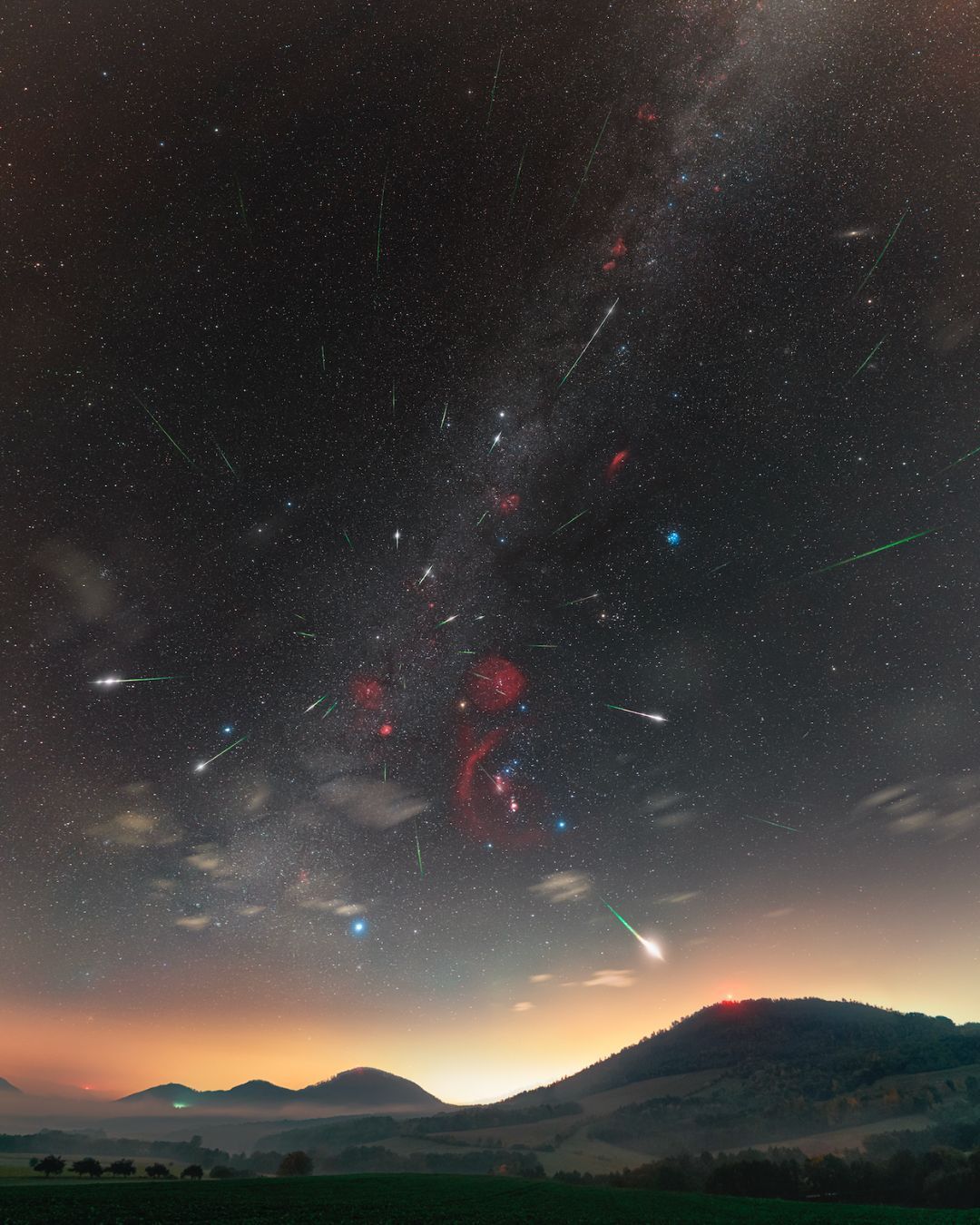
Composite image of the Orionids meteor shower taken over 2015-2022. Photographed near Presov, Slovakia.
For the best experience:
- Look up after midnight and before dawn, when Orion climbs highest in the sky.
- Find a dark, open location away from city lights.
- Give your eyes about 20 minutes to adjust to the darkness.
Because Orion lies close to the celestial equator, the show is visible from both hemispheres — in the Northern Hemisphere, look toward the southwest, and in the Southern Hemisphere, toward the northwest.
Also Read: The 5 Space Apps That Will Change How You See the Night Sky
A Gift From a Comet That Keeps Giving
Halley’s Comet won’t return to the inner solar system until 2061, but it continues to make its presence known twice every year — once in May through the Eta Aquarids, and again in October through the Orionids.
So, mark your calendars, step outside in the pre-dawn chill, and look up. The universe has been planning this light show for thousands of years — and this year’s Orionids promise a brilliant performance.