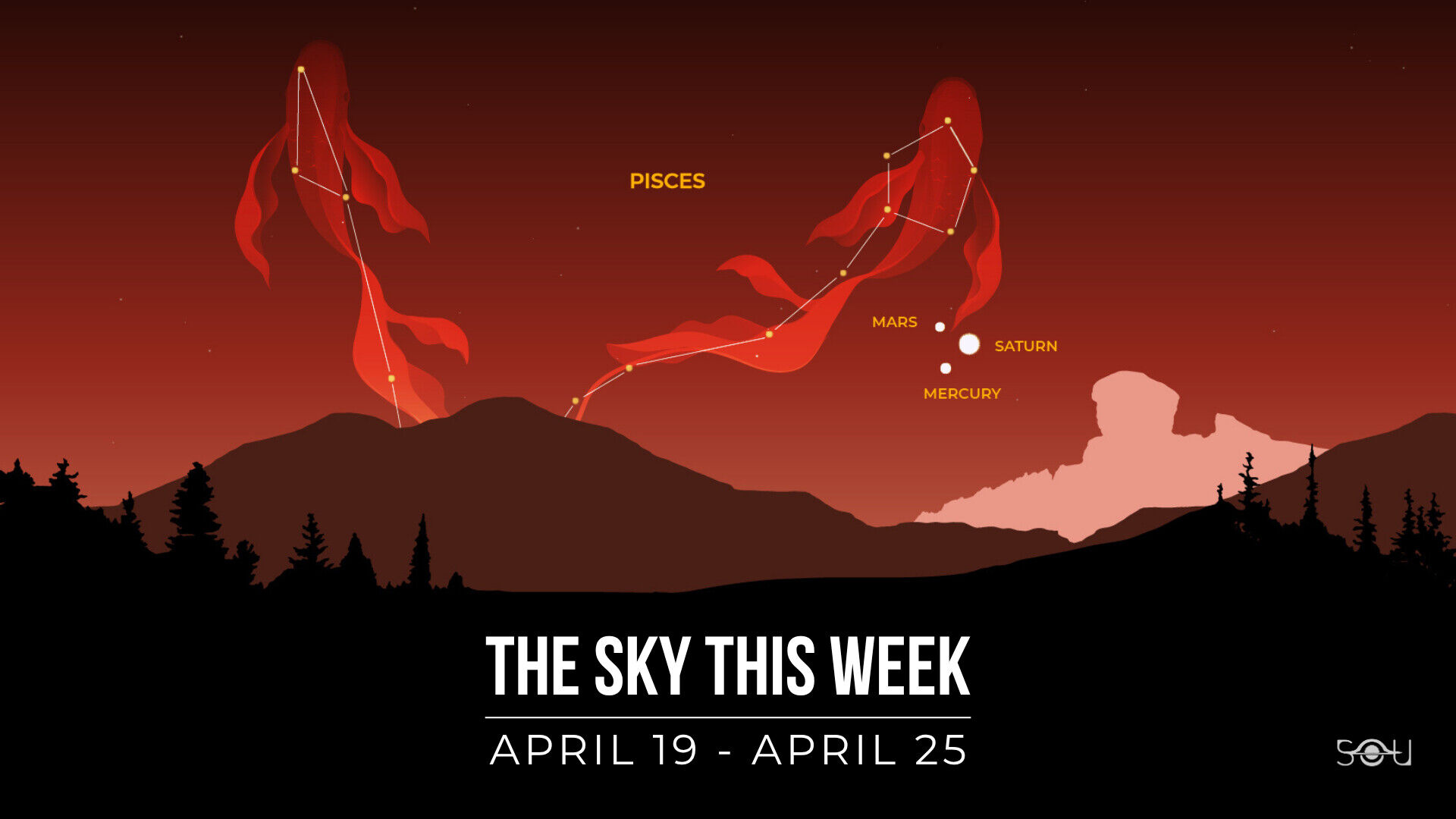
The Sky This Week, April 19 - April 25, 2026
This week offers one of the richest stretches of sky-watching in April 2026. Three planets gather at dawn, the Lyrid meteor shower peaks under dark skies, and a brightening comet climbs through Pegasus. Here's what to look for, night by night.
April 19 — A Gathering in Taurus

A crescent Moon joins Venus, the Pleiades, and Uranus in Taurus on April 19, 2026, visible 30 minutes after sunset looking west.
The week opens on Sunday evening with one of those arrangements the sky offers only occasionally — four objects, wildly different in nature and distance, briefly framed together in the same patch of Taurus. About ninety minutes after sunset, look west. A slender waxing crescent Moon, only two days old and glowing with the faint ash-light of earthshine, will hang low above the horizon. Just above it, Venus blazes at magnitude −3.9, unmistakable.
Higher still, the Pleiades, that small silver smudge of seven sisters, a cluster of hot young stars some 440 light-years away, float in their familiar dipper shape. And tucked quietly near Venus, invisible to the unaided eye, is Uranus: a pale green world four times the size of Earth and nearly three billion kilometres from the Sun. Binoculars will pull it into view as a dim, distinctly non-stellar dot.
It is a scene worth lingering over. The Moon is four light-seconds away. Venus, six light-minutes. Uranus, two and a half light-hours. The Pleiades, four and a half centuries. In a single glance west, your eye crosses from the neighbourhood to the deep past
April 20–22 — A Conference at the Horizon
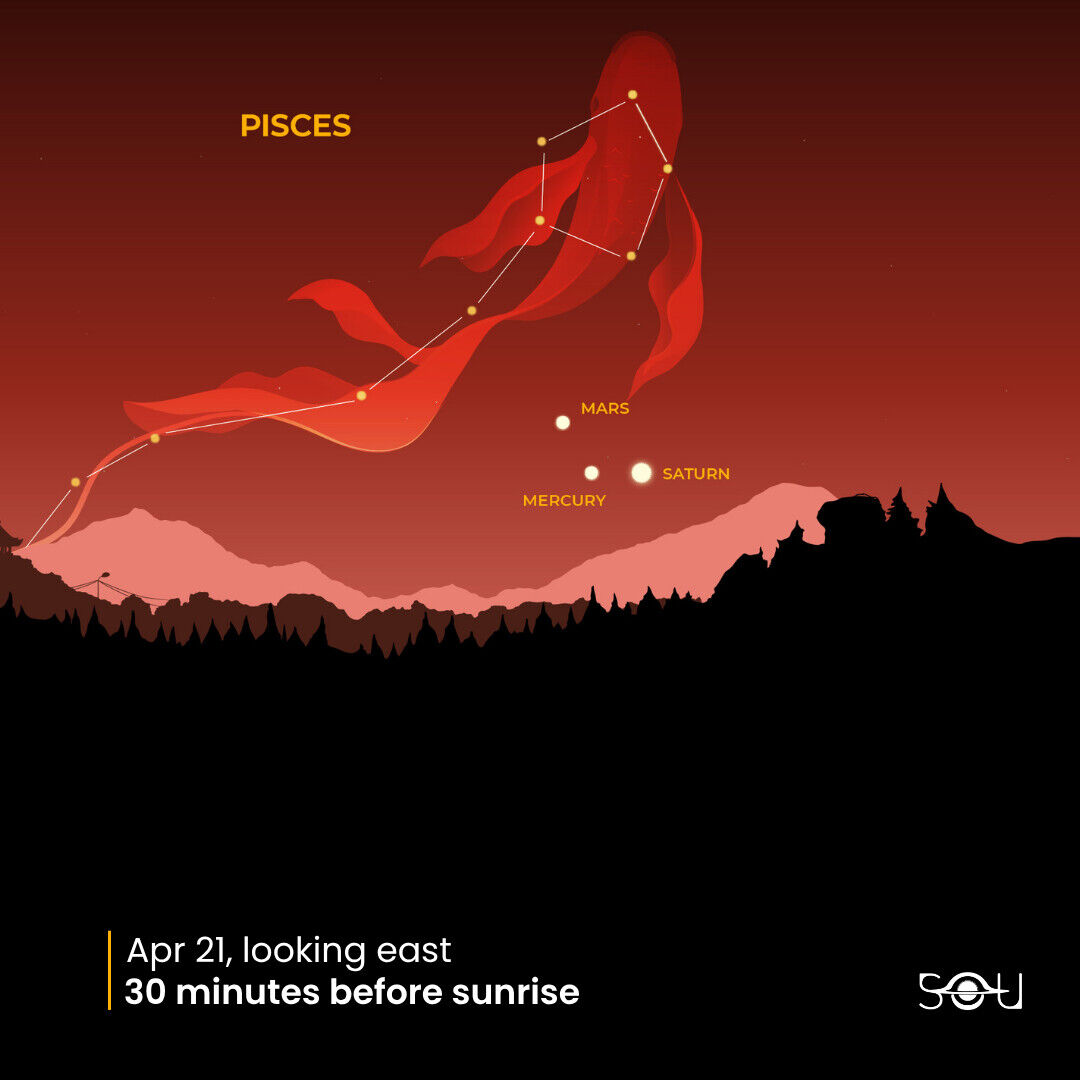
Mercury, Mars, and Saturn converge in Pisces on April 21, 2026, visible 30 minutes before sunrise looking east.
Before sunrise on Monday, three planets will press themselves so close together that two fingers held at arm's length will cover them all. Mercury, Saturn, and Mars, worlds that, in the abstract, are hundreds of millions of kilometres apart, will appear within roughly two degrees of one another, low in the eastern sky, and will hold that tight formation through the mornings of April 21 and 22, subtly shifting shape each dawn.
It is, admittedly, a difficult observation. Thirty minutes before sunrise, the trio will stand only about two degrees above the horizon. You will need an unobstructed eastern view (the shore of a lake, a rooftop), and binoculars will help considerably. Mercury, at magnitude −0.2, is the brightest and easiest to find first; Mars and Saturn, fainter and redder, follow close beside it. Observers in the Southern Hemisphere have the better seat. From the north, the show is whispered rather than spoken.
April 21–22 — The Lyrids
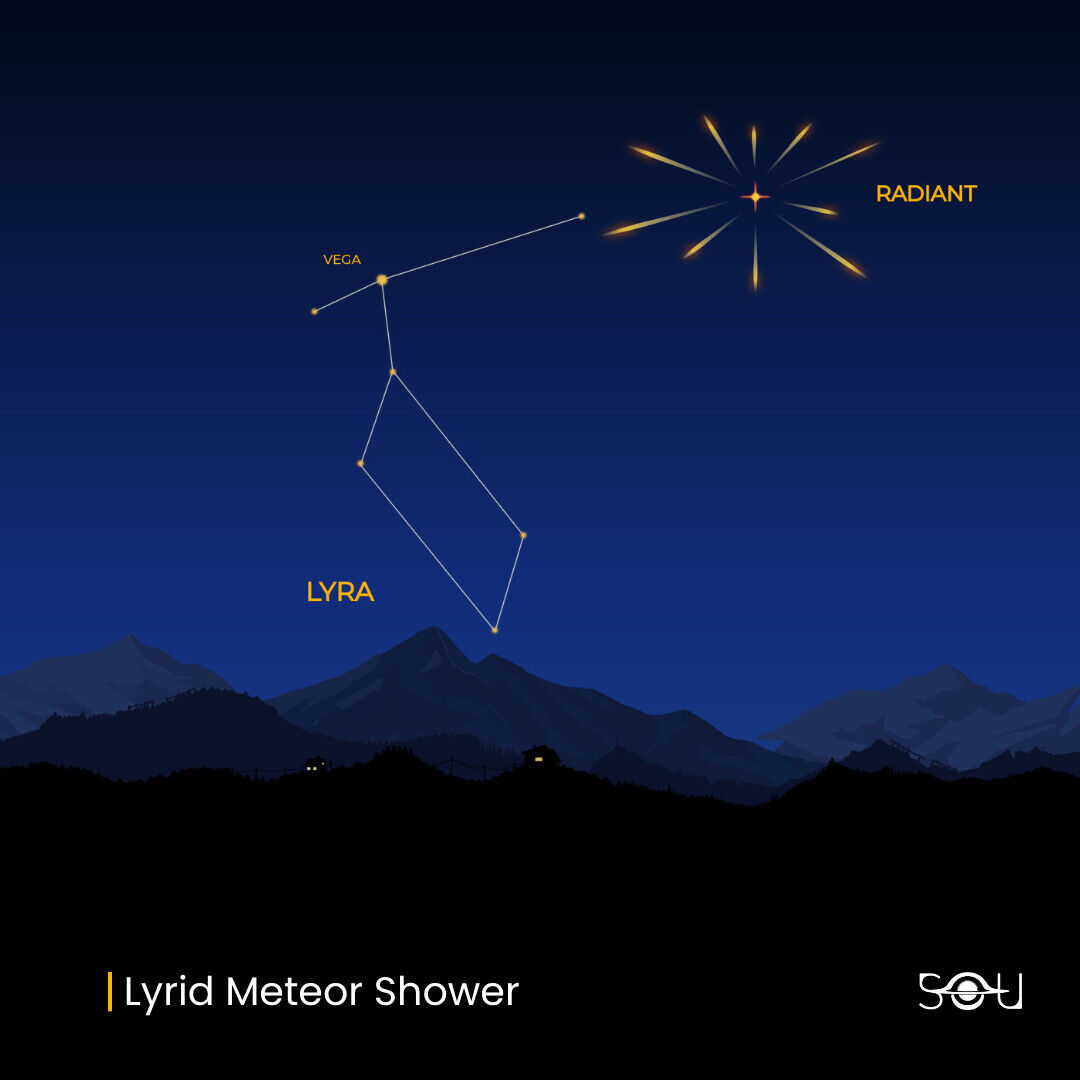
The radiant of the Lyrid meteor shower
The Lyrid meteor shower is among the oldest recorded celestial events on Earth. Chinese astronomers noted it in 687 BCE, describing stars that "fell like rain." The source is Comet Thatcher, a dusty visitor that loops through the inner solar system every 415 years. Each April, Earth ploughs through the trail it left behind, and those grains — most no larger than a grain of sand — burn through our atmosphere at forty-nine kilometres per second.
The peak falls on the night of April 21 into the early hours of April 22. The Lyrids typically deliver around twenty meteors per hour, and this year the first-quarter Moon sets shortly after midnight, surrendering the sky to darkness. Look toward Lyra, near the brilliant blue-white star Vega, rising high in the east by local midnight. Dress warmly, lie back, and give your eyes twenty minutes to adjust.
Here's your full guide to watching the Lyrid meteor shower in 2026.
April 22 — Moon and Jupiter
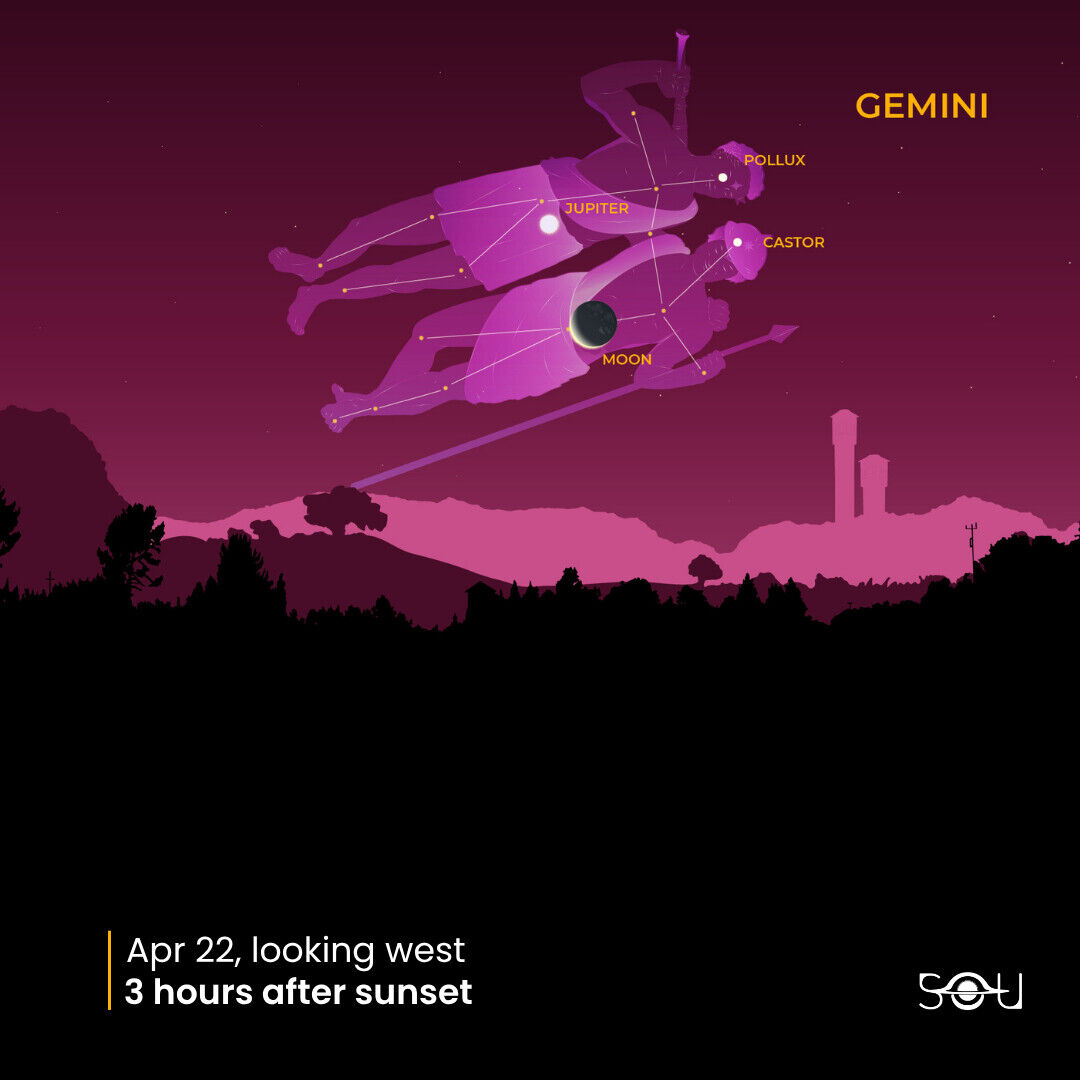
The Moon passes close to Jupiter amid the twin stars Castor and Pollux in Gemini on April 22, 2026, visible 3 hours after sunset looking west.
On Wednesday evening, a waxing crescent Moon drifts past Jupiter in the western sky. A gentle pairing, easy on the naked eye.
April 24 — A Busy Day
Three things at once.
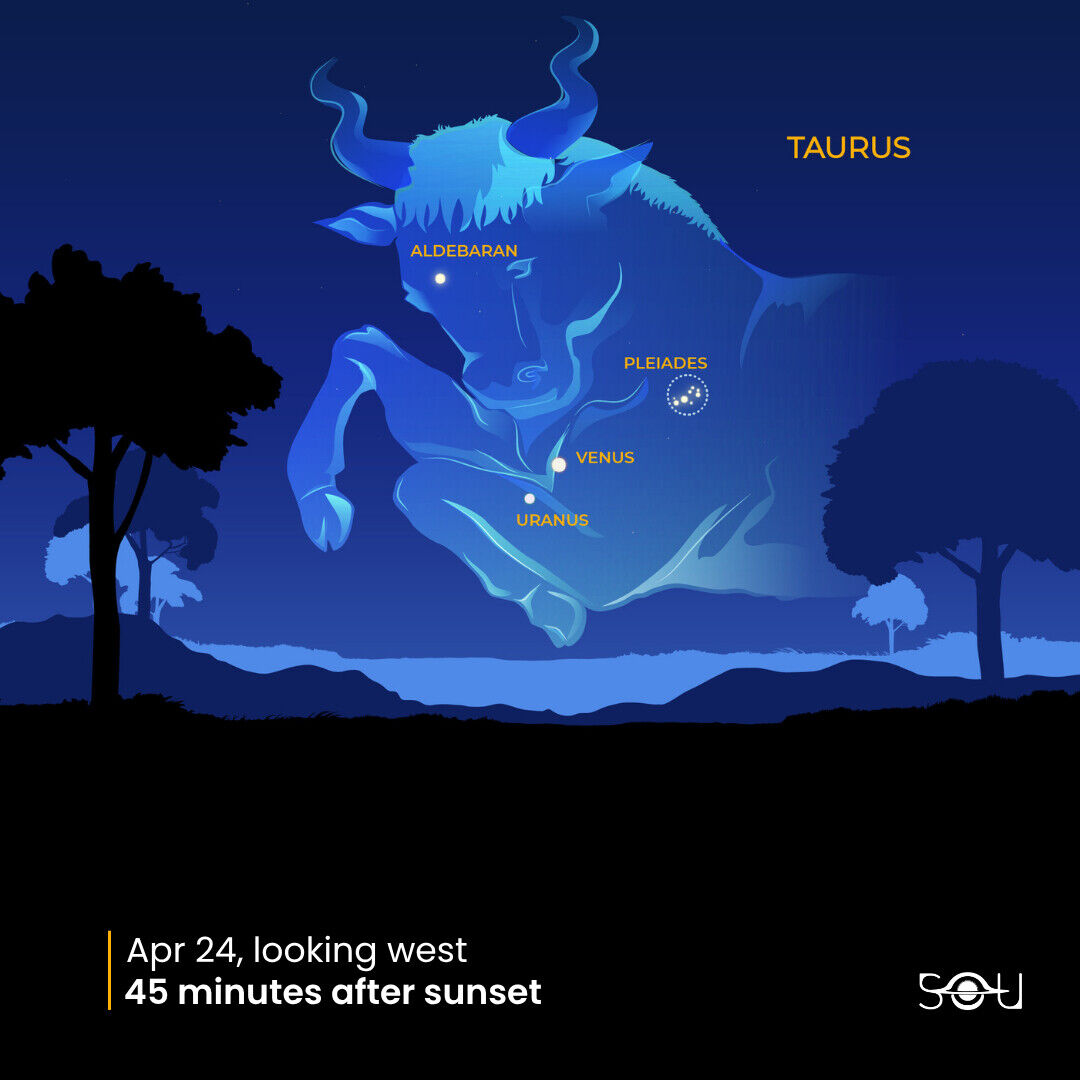
Venus passes close to Uranus near the Pleiades in Taurus on April 24, 2026, visible 45 minutes after sunset looking west.
Venus meets Uranus. In Taurus, the brightest and the faintest of the evening planets cross paths. Venus at magnitude −3.9 will guide you straight to Uranus, a dim greenish pinprick that only binoculars will reveal.
Moon meets the Beehive. The Moon glides past the Beehive Cluster (M44) in Cancer, a swarm of several hundred stars best seen in binoculars just beside the lunar glow.
The Pi Puppids. A minor shower, active only from the Southern Hemisphere, radiating from the constellation Puppis. Rates are modest, but in years when its parent comet 26P/Grigg–Skjellerup has recently passed perihelion, the Pi Puppids can surprise.
April 24–26 — A Visitor from the Deep
_on_29_March_2026-1920x1280.jpg)
Comet C/2025 R3 (PanSTARRS) on 29 March 2026, 2:45 (UTC). The comet features a round, green coma and a nice ion tail, over a degree long, extending beyond the edge of the frame. Coma is about 7 arcminutes across. The two brightest stars visible are 40 and 41 Pegasi. GSO N203/800 with coma corrector, unmodified M4/3 camera. 50x30s from B4 skies, eastern Crete. Edited with DSS, SIRIL and Ps.
Comet C/2025 R3 (PANSTARRS) reaches peak brightness during these nights — perhaps magnitude 7.7, within reach of binoculars, though optimistic forecasts suggest naked-eye visibility. The comet is threading through the Square of Pegasus, low in the eastern sky before dawn for northern observers and shifting to evening skies in the south come early May. Its closest approach to Earth arrives on April 27, at 44 million miles, cosmically intimate, practically safe. You are looking at material that has spent billions of years in the deep freeze of the outer solar system, only now catching the sun.
Next week: the Moon approaches full, Venus climbs higher into the evening, and the Eta Aquariids begin to stir — dust from Halley's Comet, returning as it does every spring.