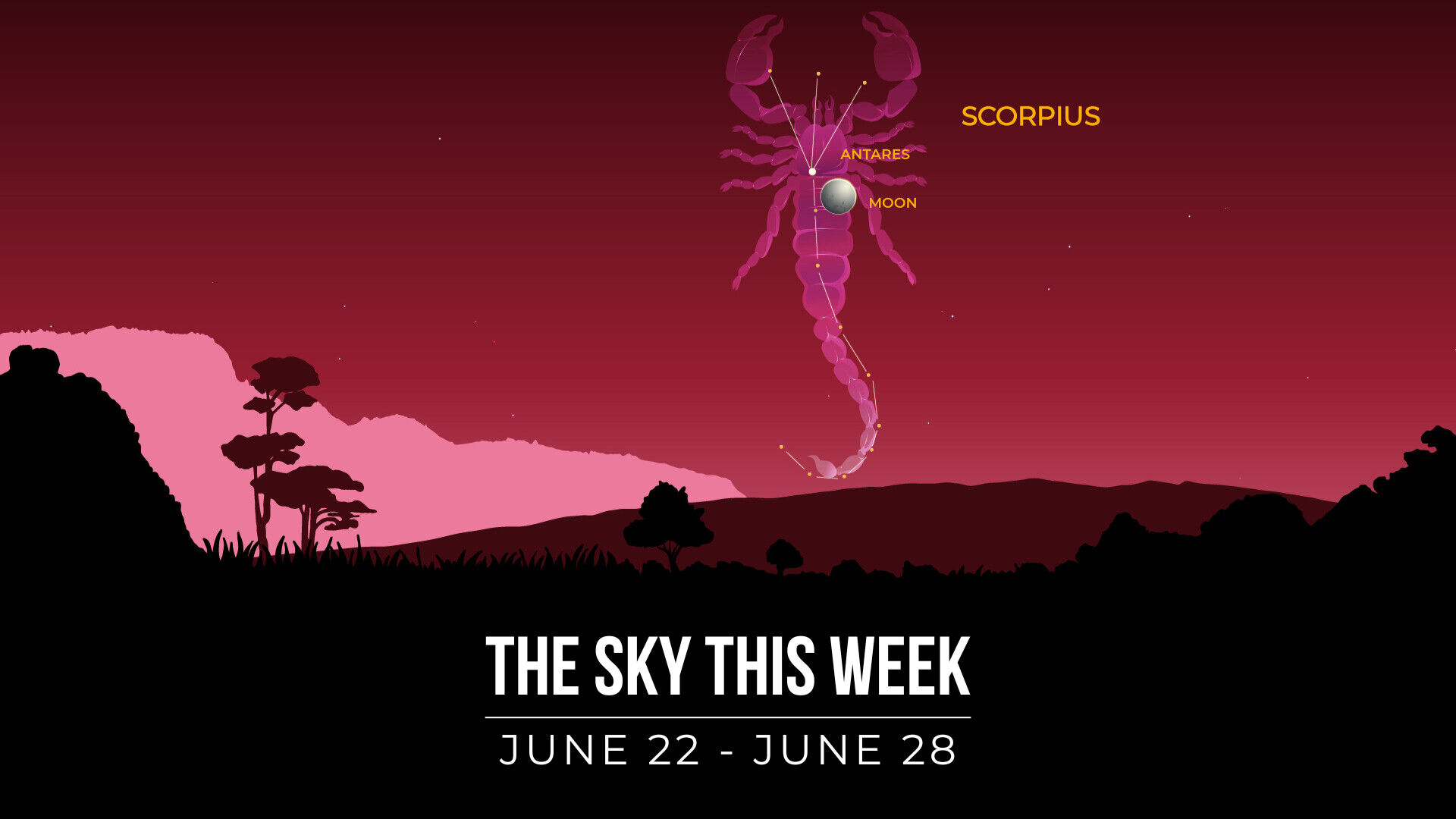
The Sky This Week, June 22 - June 28, 2026
After last week's five-body lineup, the sky changes tempo. The Moon, fresh off first quarter, swells night by night and becomes the main character, sweeping past Spica, grazing the red supergiant Antares, and parking beside the Teapot of Sagittarius by Sunday.
Meanwhile the evening planet show enters its final act as Mercury and Jupiter exchange a parting handshake in the twilight, and Mars opens a new chapter at dawn beside the Pleiades. There's even a long-shot meteor shower to start the week. Here's what to look for, night by night.
June 22 — The June Bootids, a Gamble Worth Five Minutes
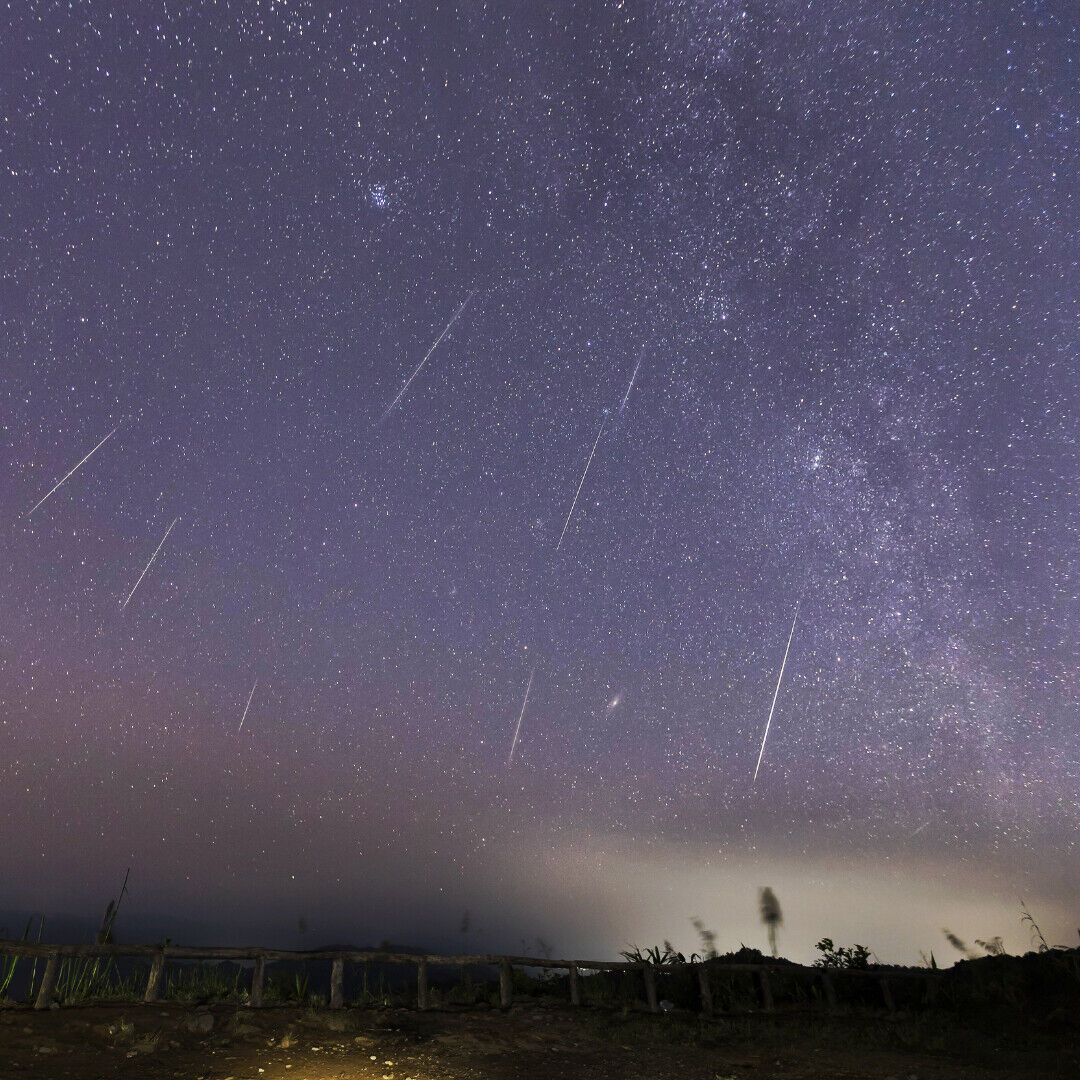
The week begins with the start of one of the year's most unpredictable meteor showers, though its best night is still to come. The June Bootids are active from June 22 to July 2, producing their peak rate of meteors around June 27. Tonight is opening night, not peak night, but the shower is worth knowing about now because of its temperament.
Most years it manages only a meteor or two an hour, debris from comet 7P/Pons-Winnecke drifting into the atmosphere at a leisurely pace. Then, without warning, it erupts: roughly a hundred meteors an hour in 1998, a strong showing again in 2004, and near-silence in the years between.
Nobody can reliably predict which kind of year is coming, and there is no forecast of an outburst for 2026, but the radiant in Boötes rides high in the evening sky for northern observers, so any meteors that do appear come conveniently before bedtime. Glance up while you're outside this week. The Bootids reward the lucky, not the dedicated.
June 23 — The Moon Glides Past Spica
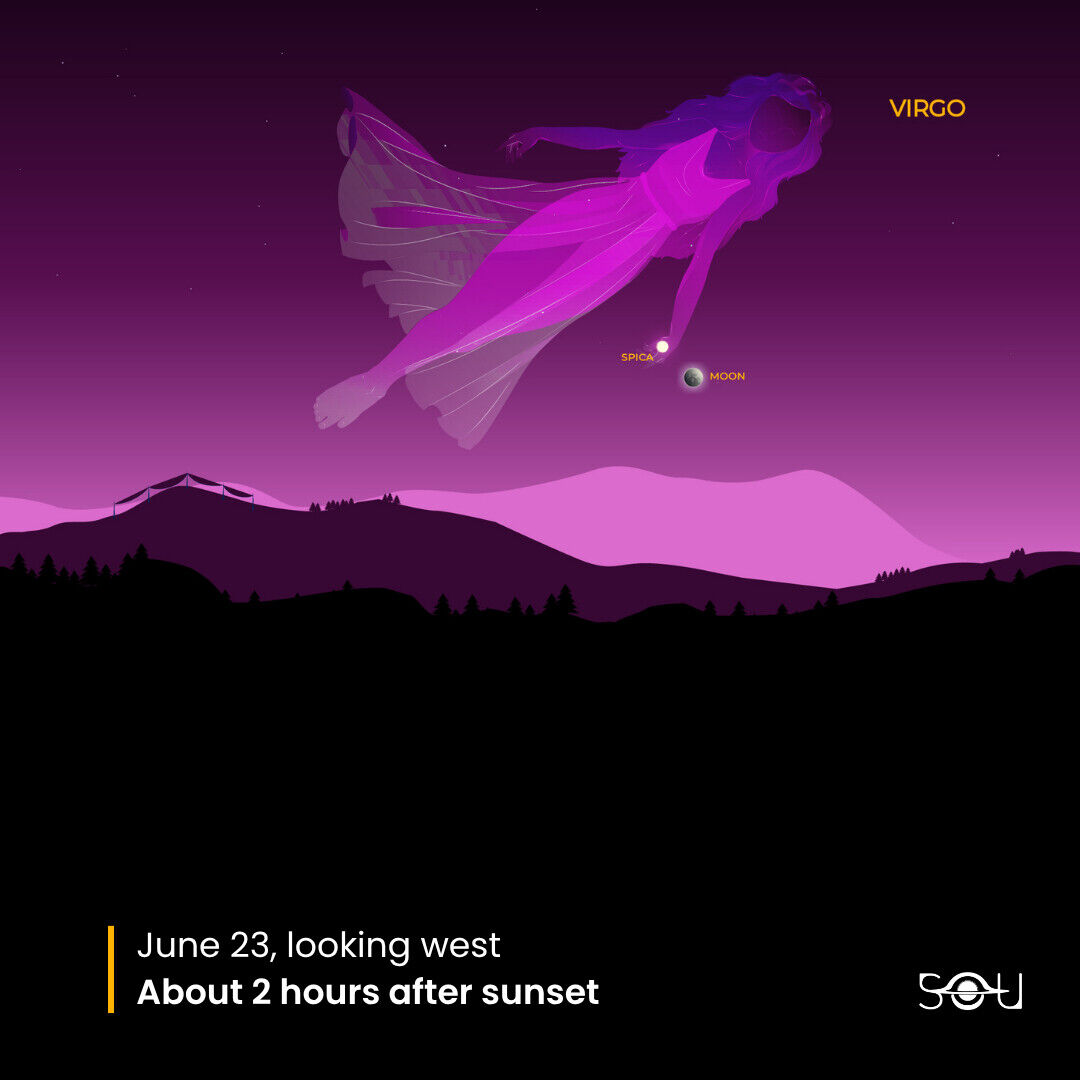
The 68-percent-illuminated Moon stands close to the blue-white star Spica, the gap between them just under 2 degrees, visible to the naked eye or through binoculars in Virgo. The pairing rides the southern sky from dusk until well past midnight and works equally well from either hemisphere.
June 24 — Dark-Sky Targets Before the Moon Takes Over
No marquee event tonight, which makes it the right evening for some housekeeping at the eyepiece. The Moon sits in the relatively empty starfields of Libra, leaving a few hours after moonset, or the moonless eastern sky before dawn, for richer hunting.

M13, the Great Globular Cluster in Hercules, captured with a broadband filter and color camera by amateur astronomer Chuck Ayoub.
Globular cluster M13 in Hercules passes nearly overhead at midnight for mid-northern latitudes, a swarm of several hundred thousand stars that resolves into a granular blaze in a 6-inch telescope.
Predawn observers should check on Saturn, now rising before 2:30 a.m. local time and climbing higher in the east each morning, its rings steadily opening after their edge-on alignment last year. The seeing often steadies just before dawn. Saturn repays the early alarm.
June 25 — Mercury Meets Jupiter, the Evening Show's Last Act
The planets that owned June's twilight are leaving, and tonight they leave together. Mercury, at magnitude 1.3, stands close to Jupiter, at magnitude minus 1.8, the two planets separated by 3 degrees 44 minutes, with Mercury in Gemini and Jupiter in Cancer.
Mercury is dropping out of its mid-month peak while Jupiter sinks toward the Sun, and within days both will be gone into the twilight. Binoculars help against the bright sky.
Look low in the west-northwest starting half an hour after sunset, with brilliant Venus higher up as your anchor. Jupiter is the bright one; Mercury, fading fast as its night side turns toward us, is the challenge. This is realistically your last easy week to see either planet in the evening until autumn.
June 27 — The Moon Nearly Swallows Antares, and Mars Finds the Pleiades
This is the week's most precise encounter. The 95-percent-illuminated Moon passes very close to Antares, the distance between them only 0 degrees 26 minutes, less than the Moon's own apparent width.
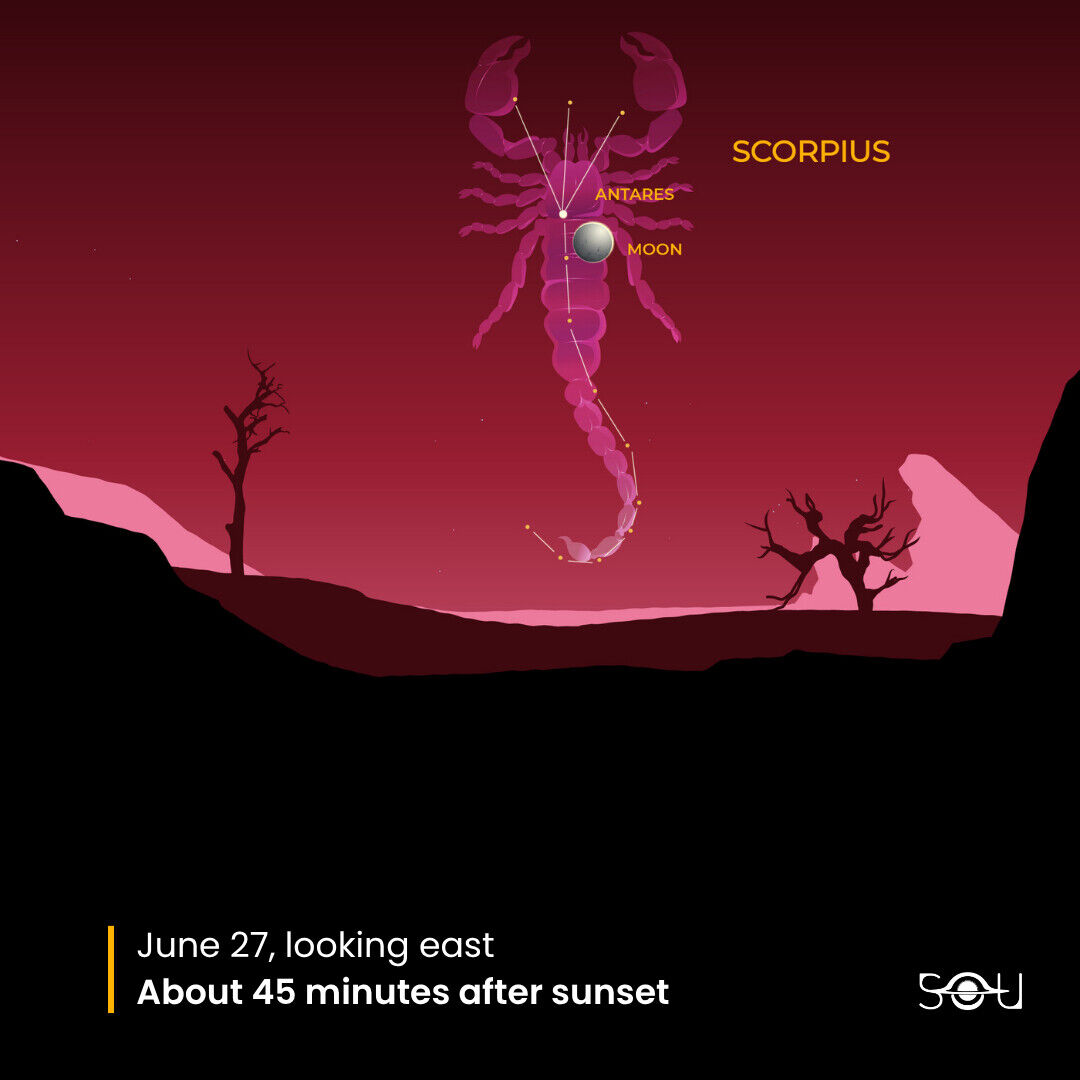
A lunar occultation of Antares will be visible from far southern latitudes, mainly across the southern Indian Ocean south of Africa and Madagascar, parts of Antarctica and the surrounding Southern Ocean, and near the southern tip of South America. The Moon passes directly in front of the star, so Antares briefly disappears behind the Moon's edge and then reappears a short time later.
For everyone else, the sight of a first-magnitude star pressed against the Moon's limb is striking on its own, and binoculars sharpen it considerably against the moonlight.
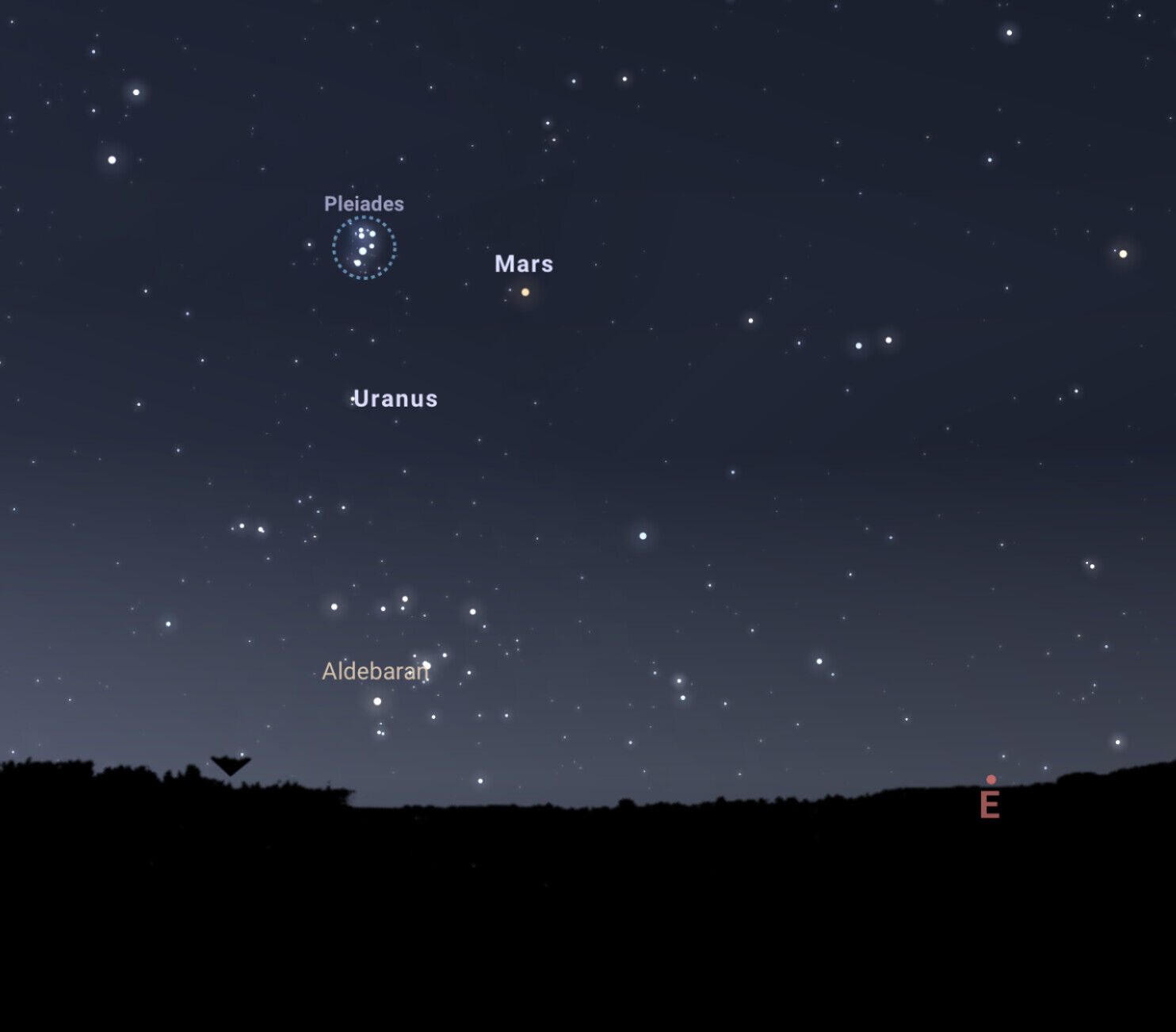
Mars and Pleiades close together on June 27, 2026
Set an alarm too. In the morning sky, Mars stands just under 5 degrees south of the Pleiades star cluster on June 27, low in the east-northeast before sunrise. The Red Planet is dim at magnitude 1.3, but paired with the most famous star cluster in the sky it becomes easy to identify, and the grouping fits in a single binocular field.
By late June, Mars rises about two and a quarter hours before the Sun, its slow return to prominence ahead of opposition in February 2027.
June 28 — The Moon Beside the Teapot, on the Eve of the Strawberry Moon
On the evening of June 28, the bright waxing gibbous Moon hangs near the stars of the Sagittarius asterism called the Teapot. The Teapot is worth learning: its spout points toward the center of the Milky Way, some 26,000 light-years away, where on dark nights the galaxy's star clouds rise like steam.
Tonight the Moon obliterates that subtlety, but it also tells you exactly where to return during July's new Moon. The Moon is now hours from full and near apogee, its farthest point from Earth, setting up tomorrow's main event: a Strawberry Micromoon, the smallest-looking full Moon of the year, rising right out of the Teapot.
Next week, the full Strawberry Micromoon rises in Sagittarius on June 29, Venus begins its climb toward a July 9 meeting with Regulus, and Jupiter takes its final bow before slipping into the Sun's glare.