The Only Real Images of Venus’ Surface Ever Taken — And the Story Behind Them
For the most part of human history, Venus was a planet of imagination. It gleamed brilliantly in the twilight sky, and because it was Earth’s near twin in size and mass, many assumed it might also be Earth’s twin in character. Perhaps it had oceans, clouds of water vapor, even life. But the truth was way too different. When the Soviet Venera probes pierced its opaque atmosphere in the 1970s and 1980s, what they revealed was far more dramatic. Beneath those brilliant clouds lay a world hotter than an oven, with air dense enough to crush steel and clouds of acid.
A Bold Vision
The Venera program, which ran from 1961 to 1983, included a series of spacecraft launched by the Soviet Union to study Venus. “Venera” simply means Venus in Russian, but it came to represent some of the most audacious exploration in human history.

At a time when both superpowers were racing to conquer space, Venus seemed a logical target for the USSR. It was close, bright, and scientifically intriguing. Yet it was also shrouded in mystery. Even telescopes revealed nothing beneath its thick clouds.
Early Venera missions, ie. Venera 1 through 6, were largely experiments in endurance. They taught engineers the brutal reality of Venus’s environment: atmospheric pressures around 90–94 bar, temperatures near 465 °C (870 °F), and an atmosphere composed almost entirely of carbon dioxide.
Undoubtedly, the dream of a gentle Venus evaporated. And what remained was a challenge unlike any other: could humans build a machine that would survive long enough in such an inferno to send back a photograph?
Venera 7: The First Landing
In 1970, Venera 7 became the first spacecraft to land on another planet and transmit data from its surface. Its radio signal was faint, lasting just 23 minutes, and it carried no camera. But, it confirmed that the planet’s heat and pressure were as hellish as predicted.
Two years later, Venera 8 achieved a longer, more stable landing, operating for about 50 minutes and measuring light levels strong enough for photography. This finding encouraged engineers to equip later landers with cameras.
Together, Venera 7 and 8 proved that landing on Venus was possible, paving the way for the first attempts to photograph its hidden surface.
Venera 9 and 10: The First Pictures from Another World
Five years later, the Soviet Union achieved what no one else had dared. Venera 9 and Venera 10 were launched in 1975, each carried an orbiter and a lander equipped with panoramic cameras protected by sapphire lenses and heavy titanium shells.
When Venera 9 descended through the dense atmosphere of Venus, its parachutes shredded, and the probe slammed onto a rocky plain. Then, through the choking haze, it opened its camera covers and transmitted the first image ever taken from the surface of another planet.
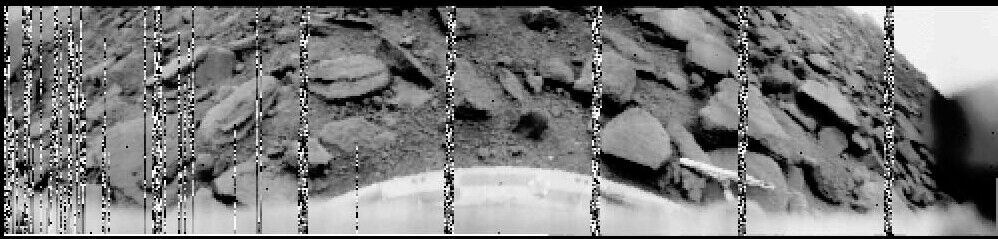
Mosaic of images of the surface of Venus captured by the Venera 9 lander, 22 October 1975.
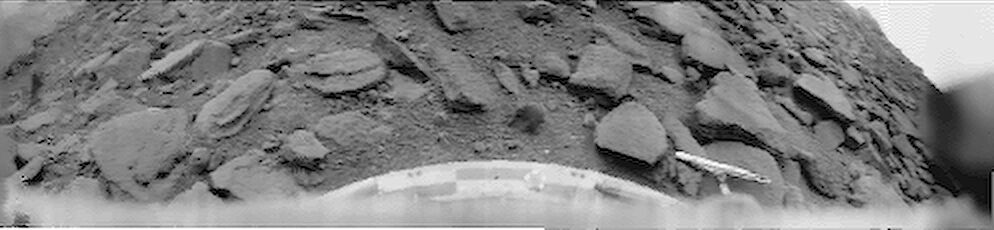
The first image from the surface of Venus, created using the data obtained by the Venera 9 lander on 22 october 1975. It shows a field of flat, angular rocks and slabs under a dim sky and half-panorama covers about 180° of terrain (processed).
Image Credits: Russian Academy of Sciences/Ted Stryk
The picture was black-and-white, grainy, and almost surreal: fractured stones scattered across a gently sloping plain. The lighting looked like twilight, though it was mid-afternoon local time, as the thick atmosphere filtered sunlight to a dull orange glow.
Three days later, Venera 10 landed on similar terrain about 2,200 kilometers (1,370 mi) away. Its panorama showed more blocky, volcanic rock fragments.

A nearly identical scene of basaltic plains and fractured rock confirmed that much of Venus’s surface is volcanic in origin (processed).
Together, the two images suggested that Venus’s surface was made mostly of basalt, the same volcanic rock found on Earth’s ocean floors, hinting at widespread volcanic activity in the planet’s past.
Venera 11 and 12: The Blind Landers
Following the success of Venera 9 and 10, in 1978, the Soviets launched another twin pair: Venera 11 and Venera 12, equipped with upgraded color cameras, microphones, and instruments to capture the planet’s atmosphere and surface.
Both landers descended through thick clouds and touched down successfully that December, transmitting data for more than an hour.
Yet, in a cruel twist, both missions’ camera lens covers failed to eject during landing, leaving their optical systems blocked. Unfortunately, no images were obtained as their cameras remained blind on the surface of Venus.
Even so, these missions made significant discoveries. They detected lightning and radio bursts, providing the first confirmation of electrical activity on another planet. Both landers also measured the detailed atmospheric composition, revealing an atmosphere made up of about 96.5 percent carbon dioxide, 3.5 percent nitrogen, and trace amounts of sulfur-bearing gases. They further confirmed the extreme surface pressure and temperature first measured by earlier probes of around 90 bar and 465 °C (869 °F), firmly establishing the physical conditions that define Venus’s unyielding environment.
However, this experience led engineers to redesign the lens-cap ejection system and improve the exposure controls that would later make the Venera 13 and 14 cameras successful.
Venera 13 and 14: Seeing in Color
In 1982, the Soviets launched the most advanced Venus explorers yet: Venera 13 and Venera 14. Each carried twin color cameras, soil analysis tools, and a drill to sample the surface.
On March 1, 1982, Venera 13 parachuted into a lowland region called Phoebe Regio. It survived far longer than expected, for about 127 minutes, and transmitted the first color photographs from Venus.

The photograph shows the raw black-and-white frame from Venera 13, showing a view of a plain near Phoebe Regio. It is one of the original single-filter images transmitted by the probe. Each frame was scanned line by line in black-and-white through red, green, and blue filters.
Image Credits: Venera 13/Don P.Mitchell via ESA archives
Although the raw data arrived as separate monochrome scans, engineers on Earth combined them to form full-color panoramas. This process used the red, green, and blue filter channels transmitted sequentially by the probe. Later digital reconstructions by Don P. Mitchell and Ted Stryk refined the color balance to match the spectrum of sunlight diffused through Venus’s thick atmosphere.

Processed colored panoramic view of Venusian surface, as obtained from Venera 13's front camera. The butterscotch sky and orange-brown surface are rendered in natural color. Flat rocks appear fractured, and a metallic ring from the lander can be seen in the foreground.
Image Credits: Russian Academy of Sciences / Ted Stryk
The scene was breathtaking in its alien stillness. The sky appeared orange, filtered by thick CO₂ air and clouds of sulfuric acid. The ground was covered in flat, layered rocks, possibly volcanic in origin. Near the bottom edge of one frame lay a circular component, which was a part of the lander itself, a haunting reminder of human presence on this distant, hostile world.
Venera 13’s twin camera produced a second panorama of the opposite direction and completed the view.

Another processed panoramic view captured by Venera 13's rear camera.
Image Credits: Russian Academy of Sciences / Ted Stryk
The lander’s drill analyzed a soil sample, finding it to be basaltic, specifically an alkali basalt, while its twin, Venera 14, sampled a tholeiitic basalt more like Earth’s oceanic crust. Both results implied extensive volcanic resurfacing in Venus’s geologic past.
Venera 13’s microphones even recorded low-frequency vibrations reflecting gusts of Venusian wind. This was also the first planetary audio ever captured.
Only four days later, Venera 14 landed about 950 kilometers away, transmitting similar images. However, during the surface operations, the lander’s soil compressibility probe experienced a minor mishap. When the sampling arm extended, it pressed down on one of the discarded camera lens covers instead of the ground. The instrument therefore measured the hardness of its own metal cap rather than the Venusian soil, producing invalid mechanical data.
Fortunately, the cameras and chemical instruments performed flawlessly, returning clear panoramas and confirming that the landing site consisted of basaltic rock fragments and fine-grained surface material typical of the planet’s volcanic plains. Despite the mishap, both missions confirmed the planet’s volcanic nature and the dim orange glow that defines Venus’s eternal day.
A Landscape Unlike Any Other
Across all four landings of Venera 9, 10, 13, and 14, the terrain shared striking similarities: flat basaltic plains, angular rocks, and very little dust. The illumination, filtered through the clouds, created a dim golden dusk even at midday.
Temperatures hovered around 465 °C, and pressures reached 90 bar, replicating conditions that would crush a submarine and melt most metals.
Each lander was a doomed hero, surviving barely an hour or two before the electronics failed. Yet in that time, they captured scenes that have defined our understanding of Venus for half a century.
Venera 15 and 16: Seeing the Planet as a Whole
The final Venera missions, Venera 15 and 16 (1983–1984), did not land but instead orbited Venus, using synthetic-aperture radar (SAR) to map the planet’s surface through its opaque atmosphere.
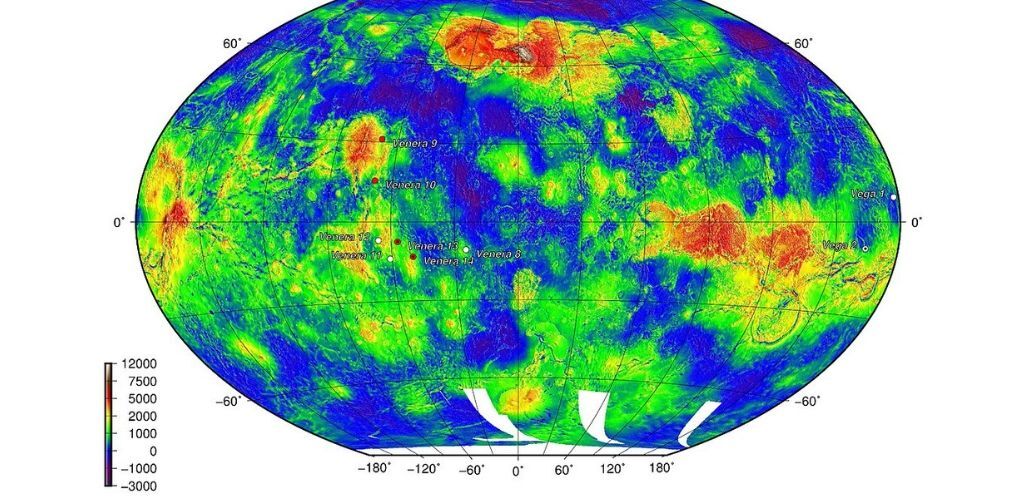
Radar mapping of Venus and position of the Venera probes.
Image Credits: NASA Space Science Data Coordinated Archive (NSSDC)/Roscosmos,/Russian Academy of Sciences/Institute of Radiotechnics and Electronics/Moscow Power Engineering Institute
Their radar maps revealed a world dominated by volcanic structures, fault lines, and immense plains of cooled lava. Combined with the surface photos, these data suggested that Venus may have resurfaced itself through planet-wide volcanism hundreds of millions of years ago.
Engineering Miracles in an Inferno
Each Venera lander was designed to survive the impossible. The titanium hulls were hermetically sealed, with pressure vessels thicker than a bank-vault door. The instruments were cooled with pre-chilled fluid loops and built using ceramic circuit boards instead of plastic.
Even so, the probes were racing against time. Once the internal temperature rose beyond 300 °C, circuits would fail. Engineers choreographed each operation, including camera activation, drilling, transmission, all down to the minute. Every image you see is a product of that intense precision.
The fact that Venera 13 lasted over two hours was considered a miracle of design.
How Did the Cameras Work?
Capturing even a single frame from Venus was a masterpiece of engineering. Each Venera camera system was sealed inside a pressurized titanium sphere, which was pre-cooled before landing.
The cameras scanned their surroundings line by line using rotating mirrors, taking several minutes to complete a panorama. Data were transmitted via the orbiter above before the probe succumbed to the heat.
The images we see today were reconstructed from those radio signals decades later, stitched together into panoramas and, in some cases, carefully colorized based on spectral data.
Interpreting the Images Today
Modern processing has breathed new clarity into the Venera panoramas. Researchers such as Don P. Mitchell and Ted Stryk have digitally corrected distortions, balanced the colors based on the cameras’ red/green/blue filter responses, and reconstructed the full 360° fields of view.
These enhanced versions reveal subtle details invisible in the raw data, including minute grains of soil, differences in rock reflectivity, and slight variations in the hazy sky’s brightness. They confirm that the surface color likely appears muted orange-brown to human eyes, with little contrast, as though viewed through a dense filter of rust-colored fog.
The Legacy of Venera
The Venera images changed planetary science forever. They proved that Venus is a real world, not a hypothetical one, a world of geological grandeur, chemical violence, and haunting stillness.
They showed that planets of similar size can have utterly different fates: while Earth thrives with oceans and life, Venus became a cautionary tale of the runaway greenhouse effect.
No mission since has returned images from the Venusian surface. Later probes such as NASA’s Pioneer Venus Multiprobe (1978) and the Soviet VEGA 1 and 2 landers (1985) did reach the surface and transmitted limited data, but none carried surface cameras.
Those few photographs remain the only direct visual records from Venus’s surface. NASA’s upcoming DAVINCI and VERITAS missions, and Russia’s proposed Venera-D, aim to return there, following in the footsteps of the Soviet engineers who first braved its inferno.
A View from the Deepest Twilight
When we look at those Venera images today, the cracked stones, the shadow of a lander under an orange sky, we see not only a planet but a human achievement. Each frame represents the success of engineering pushed to its limits and the determination to study an environment utterly unlike our own.
In just a few hours of operation, the Venera landers provided humanity with its first direct view of another planet’s surface.
Though their signals quickly faded, the photographs they returned remain an unmatched scientific record and our most tangible connection to the hidden world beneath Venus’s clouds