CERN Just Transported Antimatter on a Truck — And It Didn't Explode.
For the first time in history, a team of physicists loaded a cloud of antimatter onto a truck and drove it across one of the world's most sensitive scientific sites. It sounds impossible. It worked.
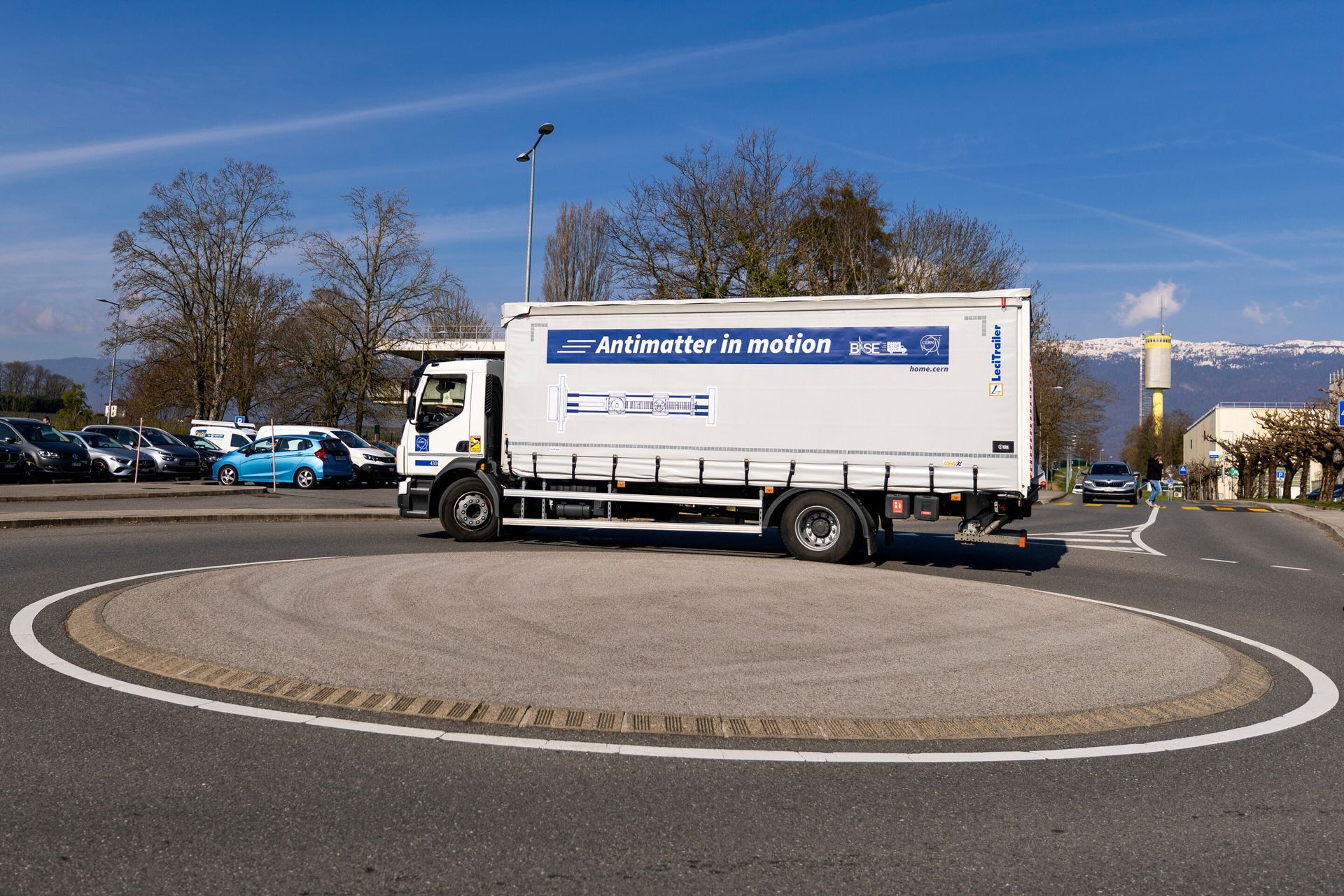
On March 24, 2026, something unprecedented happened in the hills outside Geneva, Switzerland. A specially built crate — weighing nearly a tonne, chilled to temperatures colder than outer space, and carrying 92 particles of pure antimatter — was loaded onto a truck and driven around the CERN campus. It was a short trip. It was a historic one.
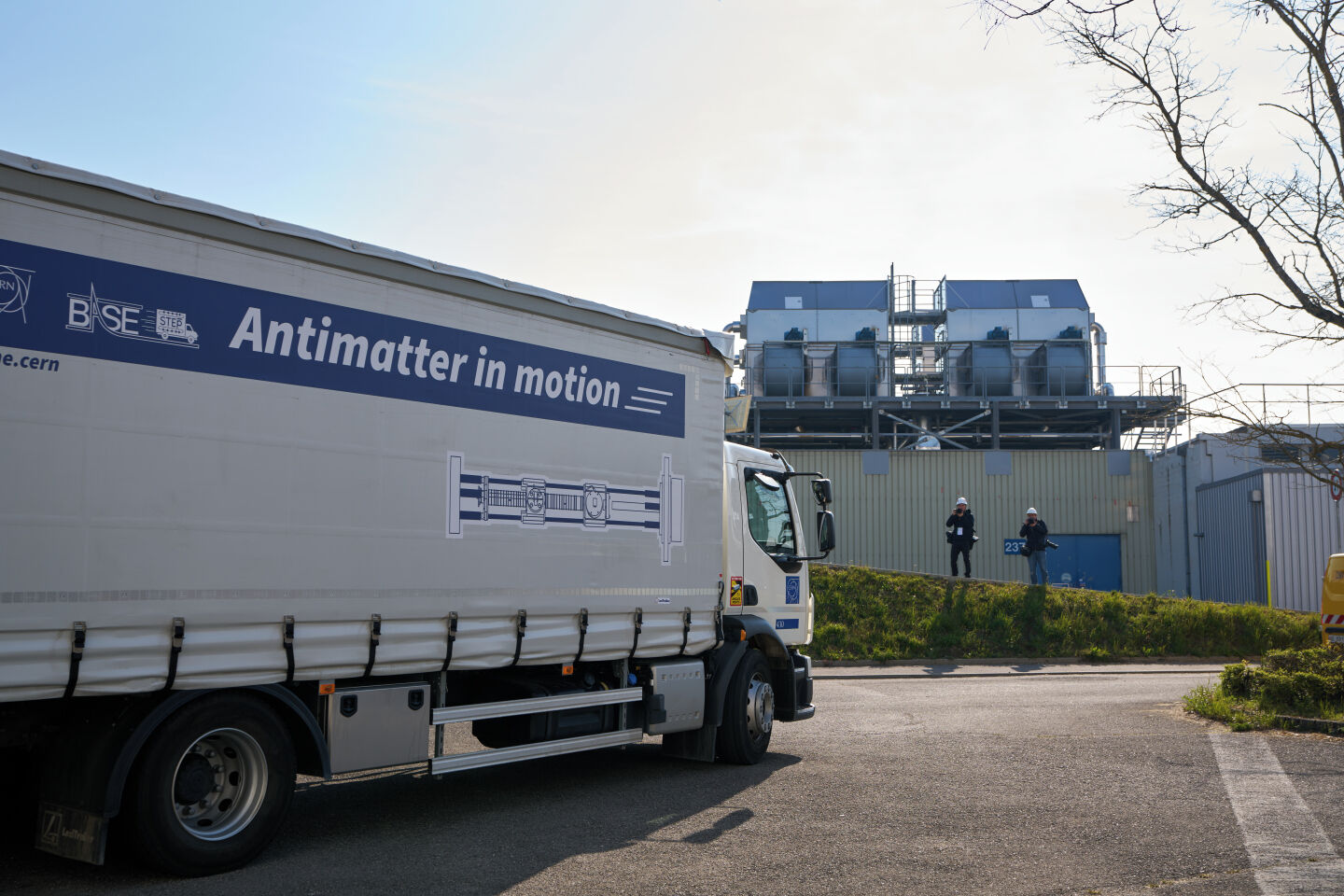
Truck transporting the BASE-STEP trap filled with antiprotons
Scientists from the BASE experiment at CERN had, for the very first time, successfully transported antimatter. Not metaphorically. Not in a simulation. On an actual truck, through actual traffic, on an actual road.
Why Is This Such a Big Deal?
To understand the magnitude of this achievement, you first need to understand what antimatter actually is — and why it is so impossibly difficult to handle.
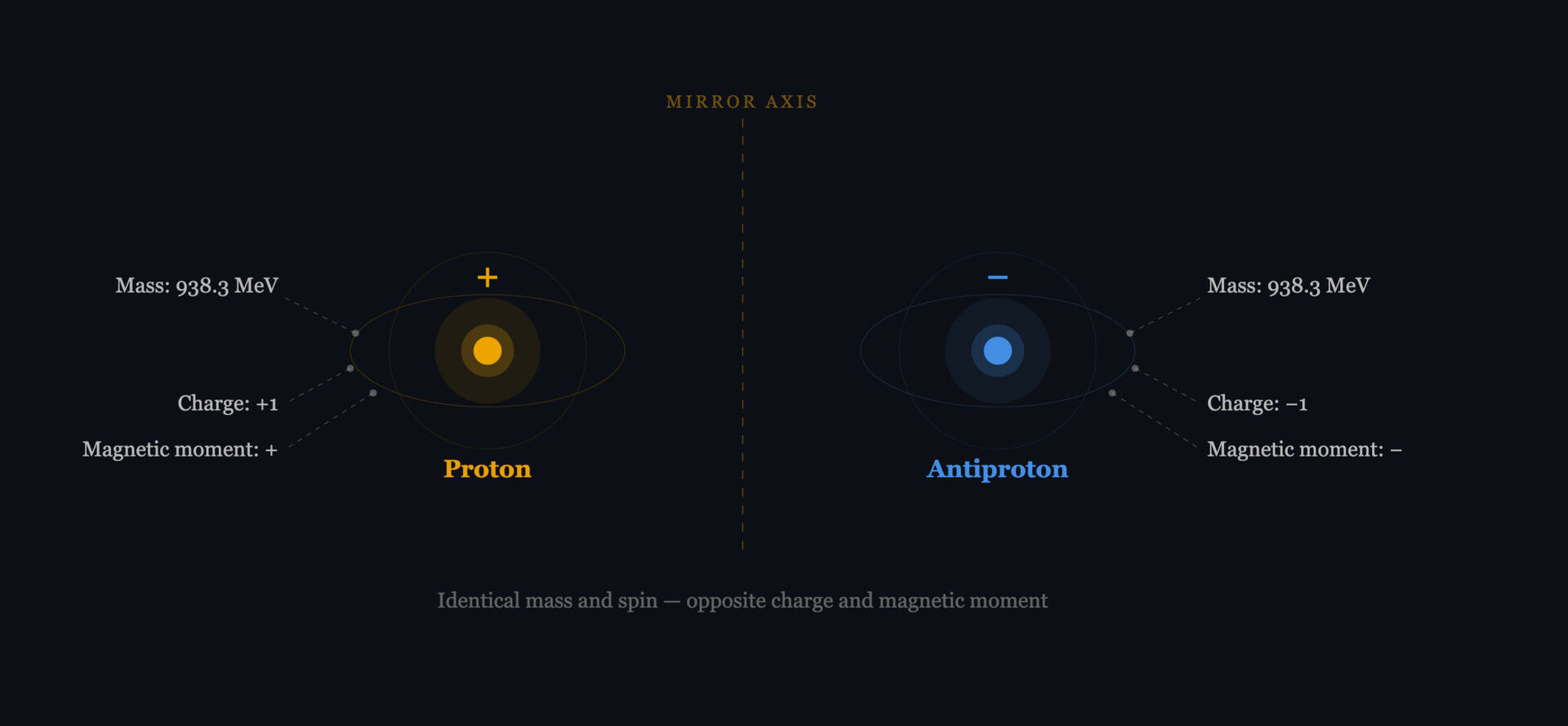
The difference between a proton and an anti-proton
Antimatter is the mirror twin of ordinary matter. For every particle in our universe, there exists an antiparticle with the opposite electric charge. The antiproton, for instance, is identical to a proton in almost every way — except it carries a negative charge and a reversed magnetic moment. The catch? The moment an antiproton meets an ordinary proton, both are instantly annihilated in a burst of energy. You cannot store antimatter in a normal container. Even a single molecule of air would destroy it.
This makes antimatter one of the most challenging substances in science to work with. It can only be produced, stored, and studied at one place on Earth: CERN's Antimatter Factory, where two successive machines — the Antiproton Decelerator (AD) and the Extra Low Energy Antiproton ring (ELENA) — strip antiprotons from high-energy collisions and slow them down until they can be trapped by magnetic and electric fields.
The Problem That Made Transport Necessary
The BASE collaboration has spent years pushing the precision of antiproton measurements to extraordinary levels. Their goal is to compare the fundamental properties of antiprotons and protons with enough accuracy to detect any subtle difference between matter and antimatter — a difference that might explain one of the deepest mysteries in physics: why the Big Bang produced a universe made almost entirely of matter rather than a perfectly balanced soup that annihilated itself into nothing.
But there was a problem. The machines and equipment in CERN's Antimatter Factory generate magnetic field fluctuations that limit how precisely the BASE team can take its measurements. These disturbances are minuscule — roughly one billionth of a tesla, about 20,000 times smaller than Earth's own magnetic field — but at the resolution BASE is working at, even noise this small becomes a fundamental barrier.
"The precision of the measurements taken in BASE is such that gaining an even deeper understanding of the fundamental properties of antiprotons will require moving the experiment out of the building," said Stefan Ulmer, Spokesperson of BASE.
The solution? Build a device that can carry the antimatter to a quieter location.
Meet BASE-STEP: The World's First Portable Antimatter Trap
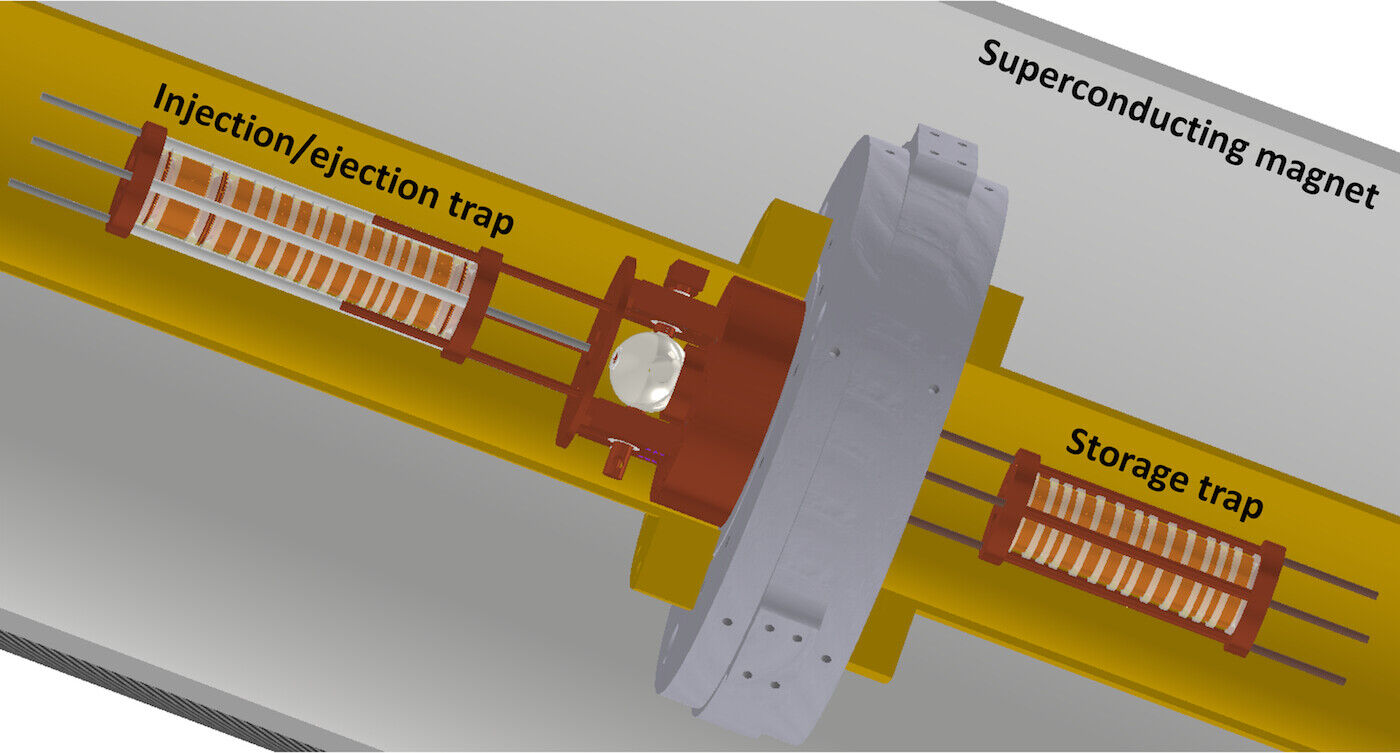
The layout of the transportable antiproton trap that BASE is developing. The device features a first trap for injection and ejection of the antiprotons produced at CERN’s Antiproton Decelerator, and a second trap for storing the antiprotons.
The BASE-STEP apparatus is a feat of engineering in its own right. Weighing around 1,000 kilograms, it houses a superconducting magnet, a liquid helium cryogenic cooling system, onboard power reserves, and a vacuum chamber that holds particles in place using precisely tuned magnetic and electric fields. Crucially, it is compact enough to fit through standard laboratory doors and robust enough to survive the bumps, vibrations, and stops of road transport.
The scientists tested that BASE-STEP can keep antiprotons stored for two weeks with no losses and can transport them for four hours — enough to move antimatter to other laboratories at CERN and its immediate vicinity.
The team had previously demonstrated the concept using ordinary protons in 2024, publishing their results in Nature. But protons are simple to handle — antiprotons demand a far more demanding vacuum environment and leave no room for error. Antiprotons require a much better vacuum chamber than protons, making this latest achievement a considerably more challenging feat.
On the morning of March 24, 92 antiprotons were loaded into the trap. A crane slowly hoisted the apparatus out of the Antimatter Factory and onto a waiting truck. A specialist driver — trained specifically to handle sensitive scientific equipment — then navigated a 4-kilometre loop around the CERN site. Throughout the journey, scientists monitored the antiprotons continuously and non-destructively. After the truck returned to its starting point, the team reconnected the trap, confirmed the particles were intact, and opened a bottle of champagne.
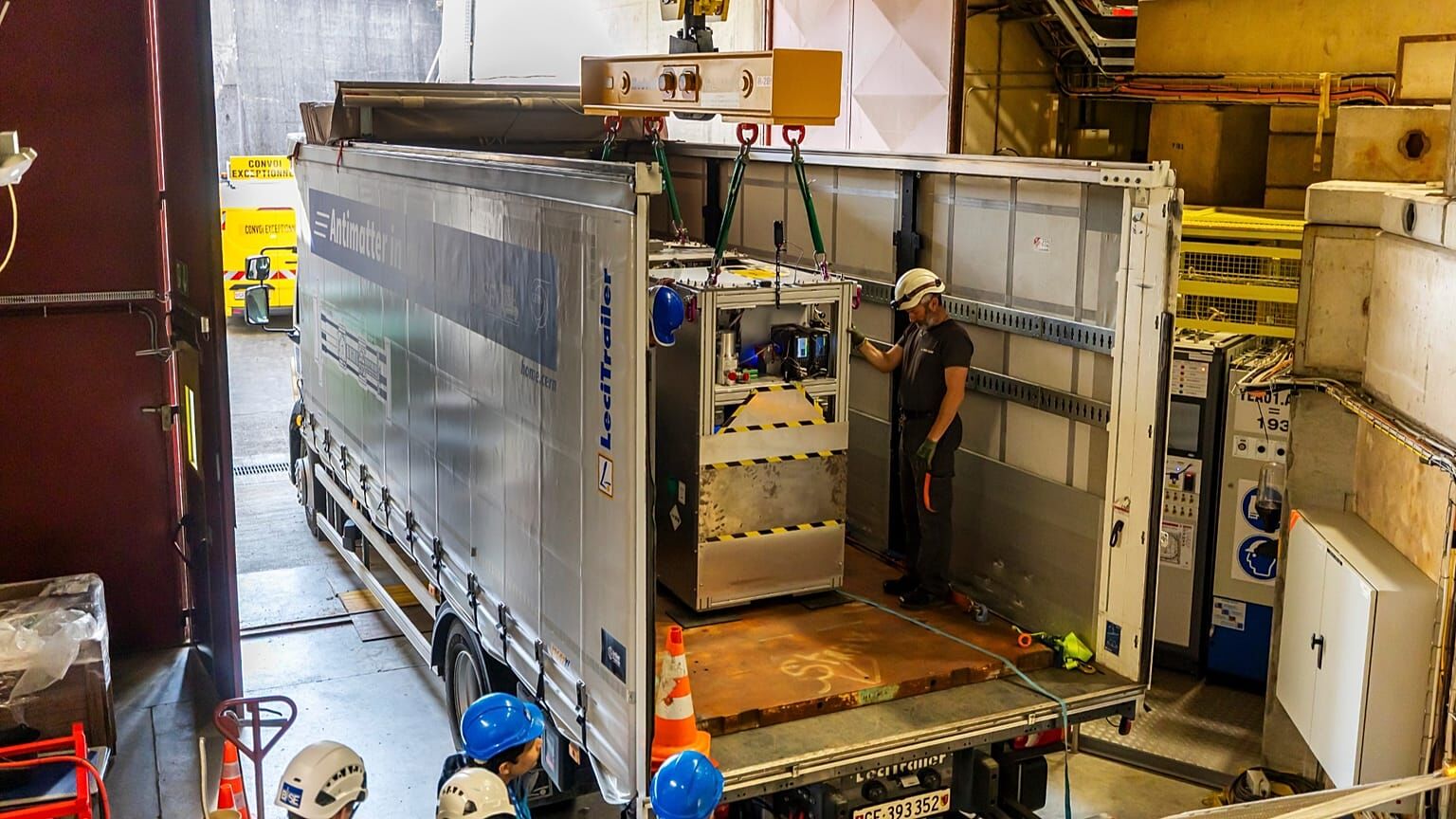
Antimatter being transported in a truck at CERN
What Comes Next
The ultimate ambition is far more ambitious than a lap of the CERN campus. The BASE team aims to deliver antiprotons to Heinrich Heine University Düsseldorf in Germany — a trip that would take at least 8 to 12 hours and requires keeping the superconducting magnet below 8.2 Kelvin (−264.95°C) for the entire duration. Currently, liquid helium provides this cooling, but the supply is finite. Researchers are now working on using a generator to power a cryocooler on the truck, which would allow transport ranges to be extended at will — potentially enabling antiproton delivery to laboratories across Europe.
The biggest challenge, however, remains what happens on arrival: transferring the antiprotons from the portable trap into the destination experiment without losing a single one.
"Transporting antimatter is a pioneering and ambitious project," said CERN's Director for Research and Computing, Gautier Hamel de Monchenault. "We are at the beginning of an exciting scientific journey that will allow us to further deepen our understanding of antimatter."
Why It Matters
If antiprotons can be routinely delivered to quiet, vibration-free precision laboratories far from CERN's accelerators, scientists expect to achieve measurement accuracy 100 to 1,000 times greater than what is currently possible. That level of precision opens the door to detecting differences between matter and antimatter that have never been visible before — differences that could, at last, begin to explain why our universe exists at all.
These measurements offer stringent tests of CPT invariance — the fundamental symmetry in the Standard Model of particle physics that holds that matter and antimatter must behave identically under simultaneous transformations of charge, parity, and time. Even the tiniest crack in that symmetry could rewrite our understanding of the cosmos.
For now, though, a truck drove 4 kilometres with 92 particles of antimatter and came back with all 92 still intact. That alone is nothing short of extraordinary.
Also Read