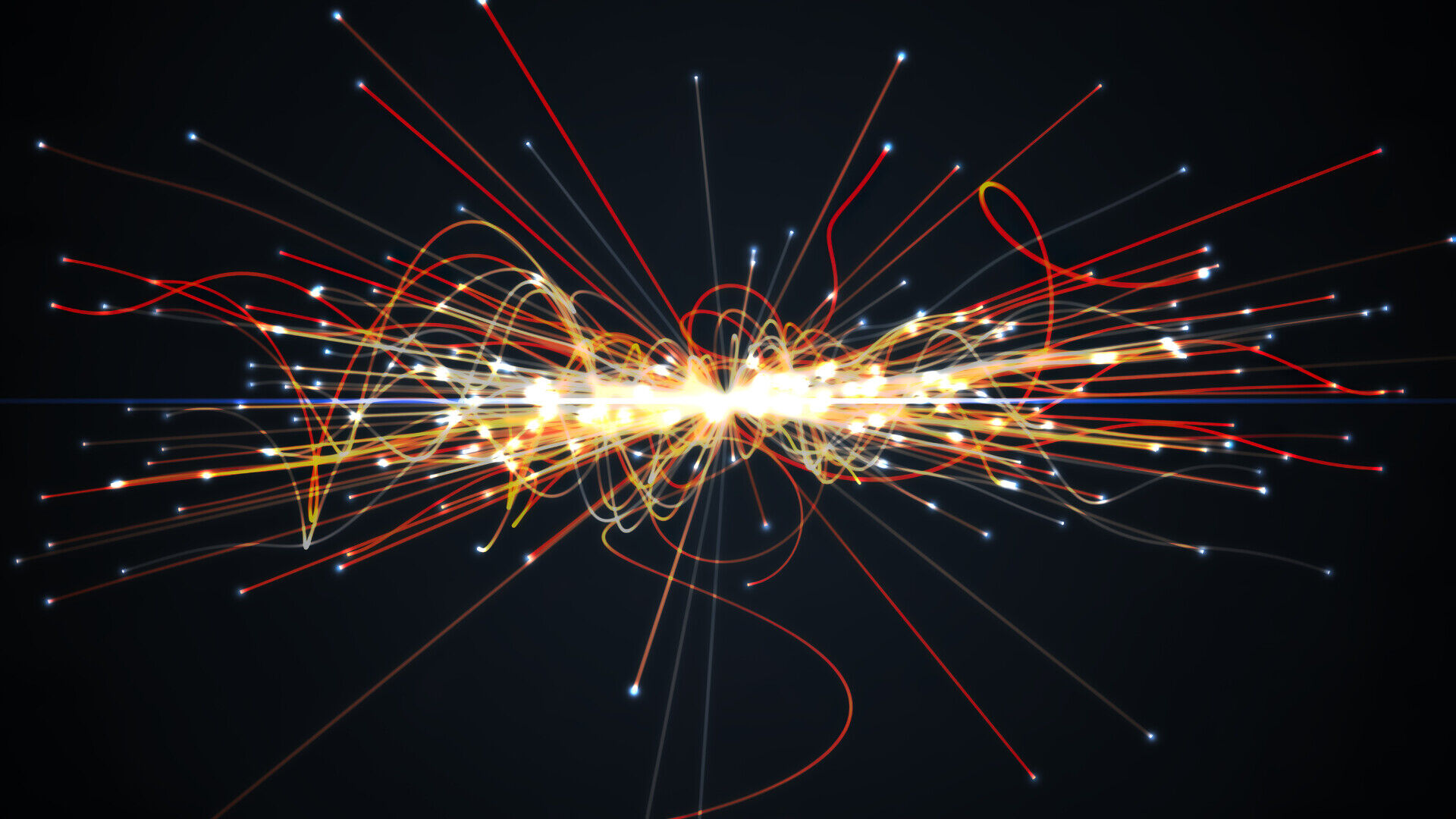
Scientists Caught a Glimpse of Particles Emerging From Empty Space For The First Time
A landmark experiment at a US particle collider has caught the quantum vacuum in the act of producing real particles. The finding could reshape how we understand one of nature's oldest puzzles: where does mass come from?
Ever since physicists figured out that the universe is governed by quantum mechanics, one idea has stubbornly refused to sound normal no matter how many times you hear it.
When scientists say "empty space," they don't actually mean empty. Not even close. According to our best theories of the subatomic world, a perfect vacuum is anything but still. It churns and crackles at a scale so small and so fast that it has always been invisible to us.
Particles flicker in and out of existence constantly, living for spans of time so brief they make a nanosecond look like an eternity. We've known about this theoretically for decades, but never quite caught it in the act. Until now.
A team of physicists working at the Relativistic Heavy Ion Collider, or RHIC, at Brookhaven National Laboratory in New York has observed this process for the first time. The collaboration, known as STAR, has gathered what may be the most direct evidence yet that real, measurable particles can be pulled straight out of the quantum vacuum. The implications reach into one of the deepest unsolved questions in all of physics: why do particles have the mass they do?
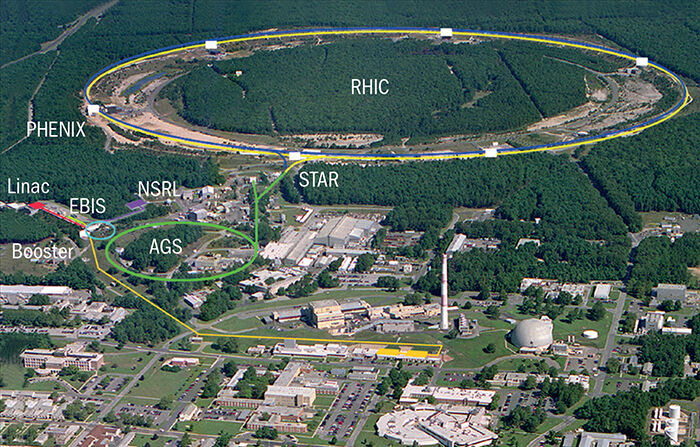
Aerial view of the RHIC at Brookhaven National Laboratory.
What Is The Quantum Vacuum?
To understand what makes this discovery significant, we first need to understand what physicists actually mean by the vacuum.
In everyday life, a vacuum simply means a space with nothing in it. But quantum mechanics tells a completely different story. According to quantum field theory, invisible fields permeate every corner of the universe. There is one for each type of fundamental particle. The electromagnetic field, for instance, is what light is made of. These fields are never perfectly still. Even at their lowest possible energy state, they undergo constant, tiny fluctuations.
This is not a flaw in the theory or a gap in our understanding. It is baked into the very fabric of quantum mechanics, a direct consequence of the energy-time uncertainty relation, which allows energy to fluctuate spontaneously over very short timescales.
These fluctuations give rise to what physicists call virtual particles. A quark and its antimatter counterpart, an antiquark, can spontaneously appear as a pair, exist for an almost unimaginably brief moment, and then annihilate each other before any instrument can detect them. But that does not make them fictional. They have measurable effects on other particles, and their influence has been confirmed through experiments like the Casimir effect and the Lamb shift. They simply do not last long enough to be observed directly under normal conditions.
The Theory That Made This Possible
The branch of physics governing the behavior of quarks is called Quantum Chromodynamics, or QCD. It is so-far our best description of the strong nuclear force, the force responsible for binding quarks together inside protons and neutrons.
The word "chromo" comes from the Greek word for color, because quarks carry a property physicists have named color charge. This has nothing to do with actual colors. It is simply a label for a property that behaves like a more complex version of electric charge, coming in three types rather than two.
However, QCD makes a striking prediction. It says that if you inject enough energy into the vacuum, those fleeting virtual quark-antiquark pairs do not have to disappear. The energy can promote them into real, stable particles with genuine, measurable mass.
The quantum vacuum, in other words, is not just a backdrop to the universe. Under the right conditions, it can become a source of matter itself. This is sometimes described as pulling particles out of nothing, though it's more accurate to say the energy of the collision is being converted into the mass of new particles, with the vacuum providing the raw quantum ingredients.
This prediction has sat in the theoretical framework of QCD for a long time. The challenge was always catching it happening, and this is where the new study becomes exciting.
The Clever Detective Work
The STAR team collided high-energy protons inside the RHIC and studied the spray of particles produced in the aftermath. Hidden somewhere in that spray were particles the researchers suspected had come directly from the vacuum, rather than from the collision energy itself. But how do you identify a particle's true origin when all you have left is the wreckage?
The answer lies in a quantum property called spin. It is a kind of intrinsic angular momentum carried by every fundamental particle. The name is a bit misleading, though. Particles are not actually spinning the way a top does on a table. Rather, spin is a purely quantum property, one that comes in fixed, discrete values and has no real equivalent in the everyday world.
When a quark and antiquark are born together from a vacuum fluctuation, their spins are correlated from the moment they appear. This means that they share a quantum alignment because of their shared origin. Crucially, this alignment survives even after the quarks bind with other quarks to form composite particles called hyperons.
Hyperons are a family of short-lived subatomic particles that contain at least one strange quark alongside up or down quarks. They typically decay in around a tenth of a nanosecond. But the spin correlation inherited from the vacuum persists long enough to leave a detectable signature in the data.
By identifying these spin-aligned hyperons in the wreckage of the proton collisions, the STAR team could trace their origins directly back to the quantum vacuum. "This is the first time we've seen the entire process," said Zhoudunming Tu, a physicist and member of the collaboration.
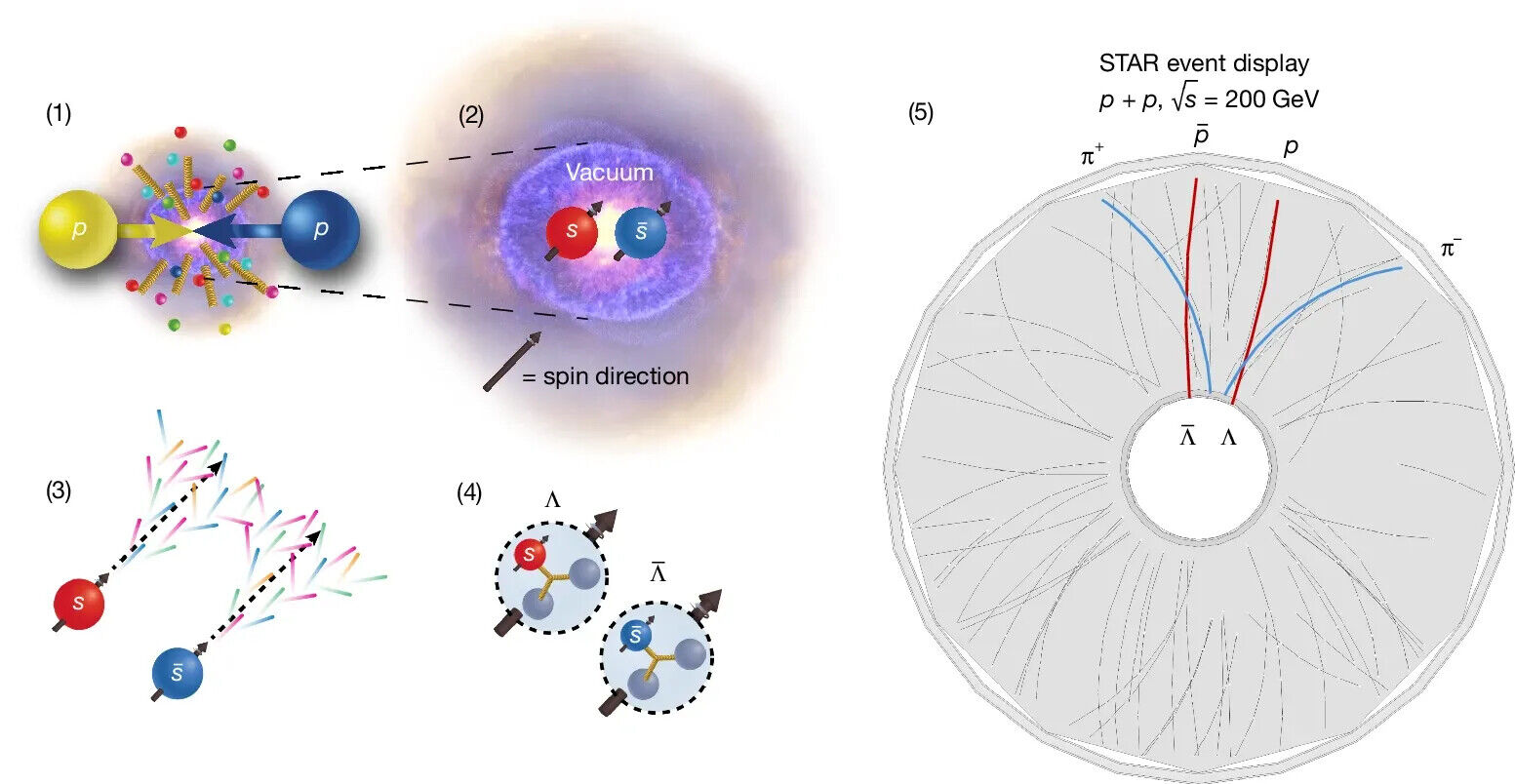
This figure shows the five stages of the STAR experiment. Two protons collide (1) and excite the vacuum, producing a strange quark-antiquark pair with correlated spins (2). The quarks combine with others to form hyperons (3 and 4), which retain the original spin alignment. The STAR detector then records the tracks of their decay products (5).
Why This Matters Far Beyond The Collider
You might have heard that the Higgs boson, discovered at CERN in 2012, is responsible for giving particles their mass. That is true, but only partially. Here is something that surprises many people: the Higgs mechanism accounts for only a small fraction of the mass of ordinary matter. A proton, for example, has a mass of roughly 938 MeV, but the three quarks inside it contribute only about 9 MeV of that total when considered in isolation.
The rest, the overwhelming majority of the proton's mass, arises from the kinetic energy of the quarks moving inside it and from the energy of the gluons, the carrier particles of the strong force, that constantly bind them together. This relationship between the quantum vacuum and the mass of everyday matter is described by QCD, but the precise mechanisms remain poorly understood.
That is exactly what makes this experiment so valuable. It is not just a confirmation of a theoretical prediction. It opens a genuinely new way to probe the quantum vacuum directly. Reconstructing particle origins from collision data is a painstaking work, and scientists will need to methodically rule out every alternative explanation before the result can be considered fully definitive. That process takes time and more data.
But the direction is clear. For the first time, physicists did not just theorize about particles being born from empty space. They watched it happen. And in doing so, they may have taken the first real step toward understanding how the universe fills itself with mass from what looks, at first glance, like absolutely nothing.
Research paper
Star Collaboration, "Measuring spin correlation between quarks during QCD confinement", Nature (2026)