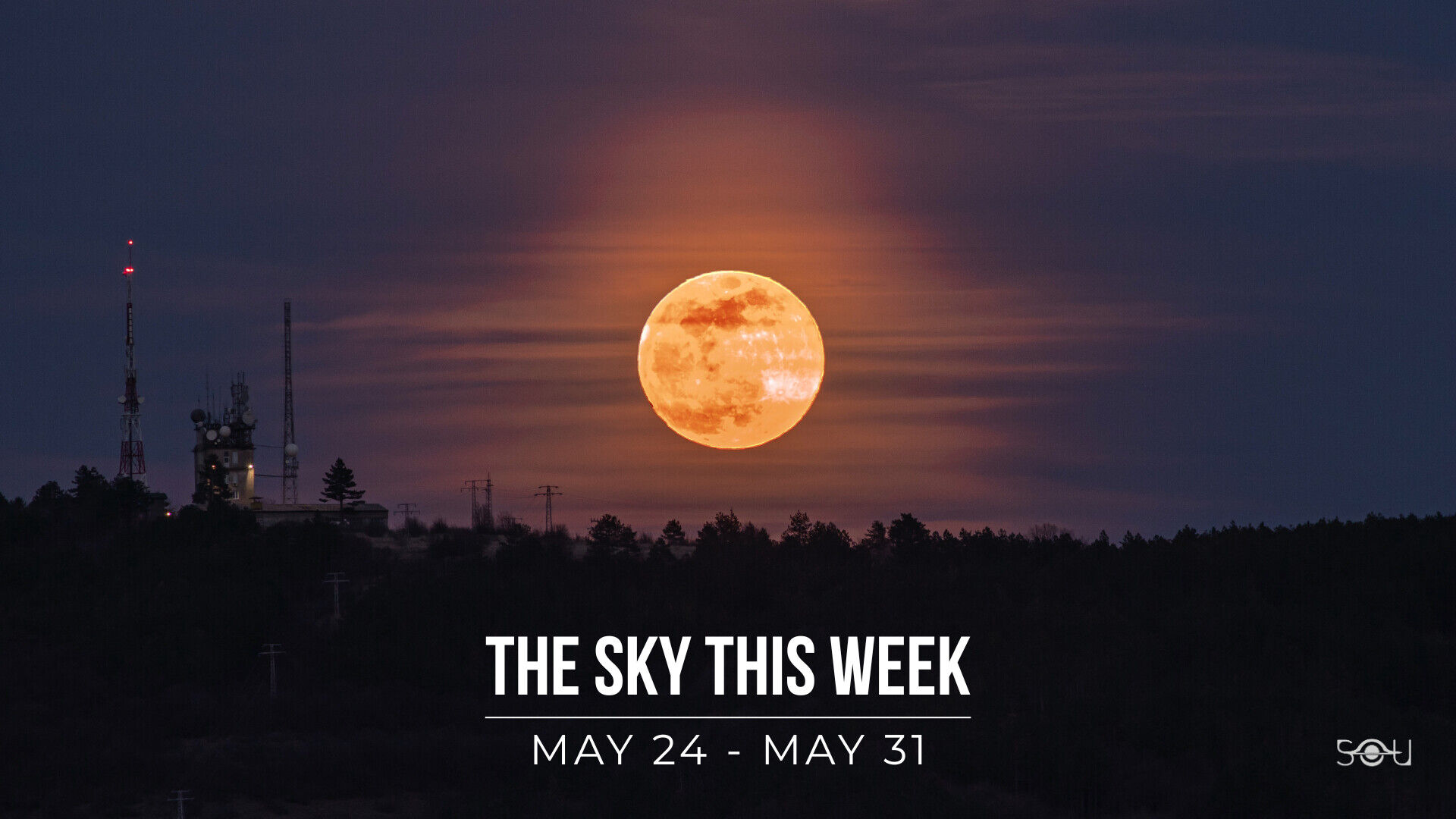
The Sky This Week, May 24 - May 31, 2026
This week, Venus and Jupiter continue tightening their gap in the western twilight, Saturn and Mars hold low in the predawn east, the Moon passes Spica in Virgo, and Vega begins to reclaim the evening sky as a sign of the coming northern summer. Then May ends with its second full Moon — a rare Blue Micromoon rising near Antares in Scorpius. Here’s what to look for, night by night.
May 24 — Venus and Jupiter Draw Closer After Sunset
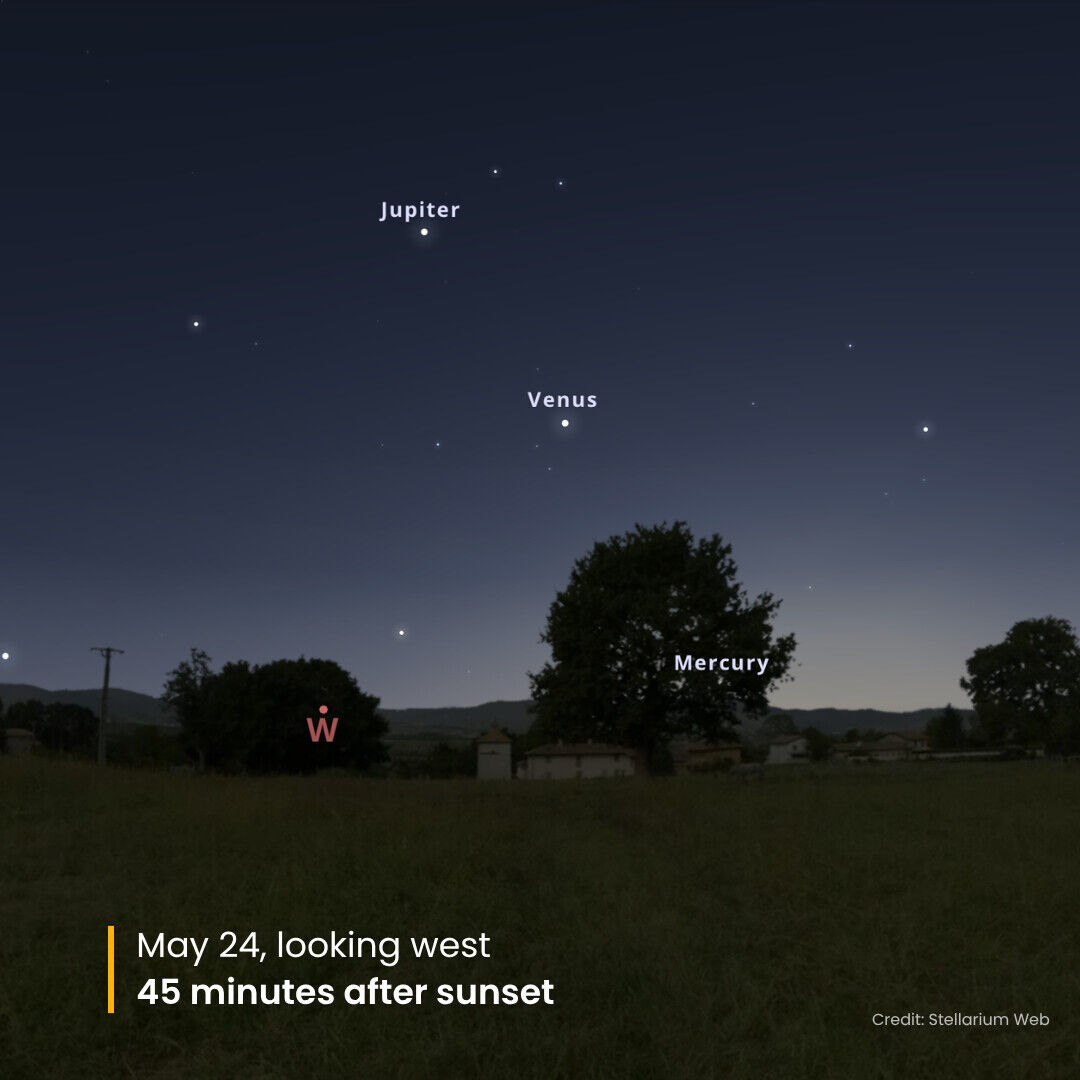
Jupiter and Venus dominate the western sky after sunset
The week begins with the two brightest planets in the sky slowly moving toward each other.
Look west after sunset. Venus will be the lower and brighter of the two, shining through the twilight as the Evening Star. Jupiter sits higher above it, less dazzling than Venus but still unmistakably bright. Across the final week of May, the distance between them shrinks night by night, setting up their much closer conjunction on June 9, 2026.
This is not a one-night event so much as a slow celestial approach. Return to the same viewing spot each evening, and the motion becomes obvious: Venus climbs away from the Sun while Jupiter sinks lower toward the western horizon. By early June, the two worlds will appear much closer together, creating one of the most eye-catching evening planet pairings of the year.
No telescope is needed. The best view comes about 30 to 60 minutes after sunset, with a clear western horizon.
May 25 — Saturn and Mars in the Eastern Predawn Sky
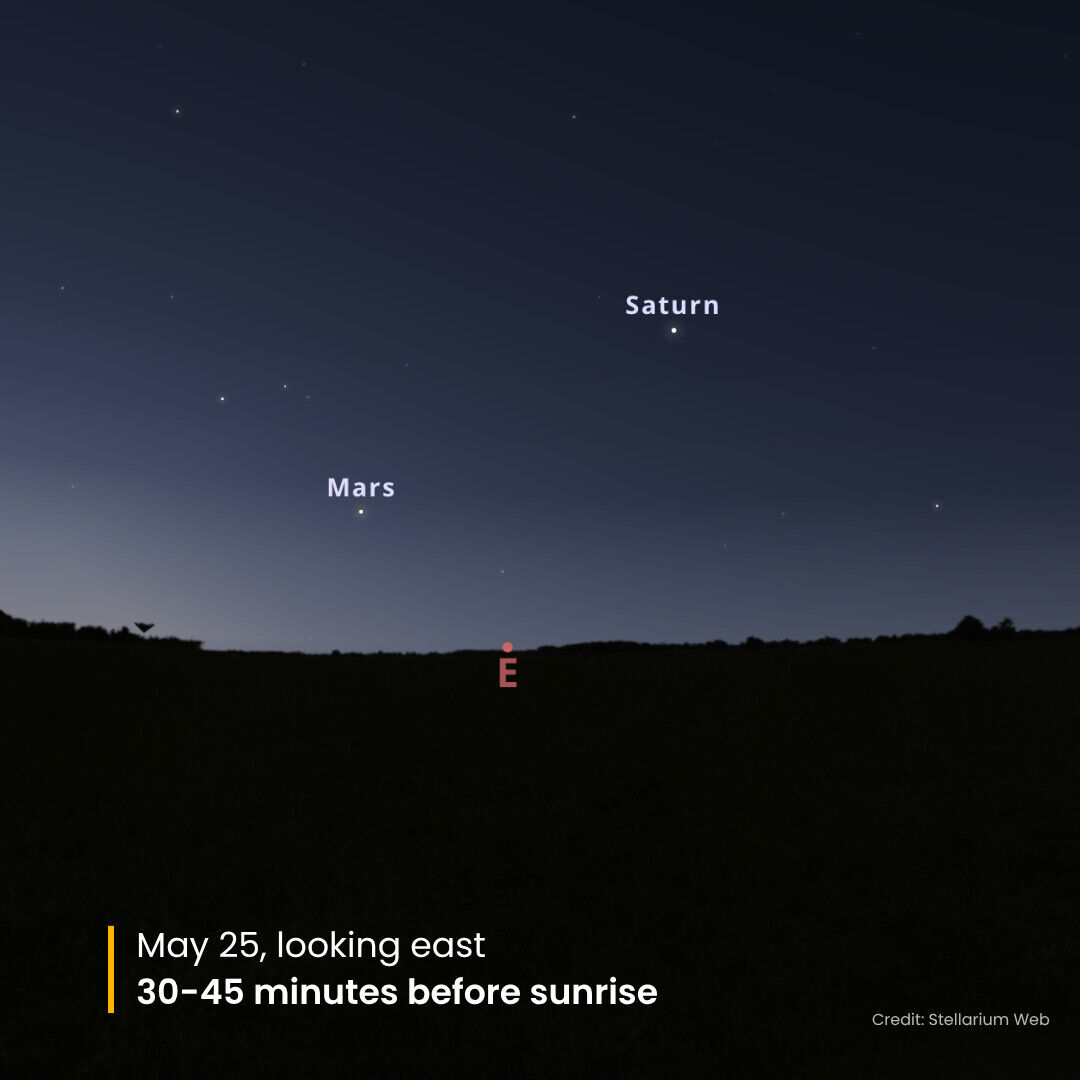
Mars and Saturn in the eastern predawn sky
While Venus and Jupiter command the evening, the morning sky has its own quieter planetary scene.
Before sunrise, Saturn and Mars sit low in the eastern sky. Saturn appears yellowish and steadier, while Mars is fainter and reddish, closer to the horizon. Both planets are still emerging from the Sun’s glare, so this is not their most dramatic showing of the year. A clear eastern horizon is essential, especially for Mars.
From lower northern latitudes, tropical regions, and parts of the Southern Hemisphere, the view is generally more forgiving because the planets rise at a better angle before dawn. From higher northern latitudes, they remain lower and more easily lost in twilight.
Look about 45 to 60 minutes before sunrise. Binoculars can help pull Mars out of the brightening sky, but make sure the Sun is still safely below the horizon before using any optical aid.
May 26–27 — The Moon Meets Spica
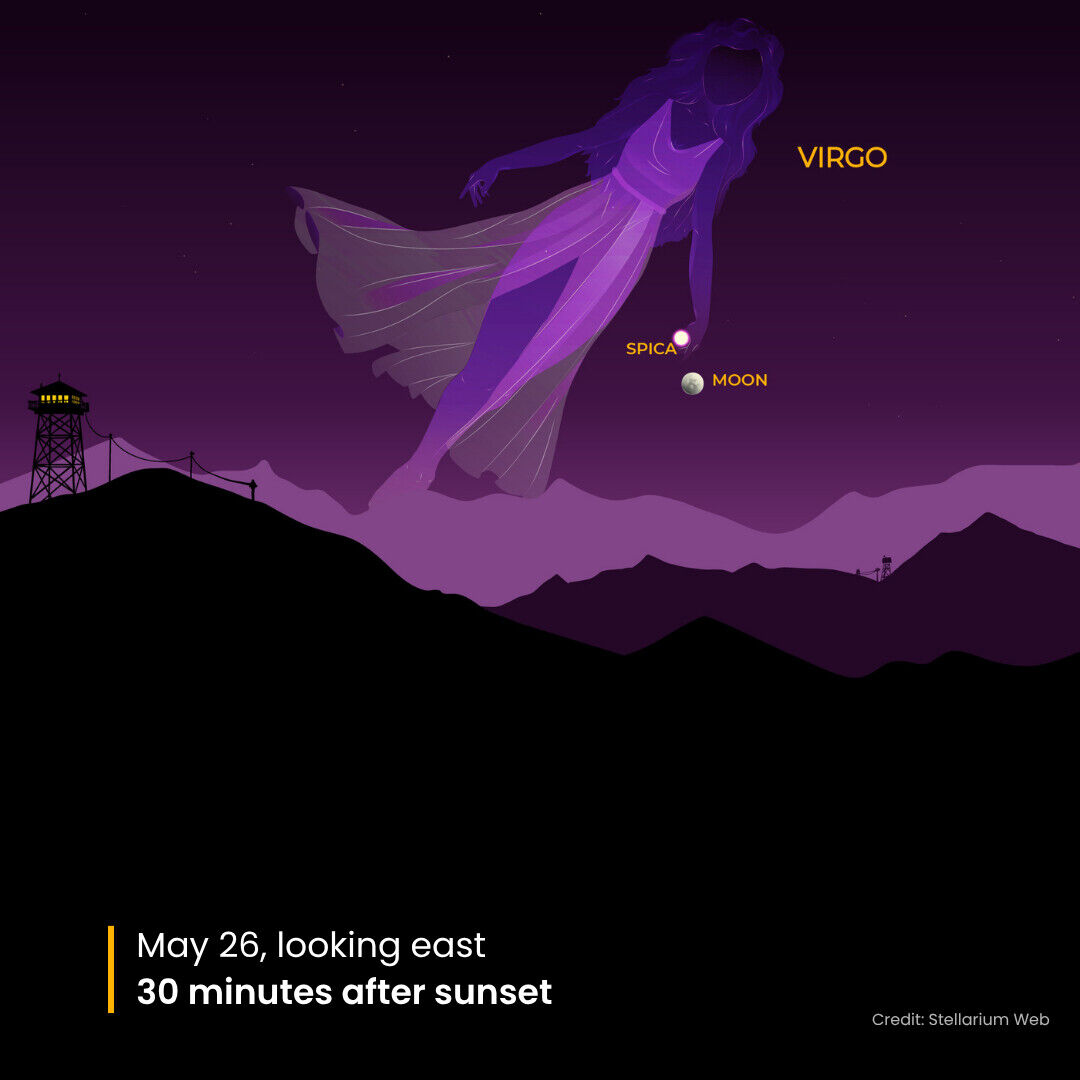
A waxing gibbous Moon meets Spica in Virgo
Late on May 26 and May 27, the waxing gibbous Moon passes close to Spica, the brightest star in Virgo. This week, the Moon will be bright — around 90 percent illuminated by May 27 — so Spica may look softer than usual through the lunar glare. Still, the pairing will be easy to locate.
Look toward the southern sky after sunset from the Northern Hemisphere. From the Southern Hemisphere, Virgo appears higher and more favourably placed, making the Moon–Spica pairing easier to appreciate.
May 28 — Vega Rises Into the Evening
By late May, Vega is becoming harder to miss.
Look toward the northeast after dark from the Northern Hemisphere, and you will see a bright blue-white star climbing into the evening sky. That is Vega, the brightest star in Lyra and one of the three stars of the Summer Triangle, along with Deneb in Cygnus and Altair in Aquila. The Summer Triangle becomes a major feature of the evening sky from around May onward, growing more prominent as summer approaches in the Northern Hemisphere.
For Southern Hemisphere observers, Vega is much lower in the northern sky and may be difficult or impossible to see from far southern latitudes. But from much of the tropics and subtropics, it still appears as a bright northern star, signalling the return of the rich Milky Way fields that dominate the months ahead.
May 30–31 — The Micro Blue Moon Rises Near Antares
May ends with its second full Moon.
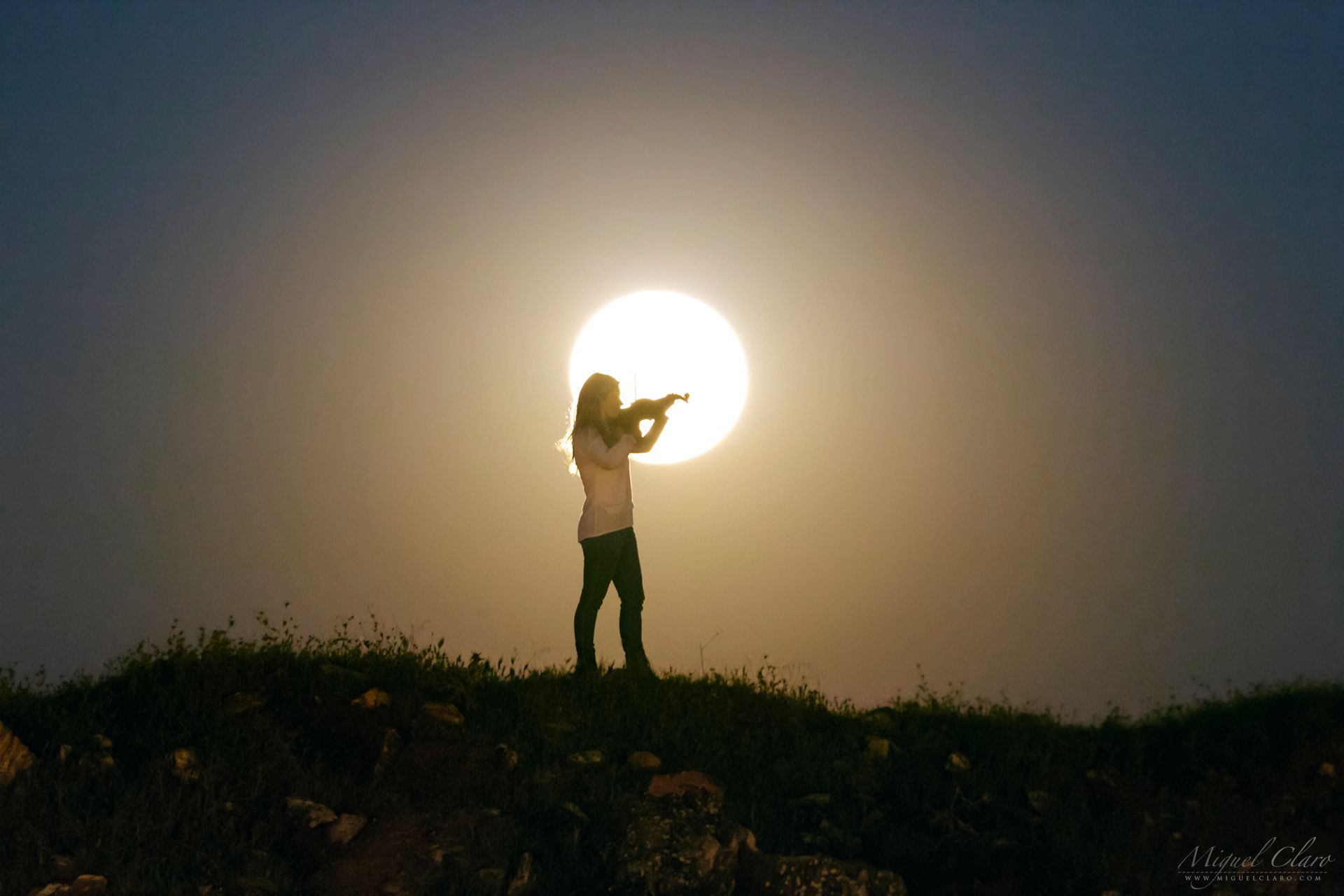
The Moon reaches full phase on May 31 at 08:45 UTC (4:45 a.m. EDT). Because this is the second full Moon in a single calendar month, it is called a Blue Moon. The name has nothing to do with colour; the Moon will not turn blue. It is a calendar label, made possible because May began with a full Moon on May 1 and ends with another on May 31.
This Blue Moon is also a micromoon. It occurs close to lunar apogee, the farthest point in the Moon’s orbit from Earth. In fact, this is the most distant full Moon of 2026, making it appear slightly smaller and dimmer than an average full Moon. The difference is real, but subtle — most people will simply see a bright full Moon rising in the east around sunset.
There is one more detail worth watching: the Moon will lie in Scorpius, close to Antares, the red supergiant star often called the heart of the Scorpion.
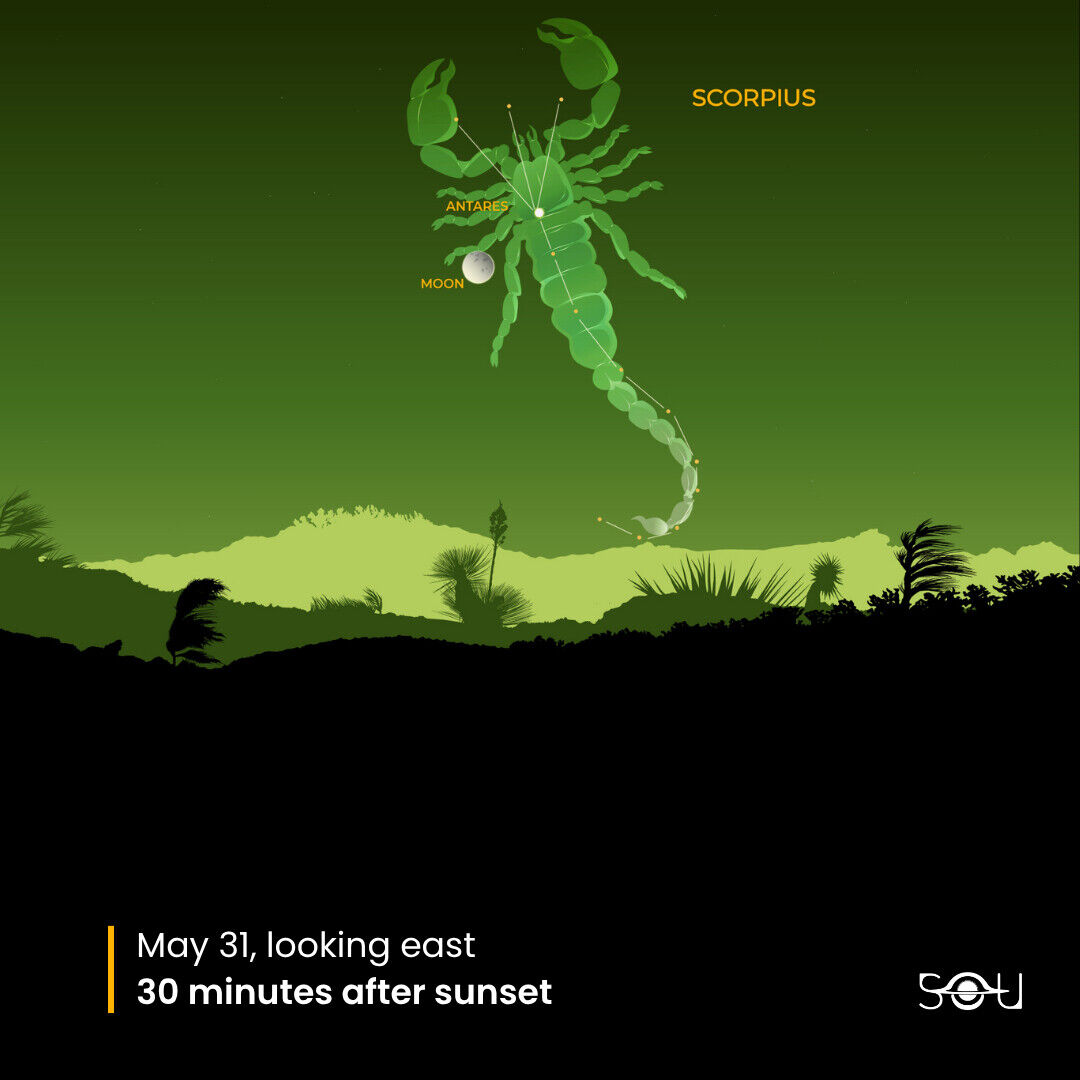
The Micro Blue Moon will glide past Antares, the brightest star of Scorpius
The best time to watch is around moonrise on the evening of May 30 or May 31, depending on your location. A low full Moon often appears golden or orange near the horizon because its light passes through more of Earth’s atmosphere. That colour is atmospheric, not related to the term Blue Moon.
May closes with the Moon full, distant, and bright — a familiar object carrying several rare labels at once. Read more about the micro blue moon here.
Next week, Venus and Jupiter continue their final approach toward a dazzling June 9 conjunction, while Mercury begins to join the evening planet display low in the west.